
Earthen pots make summer comeback


Patna: Amid scorching heat, demand for traditional earthen pots and ‘ surahis ’ has surged across the city. Despite widespread use of refrigerators and RO systems, many people are returning to clay pots , often called the “desi fridge”, for natural cooling and health benefits.
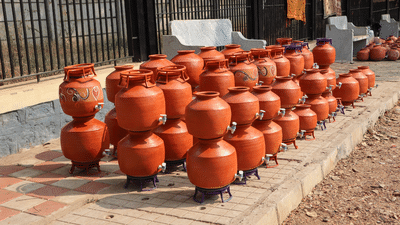
Roadside stalls and local ‘haat-bazars’ are lined with ‘ghadas’, ‘surahis’ and tap-fitted ‘matkas’, with both low-income and affluent families buying them. Vendors said the early onset of heat this April-May has boosted sales beyond previous years.
“This time, the heat showed its anger right from April. Sales are much better than last year,” said a vendor at Mithapur haat.
Power cuts and irregular electricity supply have also contributed to the rising demand. Rajesh Kumar, who runs a roadside stall near Rajendra Nagar, said, “People want cold water without depending on electricity. Clay pots give that at low cost. Many low-income families cannot afford refrigerators.”
Sellers said designs and sizes have evolved with changing consumer preferences. Pots ranging from 3 to 7 litres are available, including designer ‘surahis’ and tap-fitted ‘matkas’.
“Earlier we only sold simple open-mouth ‘ghadas’. Now tap-fitted ‘matkas’, designer ‘surahis’ and decorative pots are the first choice,” said Kamal Pandit, a seller near Ashiana Mor. He added, “Customers want convenience. Tap pots don’t need tilting, so even kids can use them.”
Locals said clay-pot water feels naturally cool and healthier than refrigerated water. “Ghade ka paani is naturally cool and has a ‘sondhi khushboo’. It gives real relief,” said Sunita Devi, a homemaker from Boring Road.
Seller Raju Pandit explained, “Clay has tiny pores. Water evaporates through them and keeps the rest cool.” He cautioned against painted pots, saying they block evaporation.
Potter Mahendra Prajapati from Bihta said rising input costs remain a challenge. “One tractor of clay now costs Rs2,000 to Rs3,000. Wood is also expensive,” he said.
Roadside stalls and local ‘haat-bazars’ are lined with ‘ghadas’, ‘surahis’ and tap-fitted ‘matkas’, with both low-income and affluent families buying them. Vendors said the early onset of heat this April-May has boosted sales beyond previous years.
“This time, the heat showed its anger right from April. Sales are much better than last year,” said a vendor at Mithapur haat.
Power cuts and irregular electricity supply have also contributed to the rising demand. Rajesh Kumar, who runs a roadside stall near Rajendra Nagar, said, “People want cold water without depending on electricity. Clay pots give that at low cost. Many low-income families cannot afford refrigerators.”
Sellers said designs and sizes have evolved with changing consumer preferences. Pots ranging from 3 to 7 litres are available, including designer ‘surahis’ and tap-fitted ‘matkas’.
“Earlier we only sold simple open-mouth ‘ghadas’. Now tap-fitted ‘matkas’, designer ‘surahis’ and decorative pots are the first choice,” said Kamal Pandit, a seller near Ashiana Mor. He added, “Customers want convenience. Tap pots don’t need tilting, so even kids can use them.”
Locals said clay-pot water feels naturally cool and healthier than refrigerated water. “Ghade ka paani is naturally cool and has a ‘sondhi khushboo’. It gives real relief,” said Sunita Devi, a homemaker from Boring Road.
Seller Raju Pandit explained, “Clay has tiny pores. Water evaporates through them and keeps the rest cool.” He cautioned against painted pots, saying they block evaporation.
Potter Mahendra Prajapati from Bihta said rising input costs remain a challenge. “One tractor of clay now costs Rs2,000 to Rs3,000. Wood is also expensive,” he said.
Next Story