
Can you be fired from job even after meeting targets?


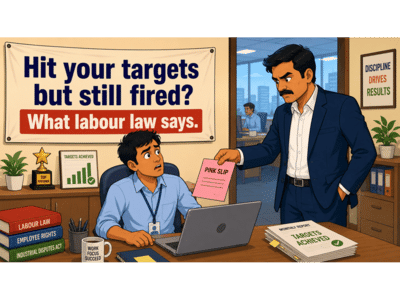
In the private sector, there is no guarantee that you will be retained even after meeting your annual targets. A bunch of factors come into play like business restructuring, redundant job roles, among others. But, if a colleague in the same position is retained while you are let go off without following the last in, first out rule, then that’s a statutory violation of the Section 25G of the Industrial Dispute Act and you can take it up with the Labour Court.
Though the new labour codes were notified by the central government back in November 2025, the rules are now gradually being notified. The rules relating to the Code on Wages and the Industrial Relations Code were notified on May 8, 2026 by the central government. As per ET sources the final Rules for the Code on Social Security and the OSH & WC Code will also be notified soon.
However, the above rule does not apply to managers and those in supervisory roles as it only applies to workers.
Here’s what the labour code says:
Malak Bhatt, Founding Partner, NM Law Chambers explains to ET Wealth Online what the law says:
For non-workmen (managers), wrongful termination claims are contractual in nature. Also read: Lost job for misconduct? PSU bank employees may still be eligible for pension; check Bipartite Settlement and eligibility rules
There is difference between workers and employees
According to Bhatt, in India, the legal remedies for wrongful termination differ based on whether the individual qualifies as a "worker" under the Industrial Disputes Act, 1947 or as an "employee" in the general sense.
Bhatt says that workers are generally those engaged in manual, unskilled, skilled, technical, operational, clerical, or supervisory work but not involved in administrative or managerial functions. The protections under the IDA, including compensation for illegal termination, are more robust for workers.
According to Bhatt, for a workman, if a colleague in an identical role is retained while you are retrenched without following the LIFO principle, this is a statutory violation under the Section 25G of the Industrial Disputes Act and can be directly challenged before the Labour Court.
Bhatt says that for a non-workman (managerial employee), the protection is weaker, but a case for discriminatory termination is still maintainable if:
When discrimination can be proved in wrongful termination cases
According to Bhatt, when an employee is dismissed based on the employee's race, gender, religion, caste, disability, or for whistleblowing or union activity, it is considered wrongful termination.
Bhatt says: “The employee must be able to demonstrate that the retained colleague had an identical or comparable role, qualifications, and performance profile, and that the selection of the claimant for termination was arbitrary or discriminatory.”
Constructive dismissal doctrine also applies here: The discharge or dismissal of a workman by way of victimisation, with or without bad faith in the colourable exercise of the employer's rights, is an unfair labour practice under the Industrial Dispute Act.
According to Bhatt, it is critical that the employee does not resign; they should force the employer to terminate formally, since resignation weakens legal standing unless a constructive dismissal argument is established.
Employer's perspective:
The employer will assert that:
According to Bhatt, the Supreme Court has often held that reinstatement with full back wages should be the primary remedy in cases of wrongful dismissal, particularly where the termination is found to be illegal or in violation of principles of natural justice.
The landmark case of Hindustan Tin Works Pvt. Ltd. v. The Employees of Hindustan Tin Works Pvt. Ltd. (1979) 2 SCC 80 established this principle firmly.
Bhatt says that in appropriate cases, labour tribunals may order reinstatement along with back wages. However, for private employment (especially managerial roles), courts usually award monetary damages instead of reinstatement due to the personal nature of such contracts.
Bhatt says: “For workmen, courts are generally sympathetic, particularly when a LIFO violation is proven. For managerial employees, the remedy is typically compensation equivalent to the notice period.”
Though the new labour codes were notified by the central government back in November 2025, the rules are now gradually being notified. The rules relating to the Code on Wages and the Industrial Relations Code were notified on May 8, 2026 by the central government. As per ET sources the final Rules for the Code on Social Security and the OSH & WC Code will also be notified soon.
However, the above rule does not apply to managers and those in supervisory roles as it only applies to workers.
Here’s what the labour code says:
Malak Bhatt, Founding Partner, NM Law Chambers explains to ET Wealth Online what the law says:
- Industrial Disputes Act, 1947: Section 25F, 25G, 25H, and Section 2A: Governs retrenchment of "workmen." Requires: one month's prior notice or pay in lieu, retrenchment compensation at 15 days' wages per year of service, and Last In, First Out (LIFO) principle, the employer must generally retrench the most recently hired employee first from among similarly placed employees.
- Industrial Employment (Standing Orders) Act, 1946: Termination must comply with certified standing orders of the establishment.
- Unfair Labour Practices (Schedule V, IDA): Includes discharging or dismissing a workman by way of victimisation, or with malafide intent in the colourable exercise of the employer's rights.
- Indian Contract Act, 1872:
There is difference between workers and employees
According to Bhatt, in India, the legal remedies for wrongful termination differ based on whether the individual qualifies as a "worker" under the Industrial Disputes Act, 1947 or as an "employee" in the general sense.
Bhatt says that workers are generally those engaged in manual, unskilled, skilled, technical, operational, clerical, or supervisory work but not involved in administrative or managerial functions. The protections under the IDA, including compensation for illegal termination, are more robust for workers.
According to Bhatt, for a workman, if a colleague in an identical role is retained while you are retrenched without following the LIFO principle, this is a statutory violation under the Section 25G of the Industrial Disputes Act and can be directly challenged before the Labour Court.
Bhatt says that for a non-workman (managerial employee), the protection is weaker, but a case for discriminatory termination is still maintainable if:
- The termination was based on a protected characteristic (gender, caste, religion, disability).
- The employer's own HR policies were selectively applied.
- The termination was in retaliation for raising a grievance.
When discrimination can be proved in wrongful termination cases
According to Bhatt, when an employee is dismissed based on the employee's race, gender, religion, caste, disability, or for whistleblowing or union activity, it is considered wrongful termination.
Bhatt says: “The employee must be able to demonstrate that the retained colleague had an identical or comparable role, qualifications, and performance profile, and that the selection of the claimant for termination was arbitrary or discriminatory.”
Constructive dismissal doctrine also applies here: The discharge or dismissal of a workman by way of victimisation, with or without bad faith in the colourable exercise of the employer's rights, is an unfair labour practice under the Industrial Dispute Act.
According to Bhatt, it is critical that the employee does not resign; they should force the employer to terminate formally, since resignation weakens legal standing unless a constructive dismissal argument is established.
Employer's perspective:
The employer will assert that:
- The termination was based on business restructuring, performance, or role redundancy, not personal bias.
- The retained employee had different qualifications, a different role scope, or seniority that justified retention.
- Proper notice and severance were provided as per the contract.
According to Bhatt, the Supreme Court has often held that reinstatement with full back wages should be the primary remedy in cases of wrongful dismissal, particularly where the termination is found to be illegal or in violation of principles of natural justice.
The landmark case of Hindustan Tin Works Pvt. Ltd. v. The Employees of Hindustan Tin Works Pvt. Ltd. (1979) 2 SCC 80 established this principle firmly.
Bhatt says that in appropriate cases, labour tribunals may order reinstatement along with back wages. However, for private employment (especially managerial roles), courts usually award monetary damages instead of reinstatement due to the personal nature of such contracts.
Bhatt says: “For workmen, courts are generally sympathetic, particularly when a LIFO violation is proven. For managerial employees, the remedy is typically compensation equivalent to the notice period.”
Next Story