
Viksit Bharat – G RAM G Initiative to Roll Out Across Rural India from July 1, 2026

The Viksit Bharat – G RAM G, the new rural employment law , is set to roll out on July 1, 2026. Its aim is to increase the guaranteed workdays from 100 to 125 days and mandates high tech oversight like biometrics into the system. It also tries to reduce immigration of rural youth to urban areas by providing them with opportunities in rural areas only. As India approaches its centenary of independence, the focus has shifted from basic sustenance to creating a high tech, high yield agrarian economy.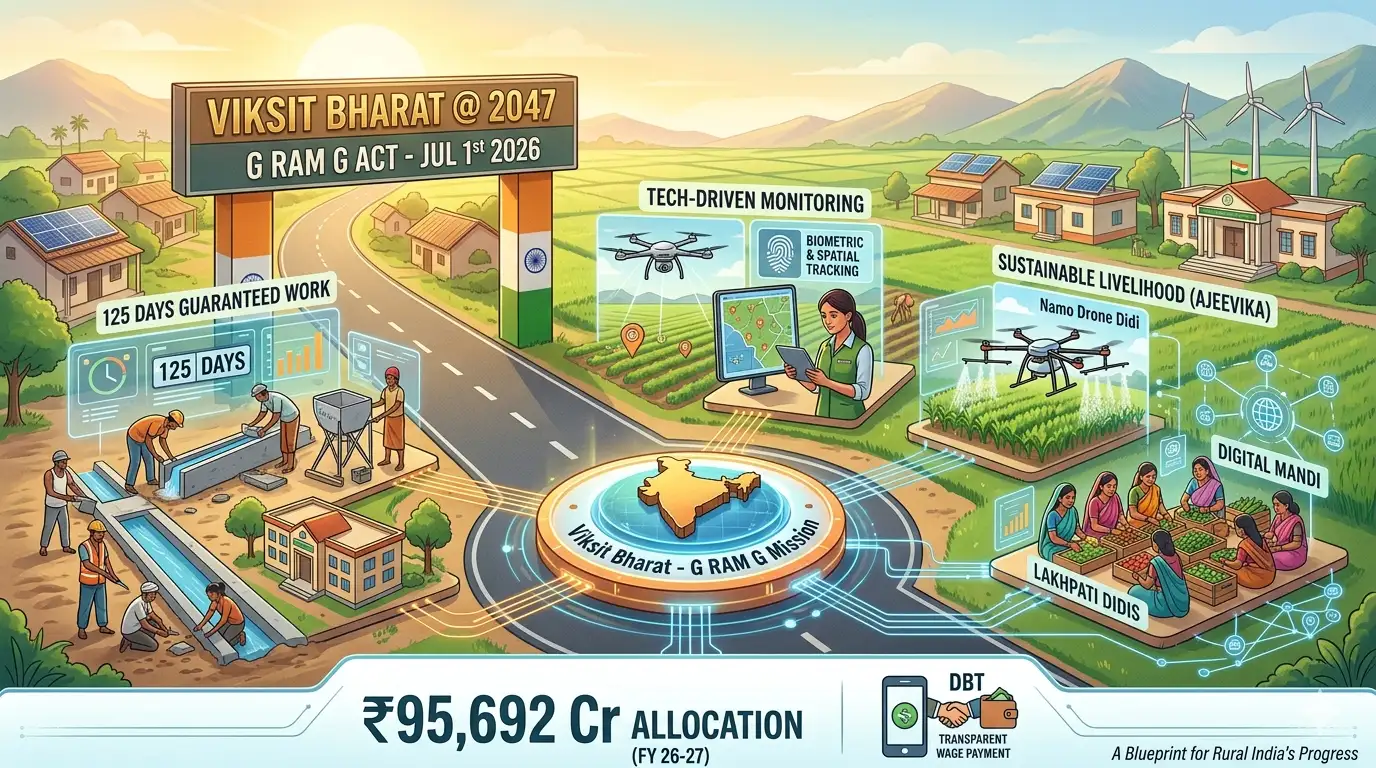
Central to this mission is integration of Gramin remote agricultural monitoring or G Ram G for short. This framework utilises technology to bridge the gap between traditional farming and modern economic standards by focusing on the four pillars of development which are the poor, youth, women and most importantly the farmers. The government aims to ensure that the prosperity of a developed economy is felt even in the remotest parts of the country.
The official rollout of the Viksit Bharat – Guarantee for Rozgar and Ajeevika Mission (Gramin) Act, 2025 is set to be on 1st July, 2026 and is set to be one of the most structural shifts in India’s rural development . It is said to replace the decades-old Mahatma Gandhi National Rural Employment Guarantee Act (MGNREGA), 2005. Here is a deeper analysis of the act:
The commencement of the G Ram G act officially repeals the Mahatma Gandhi National Rural Employment Guarantee Act (MGNREGA) of 2005. The MGNREGA was a social safety net designed for poverty alleviation while the G- Ram act is positioned as a productivity oriented mission. The government has prepared for a seamless transition which means that existing job cards remain valid and ongoing work will continue without interruption, eventually transitioning from the old scheme to the new one’s ‘National Rural Infrastructure Stack’.
One of the main provisions of the act is the statutory guarantee of wage employment. The act raises the guaranteed workdays from 100 to 125 days per financial year per rural household and if the government fails to provide work within the [prescribed timeline after a demand is submitted the state remains legally liable to provide an unemployment allowance. Also, to ensure that the rural infrastructure projects do not compete with peak harvesting cycles, the act allows states to pause the act for up to 60 days during peak harvesting season.
The act mandates high tech oversight to eliminate leakage. For example, all work sites are monitored using spatial technology and biometric authentication to ensure ‘real work for real pay’. Wages are also directly transferred to Aadhar linked bank accounts to ensure transparency. The act also prioritizes water security, core infrastructure and climate resilient community assets that contribute to long term rural wealth.
The act is not just about physical labour but it tries to empower the youth and women of the country as it integrates with broader missions like Namo Drone Didi and Lakhpati Didi initiative. It focuses on livelihood and focuses on value added rural jobs in agri tech and logistics. This act aims to make rural areas self sustainable economic hubs and reduce the migration to urban centers by providing the rural youth with dignified, tech enabled opportunities within their own district.
The government has made a significant allocation of 95,692 crores for this scheme and it is the legislative engine aiming to power the rural youth through its Viksit Bharat journey.
Central to this mission is integration of Gramin remote agricultural monitoring or G Ram G for short. This framework utilises technology to bridge the gap between traditional farming and modern economic standards by focusing on the four pillars of development which are the poor, youth, women and most importantly the farmers. The government aims to ensure that the prosperity of a developed economy is felt even in the remotest parts of the country.
The official rollout of the Viksit Bharat – Guarantee for Rozgar and Ajeevika Mission (Gramin) Act, 2025 is set to be on 1st July, 2026 and is set to be one of the most structural shifts in India’s rural development . It is said to replace the decades-old Mahatma Gandhi National Rural Employment Guarantee Act (MGNREGA), 2005. Here is a deeper analysis of the act:
The transition
The commencement of the G Ram G act officially repeals the Mahatma Gandhi National Rural Employment Guarantee Act (MGNREGA) of 2005. The MGNREGA was a social safety net designed for poverty alleviation while the G- Ram act is positioned as a productivity oriented mission. The government has prepared for a seamless transition which means that existing job cards remain valid and ongoing work will continue without interruption, eventually transitioning from the old scheme to the new one’s ‘National Rural Infrastructure Stack’.
Enhanced employment guarantee
One of the main provisions of the act is the statutory guarantee of wage employment. The act raises the guaranteed workdays from 100 to 125 days per financial year per rural household and if the government fails to provide work within the [prescribed timeline after a demand is submitted the state remains legally liable to provide an unemployment allowance. Also, to ensure that the rural infrastructure projects do not compete with peak harvesting cycles, the act allows states to pause the act for up to 60 days during peak harvesting season.
Focus on digital infrastructure
The act mandates high tech oversight to eliminate leakage. For example, all work sites are monitored using spatial technology and biometric authentication to ensure ‘real work for real pay’. Wages are also directly transferred to Aadhar linked bank accounts to ensure transparency. The act also prioritizes water security, core infrastructure and climate resilient community assets that contribute to long term rural wealth.
Empowering rural youth and women
The act is not just about physical labour but it tries to empower the youth and women of the country as it integrates with broader missions like Namo Drone Didi and Lakhpati Didi initiative. It focuses on livelihood and focuses on value added rural jobs in agri tech and logistics. This act aims to make rural areas self sustainable economic hubs and reduce the migration to urban centers by providing the rural youth with dignified, tech enabled opportunities within their own district.
The government has made a significant allocation of 95,692 crores for this scheme and it is the legislative engine aiming to power the rural youth through its Viksit Bharat journey.
Next Story