
Budget 2026: Income Tax Slabs & Key Expectations and Demands

As the countdown to the Union Budget 2026 begins, taxpayers across the country are closely tracking every signal from the government on possible income tax changes. With Finance Minister Nirmala Sitharaman set to present the Budget on February 1, 2026, expectations are high around revisions to income tax slabs , deductions and rebates under both the old and new tax regimes.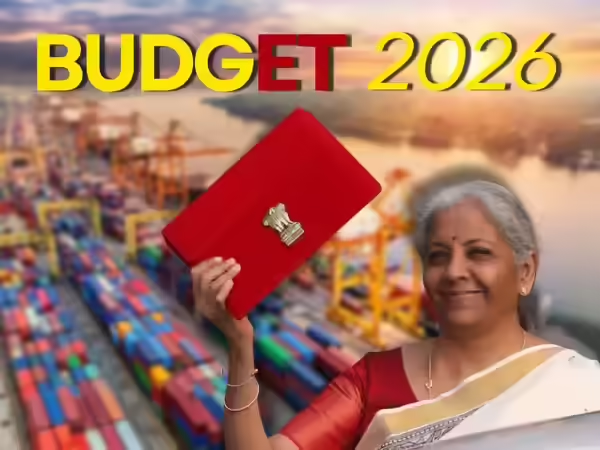
For FY 2025–26 (AY 2026–27), the government has already revamped the new tax regime by offering lower rates and simplified slabs, making it appealing to a large section of salaried taxpayers. This has also led to growing speculation over whether the old tax regime could eventually be phased out. However, rising living costs, higher housing expenses and increased taxes on investment returns have prompted taxpayers and experts to push for additional relief in Budget 2026.
The new tax regime focuses on simplicity, offering reduced rates but limited deductions. In contrast, the old regime continues to attract taxpayers who benefit from exemptions such as home loan interest, Section 80C investments and other allowances. Experts believe that instead of eliminating one regime, the government should refine existing provisions to make taxation more balanced and taxpayer-friendly.
One of the key demands ahead of Budget 2026 is the inclusion of home loan benefits in the new tax regime. Abhishek Soni, CEO and co-founder of Tax2win, highlights that the absence of deductions for home loan interest or loss from house property discourages homeownership.
Sharing his views, Soni says, “Homeownership should not become tax-inefficient under a simplified regime.” He believes allowing limited home loan benefits would support first-time buyers and create a more even playing field between the old and new regimes.
Call for tax rationalisation in fixed income
Fixed-income investors, especially retirees, are also seeking relief. Sachin Jain, managing partner at Scripbox, points out that post-tax yields on fixed-income instruments have become a major concern for those who rely on stable and predictable income.
“Targeted concessions or rationalisation here would provide much-needed relief,” says Jain, noting that higher tax brackets significantly reduce real returns for senior citizens and conservative investors.
Revisiting the Section 80C limit
Another long-standing demand is an increase in the Section 80C deduction limit. Soni notes that the current Rs 1.5 lakh cap has not changed since 2014, despite inflation steadily eroding its value.
“Inflation has reduced the real value of Section 80C deductions over the years,” says Soni. He adds, “Increasing the limit to Rs 2.5 lakh would encourage long-term savings and provide relief to middle-income taxpayers.”
Experts also want Budget 2026 to address challenges faced by NRIs, who form an important and growing segment of Indian capital markets. Jain stresses the need for clarity as global tax rules and cross-border regulations evolve.
“With changing global tax rules and cross-border regulations, clearer, simpler, and more consistent frameworks are needed to encourage long-term participation without friction,” says Jain.
Extending Section 87A rebate to equity gains
Currently, the Section 87A rebate does not apply to capital gains from equity investments, a point of concern for small investors. Soni believes this exclusion limits basic tax relief for retail participants.
“Small investors should not be excluded from basic tax relief,” he notes. “Allowing the rebate on equity capital gains would support retail investors and promote wider market participation.”
Demand to raise the standard deduction
The standard deduction under the new tax regime currently stands at Rs 75,000. Given rising living and work-related costs, Soni has urged the Finance Minister to raise it to Rs 1 lakh. He has also called for a higher standard deduction for defence personnel, citing the nature of their service and expenses.
Certainty on ITR due dates
Finally, experts are asking for clarity and consistency on income tax return deadlines. Frequent extensions of the July 31 deadline often lead to confusion and last-minute pressure.
“A permanent shift of the due date to August 31 would improve compliance and reduce stress for taxpayers,” says Soni.
As Budget 2026 approaches, taxpayers are hoping the government will address these demands and strike the right balance between simplicity and meaningful relief. Whether through slab tweaks, higher deductions or clearer rules, expectations remain high for a more practical and responsive tax framework.
For FY 2025–26 (AY 2026–27), the government has already revamped the new tax regime by offering lower rates and simplified slabs, making it appealing to a large section of salaried taxpayers. This has also led to growing speculation over whether the old tax regime could eventually be phased out. However, rising living costs, higher housing expenses and increased taxes on investment returns have prompted taxpayers and experts to push for additional relief in Budget 2026.
Where income tax slabs stand today
The new tax regime focuses on simplicity, offering reduced rates but limited deductions. In contrast, the old regime continues to attract taxpayers who benefit from exemptions such as home loan interest, Section 80C investments and other allowances. Experts believe that instead of eliminating one regime, the government should refine existing provisions to make taxation more balanced and taxpayer-friendly.
Push to allow home loan benefits under the new regime
One of the key demands ahead of Budget 2026 is the inclusion of home loan benefits in the new tax regime. Abhishek Soni, CEO and co-founder of Tax2win, highlights that the absence of deductions for home loan interest or loss from house property discourages homeownership.
Sharing his views, Soni says, “Homeownership should not become tax-inefficient under a simplified regime.” He believes allowing limited home loan benefits would support first-time buyers and create a more even playing field between the old and new regimes.
Call for tax rationalisation in fixed income
Fixed-income investors, especially retirees, are also seeking relief. Sachin Jain, managing partner at Scripbox, points out that post-tax yields on fixed-income instruments have become a major concern for those who rely on stable and predictable income.“Targeted concessions or rationalisation here would provide much-needed relief,” says Jain, noting that higher tax brackets significantly reduce real returns for senior citizens and conservative investors.
Revisiting the Section 80C limit
Another long-standing demand is an increase in the Section 80C deduction limit. Soni notes that the current Rs 1.5 lakh cap has not changed since 2014, despite inflation steadily eroding its value. “Inflation has reduced the real value of Section 80C deductions over the years,” says Soni. He adds, “Increasing the limit to Rs 2.5 lakh would encourage long-term savings and provide relief to middle-income taxpayers.”
Focus on NRIs and cross-border taxation
Experts also want Budget 2026 to address challenges faced by NRIs, who form an important and growing segment of Indian capital markets. Jain stresses the need for clarity as global tax rules and cross-border regulations evolve.
“With changing global tax rules and cross-border regulations, clearer, simpler, and more consistent frameworks are needed to encourage long-term participation without friction,” says Jain.
Extending Section 87A rebate to equity gains
Currently, the Section 87A rebate does not apply to capital gains from equity investments, a point of concern for small investors. Soni believes this exclusion limits basic tax relief for retail participants. “Small investors should not be excluded from basic tax relief,” he notes. “Allowing the rebate on equity capital gains would support retail investors and promote wider market participation.”
Demand to raise the standard deduction
The standard deduction under the new tax regime currently stands at Rs 75,000. Given rising living and work-related costs, Soni has urged the Finance Minister to raise it to Rs 1 lakh. He has also called for a higher standard deduction for defence personnel, citing the nature of their service and expenses. Certainty on ITR due dates
Finally, experts are asking for clarity and consistency on income tax return deadlines. Frequent extensions of the July 31 deadline often lead to confusion and last-minute pressure. “A permanent shift of the due date to August 31 would improve compliance and reduce stress for taxpayers,” says Soni.
As Budget 2026 approaches, taxpayers are hoping the government will address these demands and strike the right balance between simplicity and meaningful relief. Whether through slab tweaks, higher deductions or clearer rules, expectations remain high for a more practical and responsive tax framework.
Next Story