
Budget 2026 Key Highlights: FM Nirmala Sitharaman Focuses on Growth, Jobs and Connectivity

Union Finance Minister Nirmala Sitharaman on Sunday presented her ninth Union Budget for 2026, stressing that the government has consistently chosen “reform over rhetoric” to steer India’s economic journey. Highlighting stability, sustained growth and moderate inflation, Sitharaman said the government’s policy choices have translated into real outcomes rather than empty promises.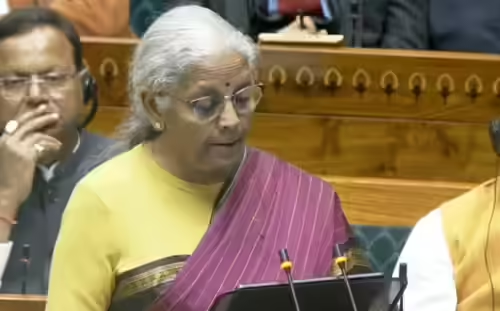
Dressed in a traditional Kanjeevaram sariwidely viewed as a symbolic nod to Tamil Nadu ahead of the state assembly elections the finance minister said India’s economic trajectory remains firmly on track. “We have pursued far-reaching structural reforms. The government has decisively chosen action over ambivalence, reform over rhetoric. Steps taken by the government have delivered high growth rate of around 7 per cent," she said.
Calling Budget 2026 a blueprint for inclusive growth, Sitharaman underlined that youth empowerment and job creation are at the heart of the government’s priorities.
‘Yuva Shakti-driven’ Budget
Terming the Budget “Yuva Shakti-driven”, the finance minister said the focus is on the poor, underprivileged and disadvantaged sections of society. “The duty is to fulfill the aspirations of the people. This three-fold approach needs a supportive ecosystem,” she said, adding that growth must be matched with opportunity and social equity.
India Semiconductor Mission 2.0
Building on earlier progress, the finance minister announced India Semiconductor Mission 2.0, with an increased focus on industry-led research, innovation and workforce training. The outlay for the mission will be raised to ₹40,000 crore to capitalise on existing momentum. Sitharaman also stressed the need to support mineral-rich states such as Odisha, Kerala, Andhra Pradesh and Tamil Nadu, which play a crucial role in semiconductor supply chains.
The Budget places renewed emphasis on inland waterways as a cost-effective and sustainable transport option. Sitharaman proposed setting up specialised training institutes to equip youth with skills needed for the waterways sector. She also announced plans to connect mineral-rich areas in Odisha through waterways and operationalise 20 new waterways over the next five years.
Boost to Medical Infrastructure and Tourism
Healthcare and wellness infrastructure will see significant upgrades. Sitharaman called for modernisation of Ayush pharmacies and drug-testing laboratories across the country. She announced plans to establish five regional medical tourism hubs in collaboration with the private sector. These hubs will include Ayush centres, and around 1.5 lakh caregivers will be trained in the coming years to support the growing healthcare ecosystem.
Renewed Focus on MSMEs
Budget 2026 signals a strong revival push for India’s MSME sector. The government plans to rejuvenate 200 traditional industrial clusters affected by financial stress and outdated technology. A ₹10,000 crore SME Growth Fund will be introduced to help promising firms scale up under performance-linked incentives. Additionally, ₹2,000 crore will be infused into the Self-Reliant India Fund to support micro enterprises that continue to face credit challenges.
Financial Sector Restructuring
To strengthen public sector finance, Sitharaman proposed incentives of ₹100 crore for municipal corporations issuing single bonds worth over ₹1,000 crore. She also announced the restructuring of REC Ltd (formerly Rural Electrification Corporation) and Power Finance Corporation as part of broader public sector financial reforms. A high-level committee on ‘Banking for Viksit Bharat’ will also be set up.
Big Connectivity Push
Infrastructure and connectivity featured prominently in the Budget. Sitharaman announced plans to develop seven high-speed rail corridors between major cities, describing them as ‘growth connectors’ that will promote environmentally sustainable passenger transport. These corridors will link Mumbai–Pune, Hyderabad–Pune, Hyderabad–Bengaluru, Hyderabad–Chennai, Chennai–Bengaluru, Delhi–Varanasi and Varanasi–Siliguri. In addition, a new dedicated east–west freight corridor connecting Dankuni in the east with Surat in the west was unveiled.
Overall, Union Budget 2026 reinforces the government’s emphasis on long-term structural reforms, infrastructure-led growth and youth empowerment, positioning economic stability and job creation as key pillars of India’s development roadmap.
Dressed in a traditional Kanjeevaram sariwidely viewed as a symbolic nod to Tamil Nadu ahead of the state assembly elections the finance minister said India’s economic trajectory remains firmly on track. “We have pursued far-reaching structural reforms. The government has decisively chosen action over ambivalence, reform over rhetoric. Steps taken by the government have delivered high growth rate of around 7 per cent," she said.
Calling Budget 2026 a blueprint for inclusive growth, Sitharaman underlined that youth empowerment and job creation are at the heart of the government’s priorities.
‘Yuva Shakti-driven’ Budget
Terming the Budget “Yuva Shakti-driven”, the finance minister said the focus is on the poor, underprivileged and disadvantaged sections of society. “The duty is to fulfill the aspirations of the people. This three-fold approach needs a supportive ecosystem,” she said, adding that growth must be matched with opportunity and social equity.Strong Push for Textiles and Handicrafts
The textiles sector emerged as a key employment driver in Budget 2026. Sitharaman proposed a textile expansion and employment scheme aimed at modernising traditional textile clusters. Mega textile parks will be set up through a challenge-based mode, while the Mahatma Gandhi Gram Samaj initiative will support Khadi and handicrafts. To reduce import dependence, the government also proposed a National Fibre Scheme to boost self-sufficiency.India Semiconductor Mission 2.0
Building on earlier progress, the finance minister announced India Semiconductor Mission 2.0, with an increased focus on industry-led research, innovation and workforce training. The outlay for the mission will be raised to ₹40,000 crore to capitalise on existing momentum. Sitharaman also stressed the need to support mineral-rich states such as Odisha, Kerala, Andhra Pradesh and Tamil Nadu, which play a crucial role in semiconductor supply chains. Expanding Waterways Infrastructure
The Budget places renewed emphasis on inland waterways as a cost-effective and sustainable transport option. Sitharaman proposed setting up specialised training institutes to equip youth with skills needed for the waterways sector. She also announced plans to connect mineral-rich areas in Odisha through waterways and operationalise 20 new waterways over the next five years.
Boost to Medical Infrastructure and Tourism
Healthcare and wellness infrastructure will see significant upgrades. Sitharaman called for modernisation of Ayush pharmacies and drug-testing laboratories across the country. She announced plans to establish five regional medical tourism hubs in collaboration with the private sector. These hubs will include Ayush centres, and around 1.5 lakh caregivers will be trained in the coming years to support the growing healthcare ecosystem. Renewed Focus on MSMEs
Budget 2026 signals a strong revival push for India’s MSME sector. The government plans to rejuvenate 200 traditional industrial clusters affected by financial stress and outdated technology. A ₹10,000 crore SME Growth Fund will be introduced to help promising firms scale up under performance-linked incentives. Additionally, ₹2,000 crore will be infused into the Self-Reliant India Fund to support micro enterprises that continue to face credit challenges.You may also like
 Union Budget 2026: Centre allocates Rs 1.4 lakh Cr for state local bodies, accepts vertical share of devolution at 41%
- Union Budget 2026 : Tax Holiday For Foreign Companies Offering Cloud Services In India
- India Budget 2026-27: Sitharaman unveils initiative for high-quality sports manufacturing
- Jaipur Polo Team reach final of Kognivera Cup with a hard-fought win over Optiemus Achievers
- Budget 2026: IT Services Clubbed Under Single Category, Safe Harbour Threshold Raised To INR 2,000 Cr
Financial Sector Restructuring
To strengthen public sector finance, Sitharaman proposed incentives of ₹100 crore for municipal corporations issuing single bonds worth over ₹1,000 crore. She also announced the restructuring of REC Ltd (formerly Rural Electrification Corporation) and Power Finance Corporation as part of broader public sector financial reforms. A high-level committee on ‘Banking for Viksit Bharat’ will also be set up. Big Connectivity Push
Infrastructure and connectivity featured prominently in the Budget. Sitharaman announced plans to develop seven high-speed rail corridors between major cities, describing them as ‘growth connectors’ that will promote environmentally sustainable passenger transport. These corridors will link Mumbai–Pune, Hyderabad–Pune, Hyderabad–Bengaluru, Hyderabad–Chennai, Chennai–Bengaluru, Delhi–Varanasi and Varanasi–Siliguri. In addition, a new dedicated east–west freight corridor connecting Dankuni in the east with Surat in the west was unveiled. Overall, Union Budget 2026 reinforces the government’s emphasis on long-term structural reforms, infrastructure-led growth and youth empowerment, positioning economic stability and job creation as key pillars of India’s development roadmap.






More from our partners


Loving Newspoint? Download the app now
