
8th CPC: Employee body wants Rs 72,000 as minimum pay


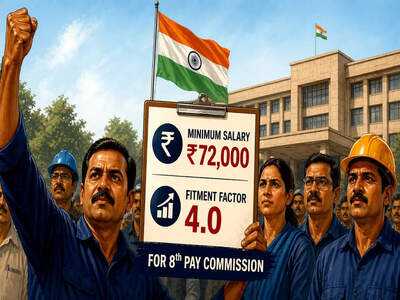
Bharatiya Pratiraksha Mazdoor Sangh (BPMS), an affiliated member of NC-JCM (staff side) in its draft submitted to the 8 th Pay Commission has demanded a minimum basic salary of Rs 72,000, a maximum of Rs 10 lakh and a fitment factor of 4.0.
BPMS, a body that represents civilian employees of defence services also demanded a to increase the 3% annual increment of central government employees to 6%. The National Council of the Joint Consultative Machinery (NC-JCM) affiliate has also demanded the family units of a central government employee for salary calculation to increase from three to five.
Mukesh Singh, working president, BPMS, told ET Wealth Online, “We submitted our proposal to the 8 th Pay Commission on Wednesday (April 22, 2026) and expect the commission to consider our demands for central government employees.”
In the 7 th Pay Commission, the basic salary of an entry level (Level 1 as per pay matrix) employee is Rs 18,000, which means a Rs 72,000 minimum salary demanded by BPMS will be a four-fold jump. Not just that, the employee body also wants the highest basic salary of Rs 2,50,000 to jump Rs 10 lakh a month. But what makes BPMS to quote such a high salary in its 8 th Pay Commission draft.
BPMS’ explanation for Rs 72,000 minimum pay
To calculate to a four-fold minimum salary, BPMS has considered the Ministry of Statistics and Programme Implementation’s (MoSPI) per capita net national income data. The employee body claims that per capita income in India has increased from Rs 1,03,219 in 2016–17 to Rs 1,92,774 in 2024–25, an approximately 86.76% rise in a less than a decade.
Applying the above growth factor to the existing minimum pay determined by the 7th Central Pay Commission, BPMS reached this conclusion.
Minimum pay (7th CPC): Rs 18,000
Dearness allowance @ 58%: Rs 10,440 (the current DA stands at 60% but it was 58% when BPMS proposed it)
Sub total: Rs 28,440
Increase @86.76%: Rs 24,674.54
Revised minimum pay: Rs 53,114.54
Since the 7 th Pay Commission calculated the basic salary of an employee for three family units, the per unit salary, as per BPMS, stands at Rs 53,114.54/3= Rs 17,704.85
Since the defence employee body wants the government to calculate five family units for the 8 th Pay Commission, BPMS estimated salary for such a family is = Rs 17,704.85X5= Rs 88,524.
Why is BPMS demanding Rs 72,000 as minimum pay instead of Rs 88,524?
The employee body says while the above calculation yields a minimum pay of Rs 88,524.24 based on objective economic growth and a realistic family unit structure, it is equally important to recognise the broader fiscal implications for the government.
The employee body argues pay revision impacts not only central government employees but also has cascading effects on pensions, allowances and state government pay structures.
“Therefore, any recommendation must balance adequacy of wages with fiscal sustainability, keeping in view factors such as revenue growth, fiscal deficit targets, and competing demands on public expenditure including infrastructure, social welfare, and defence,” says BPMS in its draft.
“In this context, a moderated and pragmatic approach is proposed. Instead of adopting the full computed figure of Rs 88,524.24, a calibrated level of Rs 72,000 per month may be considered appropriate,” says BPMS in its draft.
Fitment factor of 4.0
Since it is demanding a four-fold increase in the minimum salary, the fitment factor is also 4.0.
BPMS says it is pertinent to note that this fitment factor includes a component of 1.58 on account of Dearness Allowance (DA) neutralisation.
“The remaining portion of the fitment factor represents the real increase necessary to ensure a dignified standard of living, consistent with the principles adopted by previous pay commissions,” says BPMS.
BPMS’ proposed pay structure for 8th Pay Commission
The 7 th Pay Commission has 18 levels of basic pays for Group D, C, B and A employees. BPMS has recommended merging Level 2 and 3, Level 4 and 5 and Level 9 and 10. Its proposed pay structure for the 8 th Pay Commission is as follows-
BPMS, a body that represents civilian employees of defence services also demanded a to increase the 3% annual increment of central government employees to 6%. The National Council of the Joint Consultative Machinery (NC-JCM) affiliate has also demanded the family units of a central government employee for salary calculation to increase from three to five.
Mukesh Singh, working president, BPMS, told ET Wealth Online, “We submitted our proposal to the 8 th Pay Commission on Wednesday (April 22, 2026) and expect the commission to consider our demands for central government employees.”
In the 7 th Pay Commission, the basic salary of an entry level (Level 1 as per pay matrix) employee is Rs 18,000, which means a Rs 72,000 minimum salary demanded by BPMS will be a four-fold jump. Not just that, the employee body also wants the highest basic salary of Rs 2,50,000 to jump Rs 10 lakh a month. But what makes BPMS to quote such a high salary in its 8 th Pay Commission draft.
BPMS’ explanation for Rs 72,000 minimum pay
To calculate to a four-fold minimum salary, BPMS has considered the Ministry of Statistics and Programme Implementation’s (MoSPI) per capita net national income data. The employee body claims that per capita income in India has increased from Rs 1,03,219 in 2016–17 to Rs 1,92,774 in 2024–25, an approximately 86.76% rise in a less than a decade.
Applying the above growth factor to the existing minimum pay determined by the 7th Central Pay Commission, BPMS reached this conclusion.
Minimum pay (7th CPC): Rs 18,000
Dearness allowance @ 58%: Rs 10,440 (the current DA stands at 60% but it was 58% when BPMS proposed it)
Sub total: Rs 28,440
Increase @86.76%: Rs 24,674.54
Revised minimum pay: Rs 53,114.54
Since the 7 th Pay Commission calculated the basic salary of an employee for three family units, the per unit salary, as per BPMS, stands at Rs 53,114.54/3= Rs 17,704.85
Since the defence employee body wants the government to calculate five family units for the 8 th Pay Commission, BPMS estimated salary for such a family is = Rs 17,704.85X5= Rs 88,524.
Why is BPMS demanding Rs 72,000 as minimum pay instead of Rs 88,524?
The employee body says while the above calculation yields a minimum pay of Rs 88,524.24 based on objective economic growth and a realistic family unit structure, it is equally important to recognise the broader fiscal implications for the government.
The employee body argues pay revision impacts not only central government employees but also has cascading effects on pensions, allowances and state government pay structures.
“Therefore, any recommendation must balance adequacy of wages with fiscal sustainability, keeping in view factors such as revenue growth, fiscal deficit targets, and competing demands on public expenditure including infrastructure, social welfare, and defence,” says BPMS in its draft.
“In this context, a moderated and pragmatic approach is proposed. Instead of adopting the full computed figure of Rs 88,524.24, a calibrated level of Rs 72,000 per month may be considered appropriate,” says BPMS in its draft.
Fitment factor of 4.0
Since it is demanding a four-fold increase in the minimum salary, the fitment factor is also 4.0.
BPMS says it is pertinent to note that this fitment factor includes a component of 1.58 on account of Dearness Allowance (DA) neutralisation.
“The remaining portion of the fitment factor represents the real increase necessary to ensure a dignified standard of living, consistent with the principles adopted by previous pay commissions,” says BPMS.
BPMS’ proposed pay structure for 8th Pay Commission
The 7 th Pay Commission has 18 levels of basic pays for Group D, C, B and A employees. BPMS has recommended merging Level 2 and 3, Level 4 and 5 and Level 9 and 10. Its proposed pay structure for the 8 th Pay Commission is as follows-
Next Story