
8th CPC: Railways employees propose 5 fitment factors


In its demands related to the 8 th Pay Commission (8 th CPC) Indian Railways Technical Supervisors’ Association (IRTSA), the organisation that represents technical employees of Railways, has demanded five fitment factors for different levels of employees, an annual increment of 5%, and a promotional increment that should be equal to two annual increments.
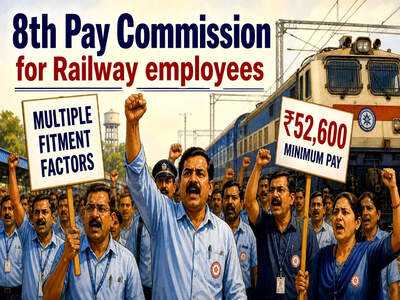
IRTSA has raised these demands in its memorandum that it submitted to the 8 th Pay Commission last month (April 2026).
Why does IRTSA want different fitment factors for Railways’ technical staff?
In its memorandum, IRTSA has demanded as many as five fitment factors for different levels of employees.
IRTSA’s proposed fitment factors for 8th CPC
IRTSA in its memorandum says there should be five-grade pay structure available for the category of technical supervisors in Railways similar to CPSE (ONGC).
“The wages of technocrats, especially those in Railways, should be fixed separately from those of non-technocrat employees with a view to adequately compensate them for hazards/job requirements, additional working hours and peculiar conditions of service,” says IRTSA in its memorandum.
As per IRTSA, among other factors why higher fitment factors are required for Railways’ technical staff are qualifications, training, experience, professional knowledge, competence required for the job, duties, responsibilities and accountability, hazards and other job difficulties, etc.
Cadre structure proposed for technical supervisors with starting pay
Dearness allowance for technical Railway employees
The Railway employee body says a separate consumer price index (CPI) should be prepared for centra government employees, and expenditure items like internet expenses, bottled drinking water expenses, health insurance premium, etc., should also be included in the expense basket to calculate average reading for DA.
“The principle laid down by the 5 th CPC for the merger of 50% of DA with the pay as DP should be followed. DA should be paid net of income tax, since it is paid as compensation for inflation,” says IRTSA.
House rent allowance (HRA)
IRTSA in its memorandum has advocated to change the current three-tier classification of DA to four. It has proposed these four HRAs for technical Railway employees.
HRA for A class cities (population 50 lakh and above)- 40%+DA
HRA for B class cities (population 20 lakh to 50 lakh)- 30%+DA
HRA for C class cities (population 5 lakh to 20 lakh)- 20%+DA
HRA for D class cities (population below 5 lakh)- 10%+DA
Night Duty Allowance (NDA)
IRTSA says 7 th CPC recommendation of continuing prescribed hourly rate of NDA equal to (Basic Pay+DA)/200 should be extended to all Railway employees.
The employee body says the ceiling limit of Rs 43,600 for calculating NDA for Railway employees should be removed.
Children Education Allowance (CEA)
IRTSA has proposed that CEA should be given up to children’s post graduation studies. The employee body says that CEA’s rates should be enhanced to Rs10,000/month or the actual expenditure.
Career progression
IRTSA has proposed for five financial upgradation (promotion) under Modified Assured Career Progression Scheme (MACPS) in the service of 30 years.
It has proposed financial upgradation under MACPS after 6, 12, 18, 24 and 30 years of service of an employee.
Leave encashment
IRTSA says employees should be allowed to encash at least 50% of leave available to their credit. The Railway body says encashment of leave at the time of retirement should be enhanced from the existing 300 days to 600 days.
Daily Allowance
IRTSA has proposed that reimbursement of staying accommodation, travelling charges, lump sum amount for employees travelling out of their headquarters for work should be increased 3 times the rates recommended by 7 th CPC and it should be implemented for Railway employees also.
Retirement benefits
While IRTSA has proposed that Old Pension Scheme (OPS) should be provided to employees who have joined their service from January 1, 2004, it has also recommended that retirement gratuity should be calculated @ 1/3 rd of a month’s BP + DA drawn on the date of retirement for each completed six monthly period of qualifying service.
“The retirement gratuity payable for qualifying service of 33 years or more should be 32 times of BP + DA, subject to a maximum of Rs 50 lakh,” says IRTSA.
It also says the maximum amount of death gratuity admissible should be Rs 50 lakh.
Group Insurance including CGEGIS
Highlighting that the rates of subscription and insurance cover for Central Government Employees Group Insurance Scheme (CGEGIS) were last revised in January 1990, IRTSA says the government should reduce subscription amounts for insurance limits of Rs 50 lakh, Rs 25 lakh and Rs15 lakh.
IRTSA has raised these demands in its memorandum that it submitted to the 8 th Pay Commission last month (April 2026).
Why does IRTSA want different fitment factors for Railways’ technical staff?
In its memorandum, IRTSA has demanded as many as five fitment factors for different levels of employees.
IRTSA’s proposed fitment factors for 8th CPC
IRTSA in its memorandum says there should be five-grade pay structure available for the category of technical supervisors in Railways similar to CPSE (ONGC).
“The wages of technocrats, especially those in Railways, should be fixed separately from those of non-technocrat employees with a view to adequately compensate them for hazards/job requirements, additional working hours and peculiar conditions of service,” says IRTSA in its memorandum.
As per IRTSA, among other factors why higher fitment factors are required for Railways’ technical staff are qualifications, training, experience, professional knowledge, competence required for the job, duties, responsibilities and accountability, hazards and other job difficulties, etc.
Cadre structure proposed for technical supervisors with starting pay
Dearness allowance for technical Railway employees
The Railway employee body says a separate consumer price index (CPI) should be prepared for centra government employees, and expenditure items like internet expenses, bottled drinking water expenses, health insurance premium, etc., should also be included in the expense basket to calculate average reading for DA.
“The principle laid down by the 5 th CPC for the merger of 50% of DA with the pay as DP should be followed. DA should be paid net of income tax, since it is paid as compensation for inflation,” says IRTSA.
House rent allowance (HRA)
IRTSA in its memorandum has advocated to change the current three-tier classification of DA to four. It has proposed these four HRAs for technical Railway employees.
HRA for A class cities (population 50 lakh and above)- 40%+DA
HRA for B class cities (population 20 lakh to 50 lakh)- 30%+DA
HRA for C class cities (population 5 lakh to 20 lakh)- 20%+DA
HRA for D class cities (population below 5 lakh)- 10%+DA
Night Duty Allowance (NDA)
IRTSA says 7 th CPC recommendation of continuing prescribed hourly rate of NDA equal to (Basic Pay+DA)/200 should be extended to all Railway employees.
The employee body says the ceiling limit of Rs 43,600 for calculating NDA for Railway employees should be removed.
Children Education Allowance (CEA)
IRTSA has proposed that CEA should be given up to children’s post graduation studies. The employee body says that CEA’s rates should be enhanced to Rs10,000/month or the actual expenditure.
Career progression
IRTSA has proposed for five financial upgradation (promotion) under Modified Assured Career Progression Scheme (MACPS) in the service of 30 years.
It has proposed financial upgradation under MACPS after 6, 12, 18, 24 and 30 years of service of an employee.
Leave encashment
IRTSA says employees should be allowed to encash at least 50% of leave available to their credit. The Railway body says encashment of leave at the time of retirement should be enhanced from the existing 300 days to 600 days.
Daily Allowance
IRTSA has proposed that reimbursement of staying accommodation, travelling charges, lump sum amount for employees travelling out of their headquarters for work should be increased 3 times the rates recommended by 7 th CPC and it should be implemented for Railway employees also.
Retirement benefits
While IRTSA has proposed that Old Pension Scheme (OPS) should be provided to employees who have joined their service from January 1, 2004, it has also recommended that retirement gratuity should be calculated @ 1/3 rd of a month’s BP + DA drawn on the date of retirement for each completed six monthly period of qualifying service.
“The retirement gratuity payable for qualifying service of 33 years or more should be 32 times of BP + DA, subject to a maximum of Rs 50 lakh,” says IRTSA.
It also says the maximum amount of death gratuity admissible should be Rs 50 lakh.
Group Insurance including CGEGIS
Highlighting that the rates of subscription and insurance cover for Central Government Employees Group Insurance Scheme (CGEGIS) were last revised in January 1990, IRTSA says the government should reduce subscription amounts for insurance limits of Rs 50 lakh, Rs 25 lakh and Rs15 lakh.
Next Story