
Bank of England holds rates, spells out inflation risks from war


The Bank of England kept interest rates on hold on Thursday and set out scenarios for the economic impact of the Iran war, one of which could require a "forceful" increase in borrowing costs.
The Monetary Policy Committee's nine members voted 8-1 to keep the BoE's benchmark Bank Rate at 3.75% with only Chief Economist Huw Pill seeking a hike to 4.0% now, in line with expectations in a Reuters poll of economists.
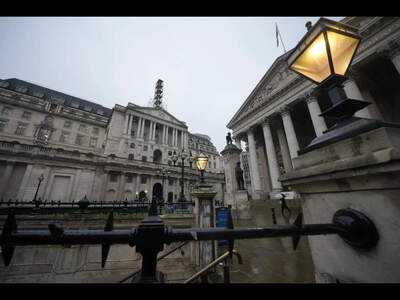
A day after U.S. Federal Reserve kept rates on hold and shortly before the European Central Bank was expected to stay on hold too, the MPC said it would continue to monitor closely the situation in the Middle East.
While there was a risk of "material second-round effects" from the energy price shock - such as demands for higher pay or companies raising prices rather than absorbing higher costs - the jobs market was weakening and a rise in financial market borrowing costs would help limit inflation, the MPC said.
"The Committee stands ready to act as necessary to ensure that CPI inflation remains on track to meet the 2% target in the medium term," it said in a statement, repeating language it used after its previous meeting in March.
Investors view Britain as highly vulnerable to the jump in energy prices due to the country's heavy use of natural gas.
Data published last week showed a rise in input costs for firms and companies raising their expectations for price increases in the 12 months ahead at a record pace.
But there are also concerns about a sharp hit to economic growth caused by the war.
SCENARIOS FOR WAR IMPACT
Faced with deep uncertainty about the duration of the war and the extent of the economic damage it will cause, the BoE scrapped its usual practice of publishing a central forecast for inflation and other key economic indicators.
Instead, it produced three scenarios based on energy prices and different degrees of second-round effects.
Under the most damaging Scenario C, where energy prices will stay high for a prolonged period, inflation could peak at 6.2% - almost double its most recent reading - and stay above the BoE's 2% target for the next three years, based on current market expectations for rates.
If that risk materialised, it was "likely to warrant a forceful tightening in monetary policy," the BoE said.
However, Scenarios A and B would require a "less restrictive policy stance" with the rise in market-based interest rates since the start of the war helping to offset inflationary pressures.
The scenarios were based on market pricing in the 15 days to April 22 and did not incorporate a further spike in global oil prices this week which hit a fresh four-year high earlier on Thursday on renewed concerns about the duration of the war.
BoE Governor Andrew Bailey said he placed most weight on Scenario B "albeit with slightly reduced second-round effects" but he also placed "some weight" on Scenario C.
Around half the other members of the MPC who voted to keep rates on hold also said they put more weight on Scenario B.
Some MPC members "might prefer to act early" to stave off the risk of inflation getting stuck too high while others could prefer waiting for more evidence of that risk crystallising, the BoE said.
Earlier this month, Bailey told investors in a Reuters interview that their bets on interest rate hikes this year were premature given the uncertainty about the duration and impact of the war.
Before the BoE announcement on Thursday, investors were pricing in almost three quarter-point rate hikes this year.
Bailey and other senior BoE officials are due to hold a news conference at 1130 GMT.
As well as its big exposure to high gas prices, Britain's economy is subject to worries about politics with Prime Minister Keir Starmer struggling to keep his grip on Downing Street which has raised questions about the government's fiscal plans.
British government bond yields are the highest among the Group of Seven economies.
The Monetary Policy Committee's nine members voted 8-1 to keep the BoE's benchmark Bank Rate at 3.75% with only Chief Economist Huw Pill seeking a hike to 4.0% now, in line with expectations in a Reuters poll of economists.
A day after U.S. Federal Reserve kept rates on hold and shortly before the European Central Bank was expected to stay on hold too, the MPC said it would continue to monitor closely the situation in the Middle East.
While there was a risk of "material second-round effects" from the energy price shock - such as demands for higher pay or companies raising prices rather than absorbing higher costs - the jobs market was weakening and a rise in financial market borrowing costs would help limit inflation, the MPC said.
"The Committee stands ready to act as necessary to ensure that CPI inflation remains on track to meet the 2% target in the medium term," it said in a statement, repeating language it used after its previous meeting in March.
Investors view Britain as highly vulnerable to the jump in energy prices due to the country's heavy use of natural gas.
Data published last week showed a rise in input costs for firms and companies raising their expectations for price increases in the 12 months ahead at a record pace.
But there are also concerns about a sharp hit to economic growth caused by the war.
SCENARIOS FOR WAR IMPACT
Faced with deep uncertainty about the duration of the war and the extent of the economic damage it will cause, the BoE scrapped its usual practice of publishing a central forecast for inflation and other key economic indicators.
Instead, it produced three scenarios based on energy prices and different degrees of second-round effects.
Under the most damaging Scenario C, where energy prices will stay high for a prolonged period, inflation could peak at 6.2% - almost double its most recent reading - and stay above the BoE's 2% target for the next three years, based on current market expectations for rates.
If that risk materialised, it was "likely to warrant a forceful tightening in monetary policy," the BoE said.
However, Scenarios A and B would require a "less restrictive policy stance" with the rise in market-based interest rates since the start of the war helping to offset inflationary pressures.
The scenarios were based on market pricing in the 15 days to April 22 and did not incorporate a further spike in global oil prices this week which hit a fresh four-year high earlier on Thursday on renewed concerns about the duration of the war.
BoE Governor Andrew Bailey said he placed most weight on Scenario B "albeit with slightly reduced second-round effects" but he also placed "some weight" on Scenario C.
Around half the other members of the MPC who voted to keep rates on hold also said they put more weight on Scenario B.
Some MPC members "might prefer to act early" to stave off the risk of inflation getting stuck too high while others could prefer waiting for more evidence of that risk crystallising, the BoE said.
Earlier this month, Bailey told investors in a Reuters interview that their bets on interest rate hikes this year were premature given the uncertainty about the duration and impact of the war.
Before the BoE announcement on Thursday, investors were pricing in almost three quarter-point rate hikes this year.
Bailey and other senior BoE officials are due to hold a news conference at 1130 GMT.
As well as its big exposure to high gas prices, Britain's economy is subject to worries about politics with Prime Minister Keir Starmer struggling to keep his grip on Downing Street which has raised questions about the government's fiscal plans.
British government bond yields are the highest among the Group of Seven economies.
Next Story