
Stuck in Middle East: Will your travel insurer pay?


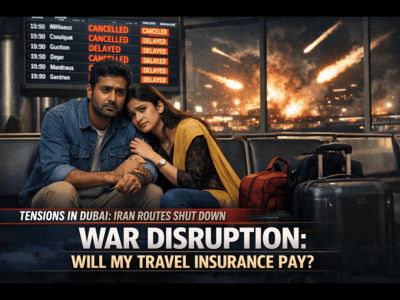
Rising tensions in the Middle East, especially around the US–Israel–Iran conflict, are now affecting flights across the region. Many travellers have been stuck at airports due to sudden cancellations, long delays and last-minute route changes. With ticket prices rising and no clarity on when things will return to normal, stranded passengers are left worried with this question: Will my travel insurance protect me during this war situation?
Read on to know the difference between operational and war-related cancellations, what the UAE and Abu Dhabi are doing for stranded travellers, and what you should keep in mind.
Will standard travel insurance cover airspace disruptions caused by war?
While domestic travel insurance is not mandatory, many international destinations require travellers to have valid insurance. This means a large number of overseas travellers are likely covered.
However, whether you can claim depends largely on two factors: the reason your flight was disrupted and the timing of when you purchased your policy.
“In most standard travel insurance policies, coverage depends on the cause of disruption. If travellers are stranded in destinations such as Dubai, Iran, Qatar or other Middle East regions due to sudden airspace closures linked to geopolitical tensions, claims may be admissible under trip delay, trip interruption, or missed connection benefits - provided the policy was purchased before the event became a “known circumstance, “ says Sarita Joshi - Head of Health and Life Insurance, Probus.
However, if the disruption is directly attributed to an officially declared war or falls within the policy’s war exclusion clause, expenses such as extended hotel stays or rebooking costs may not be covered. Some insurers may offer limited relief under specific extensions, but this varies by insurer and product design. Hence, timing of purchase and policy wording are critical here, she adds.
If the operational interruption is caused by a civil war, civil unrest, or armed conflict, then it will not be covered under travel insurance benefits, explains Arun Ramamurthy, Co-founder, Staywell.Health.
What the UAE and Abu Dhabi are doing for stranded passengers
As per the TOI, the UAE has stepped in to help thousands of travellers stranded by the flight cancellations. The General Civil Aviation Authority (GCAA) announced that it has activated emergency aviation support plans that cover all accommodation, meal and rebooking costs for passengers stuck in the country due to regional airspace closures.
The authority estimates that about 20,200 passengers have been affected by the rescheduling of flights so far. Therefore, temporary accommodation near airport hubs has been organised for travellers along with access to meals, beverages and refreshment services as they wait for further updates.
According to the Dubai Eye 103.8, Abu Dhabi's Department of Culture and Tourism has issued an official circular to hotel managers across the emirate instructing them to extend the stays of guests who are unable to depart due to travel disruptions following missile and drone attacks from Iran.
All additional accommodation costs resulting from such extended stays will be covered by DCT Abu Dhabi.
What is war exclusion clause in travel insurance?
The war exclusion clause is a standard part of most travel insurance policies. It excludes coverage for losses caused directly or indirectly by war, civil unrest, invasion, military action or nuclear events.
“In practical terms, this means if a traveller’s loss is a direct consequence of an active war situation, insurers are not liable. However, grey areas arise in cases of undeclared conflicts, sudden airspace shutdowns, or precautionary diversions. Claim admissibility then depends on how proximate the loss is to the conflict event and how the insurer interprets “direct or indirect consequence, “ says Joshi.
Travellers should carefully review policy wordings, especially exclusions and sub-limits, and ideally purchase coverage well before departure to avoid known-event exclusions, she adds.
What should travellers check before flying to volatile regions?
Before travelling to conflict-prone destinations, reviewing your insurance policy in detail is critical. Travellers should even check official government travel advisories before they leave.
“If travel is undertaken against official government advisories, insurers may not cover claims. Most policies exclude trip delays, interruptions, baggage loss, or medical claims resulting from acts of war or conflict. Carefully reviewing policy exclusions and coverage conditions before travel is essential, says Meet Kapadia, Head of Travel Insurance,” Policybazaar.
Embargo risk may not be covered. Hence, customers should check the policy terms, conditions or restrictions. Even if coverage is available, it is important to check if the hospitals and other medical infrastructure to support claim is available in the country, explains Hari Radhakrishnan, Expert, IBAI.
Read on to know the difference between operational and war-related cancellations, what the UAE and Abu Dhabi are doing for stranded travellers, and what you should keep in mind.
Will standard travel insurance cover airspace disruptions caused by war?
While domestic travel insurance is not mandatory, many international destinations require travellers to have valid insurance. This means a large number of overseas travellers are likely covered.
However, whether you can claim depends largely on two factors: the reason your flight was disrupted and the timing of when you purchased your policy.
“In most standard travel insurance policies, coverage depends on the cause of disruption. If travellers are stranded in destinations such as Dubai, Iran, Qatar or other Middle East regions due to sudden airspace closures linked to geopolitical tensions, claims may be admissible under trip delay, trip interruption, or missed connection benefits - provided the policy was purchased before the event became a “known circumstance, “ says Sarita Joshi - Head of Health and Life Insurance, Probus.
However, if the disruption is directly attributed to an officially declared war or falls within the policy’s war exclusion clause, expenses such as extended hotel stays or rebooking costs may not be covered. Some insurers may offer limited relief under specific extensions, but this varies by insurer and product design. Hence, timing of purchase and policy wording are critical here, she adds.
If the operational interruption is caused by a civil war, civil unrest, or armed conflict, then it will not be covered under travel insurance benefits, explains Arun Ramamurthy, Co-founder, Staywell.Health.
What the UAE and Abu Dhabi are doing for stranded passengers
As per the TOI, the UAE has stepped in to help thousands of travellers stranded by the flight cancellations. The General Civil Aviation Authority (GCAA) announced that it has activated emergency aviation support plans that cover all accommodation, meal and rebooking costs for passengers stuck in the country due to regional airspace closures.
The authority estimates that about 20,200 passengers have been affected by the rescheduling of flights so far. Therefore, temporary accommodation near airport hubs has been organised for travellers along with access to meals, beverages and refreshment services as they wait for further updates.
According to the Dubai Eye 103.8, Abu Dhabi's Department of Culture and Tourism has issued an official circular to hotel managers across the emirate instructing them to extend the stays of guests who are unable to depart due to travel disruptions following missile and drone attacks from Iran.
All additional accommodation costs resulting from such extended stays will be covered by DCT Abu Dhabi.
What is war exclusion clause in travel insurance?
The war exclusion clause is a standard part of most travel insurance policies. It excludes coverage for losses caused directly or indirectly by war, civil unrest, invasion, military action or nuclear events.
“In practical terms, this means if a traveller’s loss is a direct consequence of an active war situation, insurers are not liable. However, grey areas arise in cases of undeclared conflicts, sudden airspace shutdowns, or precautionary diversions. Claim admissibility then depends on how proximate the loss is to the conflict event and how the insurer interprets “direct or indirect consequence, “ says Joshi.
Travellers should carefully review policy wordings, especially exclusions and sub-limits, and ideally purchase coverage well before departure to avoid known-event exclusions, she adds.
What should travellers check before flying to volatile regions?
Before travelling to conflict-prone destinations, reviewing your insurance policy in detail is critical. Travellers should even check official government travel advisories before they leave.
“If travel is undertaken against official government advisories, insurers may not cover claims. Most policies exclude trip delays, interruptions, baggage loss, or medical claims resulting from acts of war or conflict. Carefully reviewing policy exclusions and coverage conditions before travel is essential, says Meet Kapadia, Head of Travel Insurance,” Policybazaar.
Embargo risk may not be covered. Hence, customers should check the policy terms, conditions or restrictions. Even if coverage is available, it is important to check if the hospitals and other medical infrastructure to support claim is available in the country, explains Hari Radhakrishnan, Expert, IBAI.
Next Story