
Tech without ethics can deepen inequality: Hosabale at Stanford


NEW DELHI: As debates intensify globally over the social costs of artificial intelligence, RSS general secretary Dattatreya Hosabale on Friday flagged a deeper concern — that technology-led growth, if left unchecked, could sharpen inequalities and social fragmentation, turning innovation into a source of instability rather than progress. He also used the platform to urge the Indian diaspora to remain loyal to their host nations while retaining cultural links with India, and flagged rising geopolitical tensions and social fractures as key global challenges.
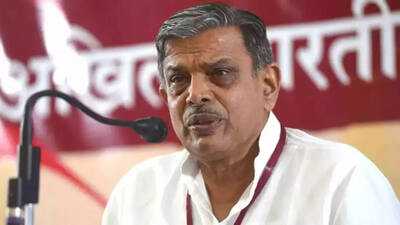
Speaking at the Thrive 2026 conference at Stanford University, Hosabale said scientific advancement must be evaluated not just through economic outcomes but through a broader lens of “economy, equality and ethics”. “Where technology advances, society tends to become more unequal,” he said, linking disparities in access to education and technology with widening gaps in income, opportunity and quality of life.
Participating in a panel on “Science, Knowledge Systems and Civilizational Leadership” alongside Ben Olsen of Responsible AI at Microsoft and Meta, Dr William Hurlbut, consulting professor, Neuroscience Institute, Stanford and moderator Bill Drexel, Senior Fellow at Hudson Institute USA, he argued that Indian civilisational thought offers a framework where science and spirituality are not in conflict. “There is no segregation between the spiritual and the secular in spiritual knowledge,” he said, describing traditions rooted in both “sensory and super sensory” inquiry.
Hosabale said he had come “to share some knowledge of my civilisation…, and also learn something from across the world,” adding that systems such as yoga reflect structured study of “human anatomy, mind sciences, human body, action, and inaction.”
He also touched on geopolitical and societal concerns, saying “today’s world is also passing through very critical times”, citing religious conflict, global power imbalances and weakening social cohesion. Warning against extremism and erosion of family structures, he said, “If families are healthy, the society is healthy, nation is healthy.”
On the Indian diaspora, Hosabale said overseas communities must prioritise loyalty to their host nations while staying culturally connected to India. “Their allegiance to the nation where they are living… is the first thing,” he said, framing it within the idea of “Vasudhaiva Kutumbakam”.
He cautioned that poor education can distort scientific understanding. “If traditional knowledge is not properly understood, all those scientific inquiries of the past will be concluded as only superstitions,” he said.
Referring to historical disruptions of indigenous knowledge systems and their ongoing revival, he also highlighted early Indian advances in “town planning, university survey, and a lot of civil engineering.”
Calling for balanced governance, he said technological growth must not come “at the cost of our environmental balance,” urging policymakers to align innovation with social stability and sustainability.
Speaking at the Thrive 2026 conference at Stanford University, Hosabale said scientific advancement must be evaluated not just through economic outcomes but through a broader lens of “economy, equality and ethics”. “Where technology advances, society tends to become more unequal,” he said, linking disparities in access to education and technology with widening gaps in income, opportunity and quality of life.
Participating in a panel on “Science, Knowledge Systems and Civilizational Leadership” alongside Ben Olsen of Responsible AI at Microsoft and Meta, Dr William Hurlbut, consulting professor, Neuroscience Institute, Stanford and moderator Bill Drexel, Senior Fellow at Hudson Institute USA, he argued that Indian civilisational thought offers a framework where science and spirituality are not in conflict. “There is no segregation between the spiritual and the secular in spiritual knowledge,” he said, describing traditions rooted in both “sensory and super sensory” inquiry.
Hosabale said he had come “to share some knowledge of my civilisation…, and also learn something from across the world,” adding that systems such as yoga reflect structured study of “human anatomy, mind sciences, human body, action, and inaction.”
He also touched on geopolitical and societal concerns, saying “today’s world is also passing through very critical times”, citing religious conflict, global power imbalances and weakening social cohesion. Warning against extremism and erosion of family structures, he said, “If families are healthy, the society is healthy, nation is healthy.”
On the Indian diaspora, Hosabale said overseas communities must prioritise loyalty to their host nations while staying culturally connected to India. “Their allegiance to the nation where they are living… is the first thing,” he said, framing it within the idea of “Vasudhaiva Kutumbakam”.
He cautioned that poor education can distort scientific understanding. “If traditional knowledge is not properly understood, all those scientific inquiries of the past will be concluded as only superstitions,” he said.
Referring to historical disruptions of indigenous knowledge systems and their ongoing revival, he also highlighted early Indian advances in “town planning, university survey, and a lot of civil engineering.”
Calling for balanced governance, he said technological growth must not come “at the cost of our environmental balance,” urging policymakers to align innovation with social stability and sustainability.
Next Story