
Trump's tariff defeat: India and China big winners; US allies pay the price


The US Supreme Court on Friday upended President Donald Trump’s tariff playbook - and temporarily flipped the winners-and-losers board for major exporters, with India and China among the clearest beneficiaries.
Driving the news
What happened: The court struck down Trump’s emergency tariffs imposed under the International Emergency Economic Powers Act (IEEPA) as illegal.
What changes now: Trump is replacing that framework with a 15% global tariff under Section 122, which lasts 150 days unless Congress extends it.
Immediate operational shift: US Customs and Border Protection said it will halt collections of IEEPA-related tariffs at 12:00am EST Tuesday, and deactivate associated tariff codes, Reuters reported.
Why it matters
India
The US SC ruling injects leverage - and uncertainty - into a fast-moving trade negotiation with Washington.
* New Delhi has postponed its trade delegation trip to Washington to finalize the legal text of an interim framework as officials assess whether the ruling creates “elbow room” to seek better terms.
* India delayed the trip “chiefly because of fresh tariff uncertainty out of the US,” a sign Delhi sees both risk and opportunity in the legal reset.
China
Beijing gains negotiating space right before a high-stakes leader-level meeting.
* Bloomberg framed the court decision as a direct hit to one of Trump’s fastest levers over China: sweeping emergency tariffs. With those struck down, China is left facing the same 15% global fee applied to US allies, rather than punitive, fast-escalating emergency rates.
* China’s commerce ministry struck a measured tone Monday, saying it is making a "full assessment" and urging Washington to lift "relevant unilateral tariff measures". It also warned, "US unilateral tariffs ... violate international trade rules and US domestic law, and are not in the interests of any party," adding "Cooperation between China and the United States is beneficial to both sides, but fighting is harmful," per Reuters.
* Markets reacted quickly: Reuters and Bloomberg both noted Chinese stocks in Hong Kong rose as investors priced in near-term relief.
Brazil, Canada, Mexico
Countries previously hammered by special executive orders get the biggest mathematical “relief” - for now.
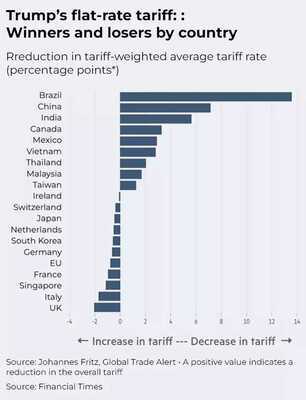
* The Financial Times cited analysis by Global Trade Alert showing Brazil enjoys the largest average tariff reduction (down 13.6 percentage points), followed by China (down 7.1 percentage points).
* Bloomberg and FT also flagged Canada and Mexico as winners because fentanyl-related levies were knocked out with the IEEPA tariffs - and Bloomberg noted that if USMCA exemptions remain, they’re in a “very favorable position.”
* FT underlined the political irony: GTA chief executive Johannes Fritz said: “Countries including China, Brazil, Mexico and Canada that were most bitterly criticised by the White House and targeted with IEEPA tariffs under special executive orders have seen their tariffs fall the most.”
Parts of export Asia (Vietnam, Thailand, Malaysia): A reset that narrows the gap.
* FT said Asian manufacturers such as Vietnam, Thailand and Malaysia - often criticized by Trump over trade surpluses - “will benefit from the new regime,” especially in categories like clothing, furniture, toys and plastics.
* But that benefit comes with a warning label
 Losers
US allies that negotiated “special” lower rates: The new flat tariff erases their advantage.
* Bloomberg pointed to the UK and Australia as losers because they had negotiated 10% levies under the earlier “reciprocal” framework - only to see the new plan lift them into a uniform 15%.
EU and Japan: Relative disadvantage - plus sector exposure.
* FT reported the EU’s overall increase is smaller (0.8 percentage points) but warned that exposure concentrates in key economies when exemptions are accounted for.
* Japan loses a different kind of edge: Bloomberg noted countries that previously had a “competitive” 15% are no longer advantaged once everyone gets pushed to 15%.
The US policy “certainty premium”: Investors don’t love the churn.
* Bloomberg reported the dollar and S&P 500 futures slid Monday as markets digested a new round of policy uncertainty, even as some equities abroad rallied.
What they are saying
He also raised the ceiling on future threats. Greer indicated Trump can use Section 338 to levy tariffs up to 50%. Europe is demanding predictability - and insisting deals still bind. The European Commission said: "A deal is a deal. As the US’s largest trading partner, the EU expects the US to honour its commitments". ECB president Christine Lagarde warned on CBS: "To sort of shake it up again is going to bring about disruptions," adding businesses need clarity. What’s next
The next 150 days are likely to become a race between shipment timing and legal engineering.
* Reuters reported the Section 122 tariff is “separate but untested,” and could invite more legal fights.
* Bloomberg and FT both say the administration is already pivoting to slower, investigation-based routes like Sections 301 and 232, plus sector-specific duties - meaning India’s exporters may get short-term relief while facing longer-term targeted pressure (pharma and autos are the classic flashpoints).
* Goldman Sachs economists told Bloomberg that imports from countries with meaningful tariff reductions “are likely to pick up in coming months,” even if macro effects are partly offset elsewhere.
The bottom line
For India, the “win” is as much diplomatic as numeric: a flatter global rate reduces discrimination, but it also forces Delhi to decide whether to press for better terms now - or wait and risk a new wave of country- or sector-specific probes later.
(With inputs from agencies)
Driving the news
What happened: The court struck down Trump’s emergency tariffs imposed under the International Emergency Economic Powers Act (IEEPA) as illegal.
What changes now: Trump is replacing that framework with a 15% global tariff under Section 122, which lasts 150 days unless Congress extends it.
Immediate operational shift: US Customs and Border Protection said it will halt collections of IEEPA-related tariffs at 12:00am EST Tuesday, and deactivate associated tariff codes, Reuters reported.
Why it matters
- This is less a tariff “rollback” than a tariff system reboot - and it reshapes bargaining power for India and others precisely when Trump is trying to convert tariff pressure into broader trade and geopolitical wins.
- Morgan Stanley’s economists argued that uncertainty is easing even amid the chaos, writing: “the peak level of uncertainty on tariffs and trade tensions has passed,” per Bloomberg.
- But the court ruling also narrows Trump’s ability to rapidly dial tariffs up or down at will - potentially strengthening counterparties at the negotiating table, especially China ahead of Trump’s planned Beijing trip.
India
The US SC ruling injects leverage - and uncertainty - into a fast-moving trade negotiation with Washington.
* New Delhi has postponed its trade delegation trip to Washington to finalize the legal text of an interim framework as officials assess whether the ruling creates “elbow room” to seek better terms.
* India delayed the trip “chiefly because of fresh tariff uncertainty out of the US,” a sign Delhi sees both risk and opportunity in the legal reset.
China
Beijing gains negotiating space right before a high-stakes leader-level meeting.
* Bloomberg framed the court decision as a direct hit to one of Trump’s fastest levers over China: sweeping emergency tariffs. With those struck down, China is left facing the same 15% global fee applied to US allies, rather than punitive, fast-escalating emergency rates.
* China’s commerce ministry struck a measured tone Monday, saying it is making a "full assessment" and urging Washington to lift "relevant unilateral tariff measures". It also warned, "US unilateral tariffs ... violate international trade rules and US domestic law, and are not in the interests of any party," adding "Cooperation between China and the United States is beneficial to both sides, but fighting is harmful," per Reuters.
* Markets reacted quickly: Reuters and Bloomberg both noted Chinese stocks in Hong Kong rose as investors priced in near-term relief.
Brazil, Canada, Mexico
Countries previously hammered by special executive orders get the biggest mathematical “relief” - for now.
* The Financial Times cited analysis by Global Trade Alert showing Brazil enjoys the largest average tariff reduction (down 13.6 percentage points), followed by China (down 7.1 percentage points).
* Bloomberg and FT also flagged Canada and Mexico as winners because fentanyl-related levies were knocked out with the IEEPA tariffs - and Bloomberg noted that if USMCA exemptions remain, they’re in a “very favorable position.”
* FT underlined the political irony: GTA chief executive Johannes Fritz said: “Countries including China, Brazil, Mexico and Canada that were most bitterly criticised by the White House and targeted with IEEPA tariffs under special executive orders have seen their tariffs fall the most.”
Parts of export Asia (Vietnam, Thailand, Malaysia): A reset that narrows the gap.
* FT said Asian manufacturers such as Vietnam, Thailand and Malaysia - often criticized by Trump over trade surpluses - “will benefit from the new regime,” especially in categories like clothing, furniture, toys and plastics.
* But that benefit comes with a warning label
US allies that negotiated “special” lower rates: The new flat tariff erases their advantage.
* Bloomberg pointed to the UK and Australia as losers because they had negotiated 10% levies under the earlier “reciprocal” framework - only to see the new plan lift them into a uniform 15%.
EU and Japan: Relative disadvantage - plus sector exposure.
* FT reported the EU’s overall increase is smaller (0.8 percentage points) but warned that exposure concentrates in key economies when exemptions are accounted for.
* Japan loses a different kind of edge: Bloomberg noted countries that previously had a “competitive” 15% are no longer advantaged once everyone gets pushed to 15%.
The US policy “certainty premium”: Investors don’t love the churn.
* Bloomberg reported the dollar and S&P 500 futures slid Monday as markets digested a new round of policy uncertainty, even as some equities abroad rallied.
What they are saying
- US Trade Representative Jamieson Greer is signaling continuity - but with different legal tools.
- On Fox News Sunday, he said: “We want to make sure that China is complying with its part of the deal,” adding, “So that means they continue to buy the products they said they would buy.”
- On CBS, Greer acknowledged the loss of IEEPA flexibility: “We don’t have the same flexibility that IEEPA gave us” but “we’re going to conduct investigations that can allow us to impose tariffs if it’s justified by the investigation”, per FT.
The next 150 days are likely to become a race between shipment timing and legal engineering.
* Reuters reported the Section 122 tariff is “separate but untested,” and could invite more legal fights.
* Bloomberg and FT both say the administration is already pivoting to slower, investigation-based routes like Sections 301 and 232, plus sector-specific duties - meaning India’s exporters may get short-term relief while facing longer-term targeted pressure (pharma and autos are the classic flashpoints).
* Goldman Sachs economists told Bloomberg that imports from countries with meaningful tariff reductions “are likely to pick up in coming months,” even if macro effects are partly offset elsewhere.
The bottom line
For India, the “win” is as much diplomatic as numeric: a flatter global rate reduces discrimination, but it also forces Delhi to decide whether to press for better terms now - or wait and risk a new wave of country- or sector-specific probes later.
(With inputs from agencies)
Next Story