
AI-driven sensors in bullet trains to detect defects early


CHENNAI: An AI-driven monitoring system using sensors mounted on trains running at up to 350kmph to detect track defects early, before cracks develop, and automatically slow trains will be installed on India’s first bullet train corridor between Mumbai and Ahmedabad. Part of a condition-based monitoring (CBM) system, the technology also tracks the health of train components such as bearings, gearboxes, traction motors and doors in real time, predicting failures weeks inadvance and enabling maintenance based on actual wear rather than fixed replacement schedules.
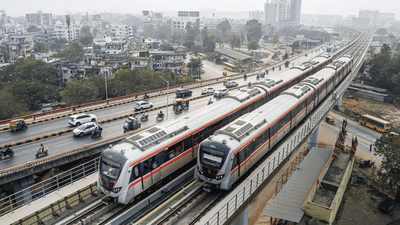
Developed by South Korea-based firm Globiz , the system was showcased at the International Rail Coach Expo 2026 organised by Integral Coach Factory (ICF) and the Confederation of Indian Industry (CII).
The system uses sensors installed on key parts of the train, including wheels, bogies, doors and electrical systems. As the train runs, the sensors continuously record vibrations and mechanicalbehaviour. The data is processed through an onboard edge server, where algorithms analyse patterns to detect anomalies.
One of the key capabilities is identifying potential track defects. Wheel-mounted sensors measure vibration changes as the train moves. If multiple coaches detect the same abnormal vibration at a location, the system flags that stretch of track for inspection. In critical situations, the system can automatically reduce the train’s speed to about 20 kmph using the braking system, while alerting the driver through the display unit and notifying maintenance teams. “We will start delivering the CBM system for India’s first high-speed rail from May,” said Woo Seong Seo, director, Globiz. “We are also in talks with the Integral Coach Factory and metro systems in the country.”
The technology can predict failures in components such as bearings weeks before breakdowns occur, allowing railway operators to intervene when early signs of wear are detected. “That helps prevent accidents and save lives while also reducing maintenance costs,” Seo said.For India, the technology has been adapted to withstand harsher operating conditions, including higher vibration levels and integration with multiple telecom networks and cloud-based monitoring systems.
Developed by South Korea-based firm Globiz , the system was showcased at the International Rail Coach Expo 2026 organised by Integral Coach Factory (ICF) and the Confederation of Indian Industry (CII).
The system uses sensors installed on key parts of the train, including wheels, bogies, doors and electrical systems. As the train runs, the sensors continuously record vibrations and mechanicalbehaviour. The data is processed through an onboard edge server, where algorithms analyse patterns to detect anomalies.
One of the key capabilities is identifying potential track defects. Wheel-mounted sensors measure vibration changes as the train moves. If multiple coaches detect the same abnormal vibration at a location, the system flags that stretch of track for inspection. In critical situations, the system can automatically reduce the train’s speed to about 20 kmph using the braking system, while alerting the driver through the display unit and notifying maintenance teams. “We will start delivering the CBM system for India’s first high-speed rail from May,” said Woo Seong Seo, director, Globiz. “We are also in talks with the Integral Coach Factory and metro systems in the country.”
The technology can predict failures in components such as bearings weeks before breakdowns occur, allowing railway operators to intervene when early signs of wear are detected. “That helps prevent accidents and save lives while also reducing maintenance costs,” Seo said.For India, the technology has been adapted to withstand harsher operating conditions, including higher vibration levels and integration with multiple telecom networks and cloud-based monitoring systems.
Next Story