
Delhi-Dehradun Expressway ease ends in gridlock as Saharanpur road chokes entry


DEHRADUN : For commuters cruising down the newly inaugurated Delhi-Dehradun expressway , the smooth ride comes to an abrupt halt at the city’s edge, where traffic congestion along Saharanpur Road continues to bottleneck entry into the capital.
With a rising number of vehicles entering Dehradun — and a further surge expected during weekends and the peak tourist season — the city’s limited urban infrastructure is increasingly being stretched.Dehradun: For commuters cruising down the newly inaugurated Delhi-Dehradun Expressway, the smooth ride comes to an abrupt halt at the city’s edge, where traffic congestion along Saharanpur Road continues to bottleneck entry into Dehradun.
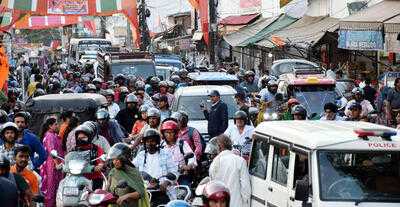
With a rising number of vehicles entering the city, and a further surge expected during weekends and the peak tourist season, the pressure is only set to intensify, exposing the strain on the city’s limited urban infrastructure.
“There is a huge, pressing local question that many, including me, have been repeatedly raising: how will this additional expressway traffic impact Dehradun’s already strained road network? Congestion within the city, which is already an issue, will increase manifold. This could offset the projected emission and fuel savings, even as ministers claim emissions will reduce along this stretch,” said Anoop Nautiyal , founder of SDC Foundation .
Concerns over Mussoorie ’s limited infrastructure and its capacity to handle rising traffic volumes have been raised in the past. Govt plans to further develop this corridor towards Mussoorie and Rishikesh have heightened worries among environmentalists, who point to the region’s already fragile ecology. Town planners, meanwhile, are calling for an overhaul of traffic and urban management systems to cope with the growing footfall. They argued that the challenge is no longer about preventing traffic growth, but managing it more efficiently.
“For hill towns like Dehradun and Mussoorie, infrastructural constraints are inevitable. With traffic volumes set to rise manifold, the focus must shift to better management to ensure smoother flow. Tourists heading to Mussoorie, for instance, need not enter the city or travel up to the Clock Tower simply because GPS navigation suggests it. Clear signage should redirect them to alternative routes such as the Shimla Bypass Road ,” said Geeta Khulbe, former senior town planner, MDDA.
She added, “At the same time, local traffic can be better regulated to minimise interference with tourist movement. Such mitigation measures can help ensure a smoother journey for all commuters without placing additional strain on existing infrastructure.”
Officials from the city’s traffic department said a standard operating procedure (SOP) has already been developed to address these concerns and came into effect on Thursday. The SOP identifies key bottlenecks, including Rispana Pull, Jogiwala and ISBT, and acknowledges issues such as inadequate parking at busy markets like Paltan Bazaar. It also factors in the impact on emergency services.
“The SOP addresses concerns such as the lack of bypasses and alternate routes, as well as Dehradun’s status as a capital city with frequent VVIP movement. Route diversions are already in place along the Shimla Bypass and GMS roads. The plan also accounts for increased traffic during the Char Dham yatra and summer months,” said Lokjeet Singh , superintendent of police (traffic).
He added that diversion plans will be communicated through social media and navigation apps, while additional police personnel will be deployed alongside micro-level planning across city zones.
Officials said a dedicated data analysis exercise will be undertaken to track traffic volumes. The traffic police have also requested additional signage from civic bodies and are planning to set up a tourist assistance helpline. Measures such as shifting the Arhat wholesale market and widening Saharanpur Road are also expected to ease congestion. Proposals for elevated corridors, overbridges and underpasses are also part of the long-term plan outlined in the SOP.
With a rising number of vehicles entering Dehradun — and a further surge expected during weekends and the peak tourist season — the city’s limited urban infrastructure is increasingly being stretched.Dehradun: For commuters cruising down the newly inaugurated Delhi-Dehradun Expressway, the smooth ride comes to an abrupt halt at the city’s edge, where traffic congestion along Saharanpur Road continues to bottleneck entry into Dehradun.
With a rising number of vehicles entering the city, and a further surge expected during weekends and the peak tourist season, the pressure is only set to intensify, exposing the strain on the city’s limited urban infrastructure.
“There is a huge, pressing local question that many, including me, have been repeatedly raising: how will this additional expressway traffic impact Dehradun’s already strained road network? Congestion within the city, which is already an issue, will increase manifold. This could offset the projected emission and fuel savings, even as ministers claim emissions will reduce along this stretch,” said Anoop Nautiyal , founder of SDC Foundation .
Concerns over Mussoorie ’s limited infrastructure and its capacity to handle rising traffic volumes have been raised in the past. Govt plans to further develop this corridor towards Mussoorie and Rishikesh have heightened worries among environmentalists, who point to the region’s already fragile ecology. Town planners, meanwhile, are calling for an overhaul of traffic and urban management systems to cope with the growing footfall. They argued that the challenge is no longer about preventing traffic growth, but managing it more efficiently.
“For hill towns like Dehradun and Mussoorie, infrastructural constraints are inevitable. With traffic volumes set to rise manifold, the focus must shift to better management to ensure smoother flow. Tourists heading to Mussoorie, for instance, need not enter the city or travel up to the Clock Tower simply because GPS navigation suggests it. Clear signage should redirect them to alternative routes such as the Shimla Bypass Road ,” said Geeta Khulbe, former senior town planner, MDDA.
She added, “At the same time, local traffic can be better regulated to minimise interference with tourist movement. Such mitigation measures can help ensure a smoother journey for all commuters without placing additional strain on existing infrastructure.”
Officials from the city’s traffic department said a standard operating procedure (SOP) has already been developed to address these concerns and came into effect on Thursday. The SOP identifies key bottlenecks, including Rispana Pull, Jogiwala and ISBT, and acknowledges issues such as inadequate parking at busy markets like Paltan Bazaar. It also factors in the impact on emergency services.
“The SOP addresses concerns such as the lack of bypasses and alternate routes, as well as Dehradun’s status as a capital city with frequent VVIP movement. Route diversions are already in place along the Shimla Bypass and GMS roads. The plan also accounts for increased traffic during the Char Dham yatra and summer months,” said Lokjeet Singh , superintendent of police (traffic).
He added that diversion plans will be communicated through social media and navigation apps, while additional police personnel will be deployed alongside micro-level planning across city zones.
Officials said a dedicated data analysis exercise will be undertaken to track traffic volumes. The traffic police have also requested additional signage from civic bodies and are planning to set up a tourist assistance helpline. Measures such as shifting the Arhat wholesale market and widening Saharanpur Road are also expected to ease congestion. Proposals for elevated corridors, overbridges and underpasses are also part of the long-term plan outlined in the SOP.
Next Story