
Fresh SoPs: Hostels, govt canteens to get LPG refills on priority


Bengaluru: In line with Union govt directives to regulate commercial use of LPG amid the West Asia crisis, the state govt Sunday issued a set of standard operating procedures (SOPs) to manage supply and distribution.
Under new guidelines, all commercial establishments must register for piped natural gas (PNG) connections with their respective distribution entities within seven days "to be considered under the allocation framework".
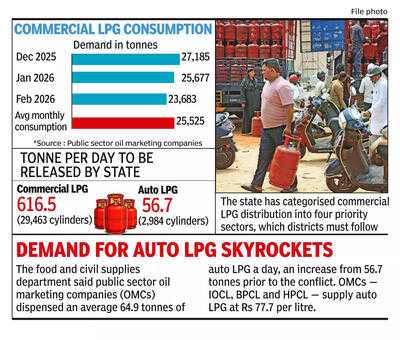
The state has categorised commercial LPG distribution into four priority sectors, which district administrations must follow. The top priority group includes essential institutions such as educational institutions, student hostels, and hospitals; second priority includes govt and public sector units, as well as canteens at airports, railway stations, and bus terminals.
100% quota to first 2 priorities
The third priority category - closely watched due to its scale - covers restaurants, dhabas, hotels, industrial canteens, food processing units, KMF (Nandini) dairies, Indira Canteens, community kitchens, paying guest accommodations, corporate canteens, and sports facilities. The fourth category includes labour-intensive and industrial sectors such as steel, automobile, textile, dye, chemical, and plastics industries, along with seed processing, agriculture and allied sectors, pharmaceuticals, fisheries, zoological parks, poultry, and sericulture.
The SOP states the first two priority sectors will receive 100% of their quota, while supply to the third category will be considered after meeting needs of higher-priority segments.
Officials said the Centre has increased Karnataka's allocation by 8%, bringing total availability for commercial purposes to 68%. The state's average monthly consumption over the past three months has been around 25,000 tonnes, while current availability stands at 18,494 tonnes. On a daily basis, Karnataka has approximately 29,463 commercial LPG cylinders available. In contrast, average consumption during normal times is about 850 tonnes/day or about 44,000 cylinders (19kg capacity).
As per guidelines from the ministry of petroleum and natural gas, stakeholders are expected to receive 578 tonnes of commercial LPG and 38.5 tonnes of auto LPG per day, totalling 616.5 tonnes. Auto LPG supply will continue as per existing allocations. "The situation in the state is expected to improve significantly," said KH Muniyappa , food and civil supplies minister.
Meanwhile, authorities have flagged black marketing, warning of legal action and licence cancellation. District-level monitoring committees, headed by deputy commissioners, have been tasked with overseeing distribution.
Under new guidelines, all commercial establishments must register for piped natural gas (PNG) connections with their respective distribution entities within seven days "to be considered under the allocation framework".
The state has categorised commercial LPG distribution into four priority sectors, which district administrations must follow. The top priority group includes essential institutions such as educational institutions, student hostels, and hospitals; second priority includes govt and public sector units, as well as canteens at airports, railway stations, and bus terminals.
100% quota to first 2 priorities
The third priority category - closely watched due to its scale - covers restaurants, dhabas, hotels, industrial canteens, food processing units, KMF (Nandini) dairies, Indira Canteens, community kitchens, paying guest accommodations, corporate canteens, and sports facilities. The fourth category includes labour-intensive and industrial sectors such as steel, automobile, textile, dye, chemical, and plastics industries, along with seed processing, agriculture and allied sectors, pharmaceuticals, fisheries, zoological parks, poultry, and sericulture.
The SOP states the first two priority sectors will receive 100% of their quota, while supply to the third category will be considered after meeting needs of higher-priority segments.
Officials said the Centre has increased Karnataka's allocation by 8%, bringing total availability for commercial purposes to 68%. The state's average monthly consumption over the past three months has been around 25,000 tonnes, while current availability stands at 18,494 tonnes. On a daily basis, Karnataka has approximately 29,463 commercial LPG cylinders available. In contrast, average consumption during normal times is about 850 tonnes/day or about 44,000 cylinders (19kg capacity).
As per guidelines from the ministry of petroleum and natural gas, stakeholders are expected to receive 578 tonnes of commercial LPG and 38.5 tonnes of auto LPG per day, totalling 616.5 tonnes. Auto LPG supply will continue as per existing allocations. "The situation in the state is expected to improve significantly," said KH Muniyappa , food and civil supplies minister.
Meanwhile, authorities have flagged black marketing, warning of legal action and licence cancellation. District-level monitoring committees, headed by deputy commissioners, have been tasked with overseeing distribution.
Next Story