
Mumbai to get new-age pod taxi system: Key routes, stations, how it will work


MUMBAI: Mumbai’s first driverless pod taxi system, aimed at easing last-mile congestion in the Bandra Kurla Complex (BKC), will see its first phase completed within 20 months, Maharashtra chief minister Devendra Fadnavis said on Monday.
The announcement sets a clear timeline for the city’s first personal rapid transit system , designed to connect key transit points and reduce dependency on multiple modes of transport.
Fadnavis performed the bhoomi pujan for the 3.36-km Phase I stretch, formally launching work on the project. Deputy Chief Ministers Eknath Shinde and Sunetra Pawar were present at the ceremony.
The project is being implemented by the Mumbai Metropolitan Region Development Authority as part of a larger plan to improve urban mobility in Mumbai’s commercial hub.
Route and key connectivity points
The initial corridor will connect Kurla terminal station with Bandra East terminal station, passing through key locations such as LBS Marg, MMRDA Pay and Park (G Block), BDB Gate 11, Kalanagar, Old MMRDA building and the excise department.
Planned as part of a larger 8.85-km network with 22 stations, the system aims to provide seamless first- and last-mile connectivity across BKC, Kurla and Bandra East.
How the pod taxi system will work
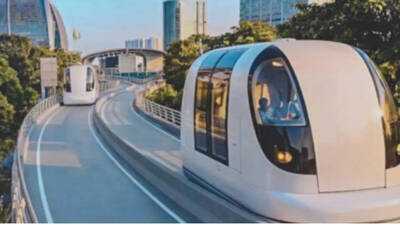
Officials said the system will use six-seater pods that are fully automated, battery-operated and powered by artificial intelligence.
The pods will run on a dedicated guideway at speeds of up to 40 kmph, with a headway of just 15 seconds. They will stop only at stations selected by passengers, reducing travel time and improving efficiency.
Integration with metro network
The pod taxi network will be integrated with Metro Line 3 at BKC and Metro Line 2B at stations near ITO and IL&FS, strengthening Mumbai’s multi-modal transport system.
A depot is also planned in Bandra East to support operations.
Ridership and long-term impact
The full project is expected to cater to around 1.1 lakh daily commuters by 2031, officials said, while significantly reducing congestion in one of Mumbai’s busiest business districts.
Authorities say the system will not only cut travel time but also promote eco-friendly mobility through its battery-operated design.
'Will reduce congestion'
Fadnavis directed officials to immediately escalate any hurdles posed by government agencies or departments, assuring that such issues would be resolved at the highest level to ensure timely completion.
"A person alighting either from the metro or a suburban train will not be required to use another mode of public transport thereafter. He can reach within a distance of 100 to 150 metres by this pod taxi," he said earlier, stressing the project’s role in reducing congestion.
The announcement sets a clear timeline for the city’s first personal rapid transit system , designed to connect key transit points and reduce dependency on multiple modes of transport.
Fadnavis performed the bhoomi pujan for the 3.36-km Phase I stretch, formally launching work on the project. Deputy Chief Ministers Eknath Shinde and Sunetra Pawar were present at the ceremony.
The project is being implemented by the Mumbai Metropolitan Region Development Authority as part of a larger plan to improve urban mobility in Mumbai’s commercial hub.
Route and key connectivity points
The initial corridor will connect Kurla terminal station with Bandra East terminal station, passing through key locations such as LBS Marg, MMRDA Pay and Park (G Block), BDB Gate 11, Kalanagar, Old MMRDA building and the excise department.
Planned as part of a larger 8.85-km network with 22 stations, the system aims to provide seamless first- and last-mile connectivity across BKC, Kurla and Bandra East.
How the pod taxi system will work
Officials said the system will use six-seater pods that are fully automated, battery-operated and powered by artificial intelligence.
The pods will run on a dedicated guideway at speeds of up to 40 kmph, with a headway of just 15 seconds. They will stop only at stations selected by passengers, reducing travel time and improving efficiency.
Integration with metro network
The pod taxi network will be integrated with Metro Line 3 at BKC and Metro Line 2B at stations near ITO and IL&FS, strengthening Mumbai’s multi-modal transport system.
A depot is also planned in Bandra East to support operations.
Ridership and long-term impact
The full project is expected to cater to around 1.1 lakh daily commuters by 2031, officials said, while significantly reducing congestion in one of Mumbai’s busiest business districts.
Authorities say the system will not only cut travel time but also promote eco-friendly mobility through its battery-operated design.
'Will reduce congestion'
Fadnavis directed officials to immediately escalate any hurdles posed by government agencies or departments, assuring that such issues would be resolved at the highest level to ensure timely completion.
"A person alighting either from the metro or a suburban train will not be required to use another mode of public transport thereafter. He can reach within a distance of 100 to 150 metres by this pod taxi," he said earlier, stressing the project’s role in reducing congestion.
Next Story