
Sat data shows inter-rookery movement of Ridleys for nesting


Bhubaneswar: Olive ridley sea turtles look for a safer haven if not comfortable nesting and laying eggs at a particular rookery. Offering fresh insight into their breeding behaviour and habitat, the satellite tagging of olive ridley sea turtles, started along Odisha coast last Dec, confirmed inter-rookery movement between two of the state’s major nesting sites — Gahirmatha and Rushikulya rookery.
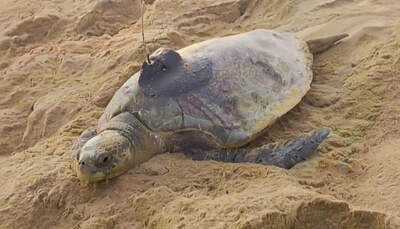
Earlier, wildlife officials used to get a rough impression about possible inter-rookery movement, but the latest data from the tagging of eight turtles fitted with satellite transmitters revealed the movement from Gahirmatha to Rushikulya rookery. The tagged turtles included both males and females, allowing researchers to compare movement patterns between the sexes.
“The inter-rookery movement indicates that turtles, when not comfortable for nesting and laying eggs, begin to shift to other safer rookery,” said Sunny Khokhar, divisional forest officer (Berhampur), who oversees protection measures at Rushikulya.
Wildlife officials said findings from the ongoing study showed that turtles largely remain near shore during the breeding season, mostly within 5km of the coastline, though some move as far as 35km offshore. The most significant observation so far is the movement of one female turtle from Gahirmatha rookery to Rushikulya and back, the officials added.
Sushil Datta, an expert, who has studied the habitat of the olive ridley turtle extensively, said the inter-rookery movement also indicates ecological connectivity between the two major nesting grounds. “It will help understand the spatial dynamics of breeding populations and in identifying critical habitats that need stronger protection. Such information is vital for planning more effective management strategies,” he said.
The satellite tagging programme was launched by the Wildlife Institute of India in collaboration with the state forest department as part of efforts to bolster marine conservation and better understand the turtles’ movements near shore as well as their migratory behaviour. “Now, we need to understand the turtle’s behavioural biology,,” Datta said.
The tagging involved carefully capturing mating turtles near shores, using scoop nets. Satellite transmitters are then attached to the turtles’ carapace with specialised epoxy adhesive and with the help of the antifouling process to ensure the devices remained secure and transmitted accurate data over time.
Wildlife authorities said early results have demonstrated value of satellite tagging as a scientific tool. By mapping turtle movements with greater precision, researchers hope to generate proof that can guide habitat protection measures.
Earlier, wildlife officials used to get a rough impression about possible inter-rookery movement, but the latest data from the tagging of eight turtles fitted with satellite transmitters revealed the movement from Gahirmatha to Rushikulya rookery. The tagged turtles included both males and females, allowing researchers to compare movement patterns between the sexes.
“The inter-rookery movement indicates that turtles, when not comfortable for nesting and laying eggs, begin to shift to other safer rookery,” said Sunny Khokhar, divisional forest officer (Berhampur), who oversees protection measures at Rushikulya.
Wildlife officials said findings from the ongoing study showed that turtles largely remain near shore during the breeding season, mostly within 5km of the coastline, though some move as far as 35km offshore. The most significant observation so far is the movement of one female turtle from Gahirmatha rookery to Rushikulya and back, the officials added.
Sushil Datta, an expert, who has studied the habitat of the olive ridley turtle extensively, said the inter-rookery movement also indicates ecological connectivity between the two major nesting grounds. “It will help understand the spatial dynamics of breeding populations and in identifying critical habitats that need stronger protection. Such information is vital for planning more effective management strategies,” he said.
The satellite tagging programme was launched by the Wildlife Institute of India in collaboration with the state forest department as part of efforts to bolster marine conservation and better understand the turtles’ movements near shore as well as their migratory behaviour. “Now, we need to understand the turtle’s behavioural biology,,” Datta said.
The tagging involved carefully capturing mating turtles near shores, using scoop nets. Satellite transmitters are then attached to the turtles’ carapace with specialised epoxy adhesive and with the help of the antifouling process to ensure the devices remained secure and transmitted accurate data over time.
Wildlife authorities said early results have demonstrated value of satellite tagging as a scientific tool. By mapping turtle movements with greater precision, researchers hope to generate proof that can guide habitat protection measures.
Next Story