
Theatre review: Ambaa reclaims women's agency, voice using satire


From the Iliad to the Mahabharata , women have often been wrongly portrayed as catalysts of war. Atul Kumar’s Ambaa challenges this flawed notion and turns it on its head. Inspired by Aristophanes’ 5th-century BCE comedy Lysistrata , this satirical drama is reimagined for contemporary audiences. While Lysistrata shows women coming together to end the decades-long Peloponnesian War between the city-states of Athens and Sparta in ancient Greece, Kumar’s adaptation leaves its time and place unspecified, keeping the play strikingly relevant and universal.
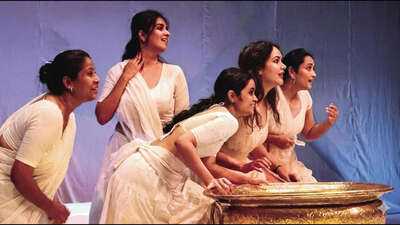 In both the original play and its adaptation, the women possess agency and a strong voice, fully aware of the dynamics of gendered power. To end the bloodshed and warmongering, they devise an unusual strategy: denying their partners sexual intimacy until the men lay down their arms and embrace lasting peace. In doing so, the play explores complex themes, including masculine pride, male ego and deeprooted patriarchy. The 90-minute play, however, maintains a light mood through playful, risqué dialogues delivered in a blend of Hindi and Bundeli.
Kamna Pathak as Ambaa is convincing, and so is the rest of the cast. Apart from its theme, Ambaa also draws heavily on the ‘old comedy’ tradition of Lysistrata , also known as Aristophanic comedy – a genre characterised by spirited critiques of public affairs through song, dance and buffoonery.
The play’s all-white costumes and set design deftly bring out its central message of peace. In the climactic scene, the stage is bathed in a soft pink hue, achieved through effective lighting that subtly highlights the union of masculine and feminine energies, culminating in a final visual where the futility of war and the all-consuming power of love and passion resonate most profoundly.
Produced by D for Drama, Ambaa opened the META Theatre Festival at Delhi’s Kamani Auditorium, which was underway from March 19 to 25.
Kamna Pathak as Ambaa is convincing, and so is the rest of the cast. Apart from its theme, Ambaa also draws heavily on the ‘old comedy’ tradition of Lysistrata , also known as Aristophanic comedy – a genre characterised by spirited critiques of public affairs through song, dance and buffoonery.
The play’s all-white costumes and set design deftly bring out its central message of peace. In the climactic scene, the stage is bathed in a soft pink hue, achieved through effective lighting that subtly highlights the union of masculine and feminine energies, culminating in a final visual where the futility of war and the all-consuming power of love and passion resonate most profoundly.
Next Story