
Vivekanand Kumar rescues over 2,200 snakes in Ranchi; Educates residents on snake safety


Ranchi: For over two decades, Vivekanand Kumar has been rescuing snakes across the city, saving both humans and reptiles. He has rescued more than 2,200 snakes, responded whenever residents reported sightings, and later released the reptiles into nearby forests.
“When people see a snake, their first instinct is to kill it, fearing that it is venomous. However, not all snakes have venom. Even the venomous ones are more scared of people than humans are of them. They do not attack unless instigated,” Vivekanand said. He doesn’t charge for the rescues.
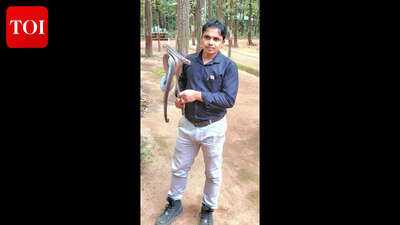
Among the snakes he has rescued are non-venomous species such as checkered keelback, rat snake, python, striped keelback, and common cat snake, and venomous ones including cobra, krait and Russell’s viper.
His fascination with snakes began during his school days after he saw one in the biology lab. “When I saw a snake for the first time, I was fascinated. I started watching wildlife channels and developed a deep interest. As a child, I used to say I would become a snake scientist,” he said.
His journey began in 2003, when he was just 14. Now in his 30s, he works as a zoo biologist at Bhagwan Birsa Biological Park and is pursuing a PhD on ‘Snakes: Diversity and Distribution in Jharkhand’.
He also coordinates with a network of snake rescuers across around 10 districts, connecting with them whenever rescue calls come from outside Ranchi.
Vivekanand also spreads awareness among residents about snake behaviour and safety. He advises people not to panic if they encounter a snake.
“Do not attack or create a commotion, or the snake may become agitated. Try to take a photo and share it with a snake rescuer so they come prepared with required equipment. Throw a blanket or a heavy cloth over the snake so it feels well-hidden and does not slither around searching for a hiding place,” he said.
In case of a snakebite, he urged immediate medical treatment. “If a hospital is nearby, do not tie a cloth to stop blood circulation. If it is far away, tie a crepe bandage or a broad cloth near the bitten area, but ensure it is not too tight so that there is blood circulation,” he added.
“When people see a snake, their first instinct is to kill it, fearing that it is venomous. However, not all snakes have venom. Even the venomous ones are more scared of people than humans are of them. They do not attack unless instigated,” Vivekanand said. He doesn’t charge for the rescues.
Among the snakes he has rescued are non-venomous species such as checkered keelback, rat snake, python, striped keelback, and common cat snake, and venomous ones including cobra, krait and Russell’s viper.
His fascination with snakes began during his school days after he saw one in the biology lab. “When I saw a snake for the first time, I was fascinated. I started watching wildlife channels and developed a deep interest. As a child, I used to say I would become a snake scientist,” he said.
His journey began in 2003, when he was just 14. Now in his 30s, he works as a zoo biologist at Bhagwan Birsa Biological Park and is pursuing a PhD on ‘Snakes: Diversity and Distribution in Jharkhand’.
He also coordinates with a network of snake rescuers across around 10 districts, connecting with them whenever rescue calls come from outside Ranchi.
Vivekanand also spreads awareness among residents about snake behaviour and safety. He advises people not to panic if they encounter a snake.
“Do not attack or create a commotion, or the snake may become agitated. Try to take a photo and share it with a snake rescuer so they come prepared with required equipment. Throw a blanket or a heavy cloth over the snake so it feels well-hidden and does not slither around searching for a hiding place,” he said.
In case of a snakebite, he urged immediate medical treatment. “If a hospital is nearby, do not tie a cloth to stop blood circulation. If it is far away, tie a crepe bandage or a broad cloth near the bitten area, but ensure it is not too tight so that there is blood circulation,” he added.
Next Story