
Redefining Growth and Purpose at Epsilon: Where Careers, Culture, and Innovation Intersect.


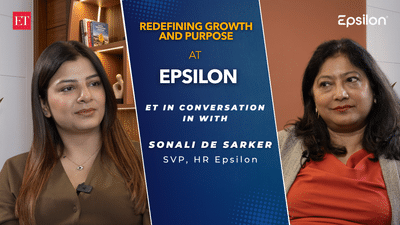
In a conversation with The Economic Times Neha Vashishth, Principal Content Producer and Anchor, Sonali De Sarker, Senior Vice President, HR- Epsilon India, lays out a playbook that is as much about pushing boundaries as it is about building an ecosystem where employees own their careers.
People philosophy: Whole selves, real impact
Sonali’s people lens is disarmingly simple. “It actually boils down to pretty simple things.” For her, the test is whether employees can bring their “whole selves” to work and still find fairness and joy.
That translates into a checklist that is less slogan and more operating question: “Do I enjoy working here? Can I learn? Can I grow? Can I value add? Can I make an impact? As a result, do I get recognised and do I have fun?” ERGs matter because they allow people to pursue interests outside their core roles; fair processes matter because they ensure “your impact is valued”; and fun is non-negotiable, but only when anchored in meaningful work. This philosophy sets the tone for everything from hiring to mobility: if the organisation cannot answer “yes” to those questions for enough people, HR has unfinished business.
Client-centricity
The other axis that defines Epsilon India’s strategy is client-centricity. The centre has evolved into a product and engineering hub, but Sonali is clear that the underlying client obsession has not shifted. “If client centricity is important, then how do I look at my processes?” she asks, recounting an instance where a particularly critical customer forced teams to “think outside the box… without… breaking processes internally”.
For HR, that means treating employees as internal clients while never losing sight of the external ones they serve. In hiring, the same principle shows up differently by role. In professional services, apart from technical depth, HR consciously screens for “good consulting skills” and the ability to explain to customers, “this is what we are looking at”. In engineering, the focus shifts to “how clean is the code” and overall quality. The common thread is a single question: “How do we keep the client in the center of it and have different aspects of that show up in a hiring process?” That client lens, she argues, must “pervade the entire organisation”, including HR itself.
AI fluency as a new baseline
If there is one force accelerating that shift, it is AI. Epsilon’s products have embedded AI “for many, many years”, and the company is driving AI fluency across the organization. She also talks about Marcel, Publicis Groupe’s AI-powered platform that connects over 100,000 employees and offers thousands of learning modules, mentoring and internal mobility tools. Marcel, she explains, is a “hyper-personalised” learning and talent ecosystem where an engineer in India can binge on AI courses at her own pace, or a senior leader can access “cheat sheets” on writing better prompts.
Democratizing learning, careers and culture
If AI is the engine, democratization is the steering. Sonali is emphatic that learning at Epsilon India is not something managers gatekeep. On Marcel, an employee can decide, they want to learn Spanish, which is completely disassociated from their work. And there are courses available. Or dive into deep technical content without needing anyone’s nod. This “democratization of learning” is mirrored in talent mobility: internal roles across Epsilon and other Publicis entities are visible, and employees who have spent 12 months in a role can apply.
GCCs, AI and the next frontier for Epsilon India
Zooming out, Sonali locates Epsilon India’s journey inside a broader evolution of India’s GCC landscape. The old model was “cost arbitrage… dollar or euro compared to the rupee”. Now, she notes, multinational headquarters are asking “how can I leverage this team in India, bring higher value in”, and shifting towards value creation, product ownership and global leadership from Indian centers.
AI, in her view, is where India’s GCCs will increasingly punch above their weight. It is a space that “comes naturally to us”, and she expects Indian teams to play “a larger role… globally in the years to come”. At Epsilon India, that is already visible in the kind of work being led from here: client-centric product engineering, global delivery and what she describes as “the kind of impact we've made across globally”.
Asked where she sees Epsilon India in three to five years, she resists easy projections. Instead, she returns to a theme that has run through every answer: “Epsilon India is anyway an integral part of Epsilon globally, but it’s all about saying what’s the next step”. In her lexicon, the next step is almost always about “pushing boundaries and just moving higher”, whether that is HR teams cracking AI hackathons, employees crafting their own global careers through Marcel, or an organization choosing to treat AI not as a threat but as an everyday instrument for better, more human work.
People philosophy: Whole selves, real impact
Sonali’s people lens is disarmingly simple. “It actually boils down to pretty simple things.” For her, the test is whether employees can bring their “whole selves” to work and still find fairness and joy.
That translates into a checklist that is less slogan and more operating question: “Do I enjoy working here? Can I learn? Can I grow? Can I value add? Can I make an impact? As a result, do I get recognised and do I have fun?” ERGs matter because they allow people to pursue interests outside their core roles; fair processes matter because they ensure “your impact is valued”; and fun is non-negotiable, but only when anchored in meaningful work. This philosophy sets the tone for everything from hiring to mobility: if the organisation cannot answer “yes” to those questions for enough people, HR has unfinished business.
Client-centricity
The other axis that defines Epsilon India’s strategy is client-centricity. The centre has evolved into a product and engineering hub, but Sonali is clear that the underlying client obsession has not shifted. “If client centricity is important, then how do I look at my processes?” she asks, recounting an instance where a particularly critical customer forced teams to “think outside the box… without… breaking processes internally”.
For HR, that means treating employees as internal clients while never losing sight of the external ones they serve. In hiring, the same principle shows up differently by role. In professional services, apart from technical depth, HR consciously screens for “good consulting skills” and the ability to explain to customers, “this is what we are looking at”. In engineering, the focus shifts to “how clean is the code” and overall quality. The common thread is a single question: “How do we keep the client in the center of it and have different aspects of that show up in a hiring process?” That client lens, she argues, must “pervade the entire organisation”, including HR itself.
AI fluency as a new baseline
If there is one force accelerating that shift, it is AI. Epsilon’s products have embedded AI “for many, many years”, and the company is driving AI fluency across the organization. She also talks about Marcel, Publicis Groupe’s AI-powered platform that connects over 100,000 employees and offers thousands of learning modules, mentoring and internal mobility tools. Marcel, she explains, is a “hyper-personalised” learning and talent ecosystem where an engineer in India can binge on AI courses at her own pace, or a senior leader can access “cheat sheets” on writing better prompts.
Democratizing learning, careers and culture
If AI is the engine, democratization is the steering. Sonali is emphatic that learning at Epsilon India is not something managers gatekeep. On Marcel, an employee can decide, they want to learn Spanish, which is completely disassociated from their work. And there are courses available. Or dive into deep technical content without needing anyone’s nod. This “democratization of learning” is mirrored in talent mobility: internal roles across Epsilon and other Publicis entities are visible, and employees who have spent 12 months in a role can apply.
GCCs, AI and the next frontier for Epsilon India
Zooming out, Sonali locates Epsilon India’s journey inside a broader evolution of India’s GCC landscape. The old model was “cost arbitrage… dollar or euro compared to the rupee”. Now, she notes, multinational headquarters are asking “how can I leverage this team in India, bring higher value in”, and shifting towards value creation, product ownership and global leadership from Indian centers.
AI, in her view, is where India’s GCCs will increasingly punch above their weight. It is a space that “comes naturally to us”, and she expects Indian teams to play “a larger role… globally in the years to come”. At Epsilon India, that is already visible in the kind of work being led from here: client-centric product engineering, global delivery and what she describes as “the kind of impact we've made across globally”.
Asked where she sees Epsilon India in three to five years, she resists easy projections. Instead, she returns to a theme that has run through every answer: “Epsilon India is anyway an integral part of Epsilon globally, but it’s all about saying what’s the next step”. In her lexicon, the next step is almost always about “pushing boundaries and just moving higher”, whether that is HR teams cracking AI hackathons, employees crafting their own global careers through Marcel, or an organization choosing to treat AI not as a threat but as an everyday instrument for better, more human work.
Next Story