
Spring break hit: Indian students cut travel plans as airfares surge amid West Asia tensions


New Delhi: As airfares surge and routes lengthen amid tensions in West Asia, Indians studying abroad in the Northern Hemisphere are scaling back their spring break travel plans, prompting many to stay back, defer trips, or opt for shorter regional travel, experts said.
For instance, a Global Reach study-abroad platform spokesperson said a student travelling to Germany last week had to avoid flying through Dubai due to restrictions and ended up paying around ₹1.2 lakh for the ticket. "Most students are paying over Rs 50,000 more than usual," said Aditeya Lochan Singh, university relationships and marketing manager) at Global Reach.
"What we're seeing is not a uniform spike, but a clear reset in pricing across key student corridors," said Saurabh Arora, founder of student housing marketplace, University Living. noting that India-US return fares have jumped from around ₹90,000 to ₹2-3 lakh, while UK routes have nearly doubled to ₹1 lakh on certain dates, he said the increase was being driven more by capacity constraints and longer routes than by demand.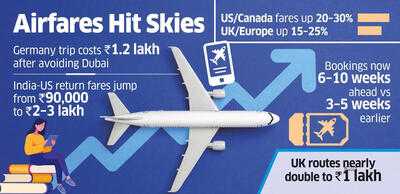 Other estimates point to a slightly more moderate but still significant rise. According to Sanjay Laul, founder of global education marketplace and student recruitment platform MSM Unify, fares to the US and Canada are up 20-30% during peak travel periods, while UK and European routes have risen by 15-25%.
"The current shift has reached a more detectable stage because airports started closing their airspace during the ongoing conflict," he said. The cost escalation is also being compounded by currency pressures. Pavan Kavad, managing director of currency exchange and remittance service provider Prithvi Exchange, said India-US fares that were earlier ₹55,000-₹90,000 have climbed to ₹1.3 lakh- ₹3 lakh, "effectively doubling or tripling the dollar outflow for students." European routes have seen similar jumps, with ticket costs now ranging from ₹1,200 to ₹1,500 for travel alone.
For instance, a Global Reach study-abroad platform spokesperson said a student travelling to Germany last week had to avoid flying through Dubai due to restrictions and ended up paying around ₹1.2 lakh for the ticket. "Most students are paying over Rs 50,000 more than usual," said Aditeya Lochan Singh, university relationships and marketing manager) at Global Reach.
"What we're seeing is not a uniform spike, but a clear reset in pricing across key student corridors," said Saurabh Arora, founder of student housing marketplace, University Living. noting that India-US return fares have jumped from around ₹90,000 to ₹2-3 lakh, while UK routes have nearly doubled to ₹1 lakh on certain dates, he said the increase was being driven more by capacity constraints and longer routes than by demand.
"The current shift has reached a more detectable stage because airports started closing their airspace during the ongoing conflict," he said. The cost escalation is also being compounded by currency pressures. Pavan Kavad, managing director of currency exchange and remittance service provider Prithvi Exchange, said India-US fares that were earlier ₹55,000-₹90,000 have climbed to ₹1.3 lakh- ₹3 lakh, "effectively doubling or tripling the dollar outflow for students." European routes have seen similar jumps, with ticket costs now ranging from ₹1,200 to ₹1,500 for travel alone.
Next Story