
Chandrayaan-3: Vikram’s Small Hop Uncovers Fresh Clues About the Moon’s Surface

A simple but carefully executed “hop” by the Vikram lander from India’s Chandrayaan-3 mission has opened a new window into the Moon’s surface behaviour. What looked like a minor movement has now turned into a major scientific opportunity, giving researchers detailed insights into lunar soil near the south pole.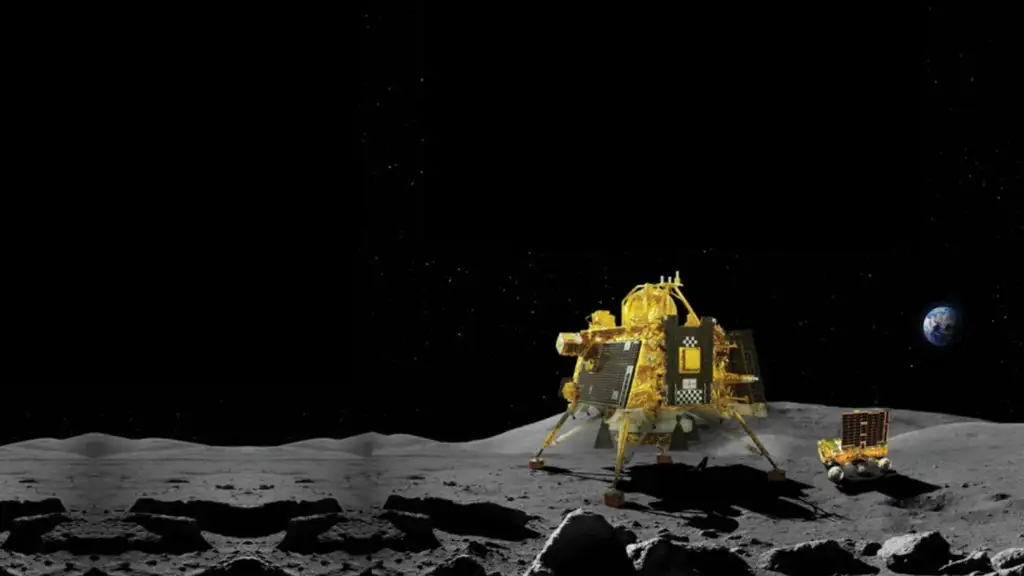
The manoeuvre was performed just before the lander went into sleep mode, and scientists say it has provided rare, close-range data that would have been impossible through stationary observations alone.
A brief lift, a valuable experiment
In the final phase of the mission, ISRO directed Vikram to use its remaining fuel for a controlled engine burn. The lander lifted nearly 40 cm above the lunar surface and then gently touched down about 30 to 40 cm away from its original position.
“During this manoeuvre, which was executed at the end of the mission, the lander utilised residual propellant to briefly ascend and relocate to a nearby location,” the researchers wrote. “After a safe landing at the new location, the lander payloads were redeployed and resumed scientific observations until the lander was set to sleep mode.”
This short movement was not just a technical demonstration. It was also a deliberate scientific experiment designed to study how lunar soil reacts when disturbed by engine thrust and landing forces.
ChaSTE reveals hidden layers beneath the surface
One of the key instruments on board, ChaSTE (Chandra’s Surface Thermophysical Experiment), played a central role in the discovery. It measured surface temperature, subsurface temperature, and thermal conductivity of lunar soil up to a depth of about 10 cm.
The findings are helping scientists better understand the Moon’s thermophysical environment, especially in polar regions where future missions are increasingly focused.
“This layered structure suggests that even shallow depths on the Moon can show significant variation in physical properties,” the researchers noted.
Two distinct layers in lunar soil
Data from ChaSTE and other instruments revealed something unexpected. The top layer of lunar soil, extending up to around 6.5 cm, appears to consist of two different sub-layers.
The upper portion shows higher thermal conductivity, meaning it transfers heat more efficiently. Beneath it lies a slightly less conductive layer, indicating different compaction or material composition.
This discovery suggests that lunar soil is far more complex than previously thought, even at very shallow depths. Such variations could influence how heat moves through the ground and how future landers interact with the surface.
What the hop revealed about lunar dust behavior
The brief lift and repositioning also gave scientists a rare chance to observe how lunar dust, rocks, and soil respond when exposed to engine thrust. The interaction between exhaust energy and surface material provided direct evidence of changes in both thermophysical and geotechnical properties around the landing site.
These observations are especially important because they help simulate real landing conditions for future missions. Engineers can now better understand how the surface behaves during touchdown, lift-off, or movement.
Why this matters for future Moon missions
Experts believe these insights will play a key role in shaping the design of future lunar landers, robotic explorers, and even long-term human habitats. Understanding how the soil behaves under pressure, heat, and movement is critical for safe landings and successful surface operations.
The Chandrayaan-3 “hop” experiment proves that even a small, carefully planned movement on the Moon can deliver high-value scientific data. It also strengthens India’s growing contribution to lunar science and future deep-space exploration efforts, especially in challenging polar regions that may hold clues to water ice and long-term exploration potential.
The manoeuvre was performed just before the lander went into sleep mode, and scientists say it has provided rare, close-range data that would have been impossible through stationary observations alone.
A brief lift, a valuable experiment
In the final phase of the mission, ISRO directed Vikram to use its remaining fuel for a controlled engine burn. The lander lifted nearly 40 cm above the lunar surface and then gently touched down about 30 to 40 cm away from its original position.“During this manoeuvre, which was executed at the end of the mission, the lander utilised residual propellant to briefly ascend and relocate to a nearby location,” the researchers wrote. “After a safe landing at the new location, the lander payloads were redeployed and resumed scientific observations until the lander was set to sleep mode.”
This short movement was not just a technical demonstration. It was also a deliberate scientific experiment designed to study how lunar soil reacts when disturbed by engine thrust and landing forces.
ChaSTE reveals hidden layers beneath the surface
One of the key instruments on board, ChaSTE (Chandra’s Surface Thermophysical Experiment), played a central role in the discovery. It measured surface temperature, subsurface temperature, and thermal conductivity of lunar soil up to a depth of about 10 cm. The findings are helping scientists better understand the Moon’s thermophysical environment, especially in polar regions where future missions are increasingly focused.
“This layered structure suggests that even shallow depths on the Moon can show significant variation in physical properties,” the researchers noted.
Two distinct layers in lunar soil
Data from ChaSTE and other instruments revealed something unexpected. The top layer of lunar soil, extending up to around 6.5 cm, appears to consist of two different sub-layers.The upper portion shows higher thermal conductivity, meaning it transfers heat more efficiently. Beneath it lies a slightly less conductive layer, indicating different compaction or material composition.
This discovery suggests that lunar soil is far more complex than previously thought, even at very shallow depths. Such variations could influence how heat moves through the ground and how future landers interact with the surface.
What the hop revealed about lunar dust behavior
The brief lift and repositioning also gave scientists a rare chance to observe how lunar dust, rocks, and soil respond when exposed to engine thrust. The interaction between exhaust energy and surface material provided direct evidence of changes in both thermophysical and geotechnical properties around the landing site. These observations are especially important because they help simulate real landing conditions for future missions. Engineers can now better understand how the surface behaves during touchdown, lift-off, or movement.
Why this matters for future Moon missions
Experts believe these insights will play a key role in shaping the design of future lunar landers, robotic explorers, and even long-term human habitats. Understanding how the soil behaves under pressure, heat, and movement is critical for safe landings and successful surface operations.The Chandrayaan-3 “hop” experiment proves that even a small, carefully planned movement on the Moon can deliver high-value scientific data. It also strengthens India’s growing contribution to lunar science and future deep-space exploration efforts, especially in challenging polar regions that may hold clues to water ice and long-term exploration potential.
Next Story