
Lok Sabha 2024 Elections: How India's Political Map Changed During BJP's Decade of Dominance Amidst INDIA Bloc Challenge

As the Lok Sabha Elections 2024 unfold, early trends indicate that the Bharatiya Janata Party ( BJP )-led National Democratic Alliance ( NDA ) is on course for another victory, though not without stiff competition from the Congress-led India n National Developmental Inclusive Alliance (INDIA). With vote counting still in progress, the NDA leads with 293 seats, while the INDIA bloc is ahead with 229 seats.
Prominent winners have started to emerge: Home Minister Amit Shah secured his seat in Gandhinagar, Gujarat; HD Kumaraswamy triumphed in Karnataka's Mandya; and Rahul Gandhi won from Raebareli. Additionally, the BJP made a notable breakthrough in Kerala with Suresh Gopi winning in Thrissur.
The election, held across 542 constituencies in seven phases from April 19 to June 1, required any party or coalition to secure at least 272 seats to form the government. The BJP's performance, though slightly less dominant than in 2019 when it won 303 seats, still positions it strongly.
In the 2019 general elections, the Bharatiya Janata Party (BJP) alone secured 303 seats, while the National Democratic Alliance (NDA), which it leads, collectively won 353 seats. The Indian National Congress, the principal opposition party, managed 52 seats, with the United Progressive Alliance (UPA) it spearheads garnering a total of 91 seats.
To counter the political dominance of the BJP, several major opposition parties formed a new coalition called the Indian National Developmental Inclusive Alliance (INDIA bloc) last year. This coalition includes the Congress, Samajwadi Party, Aam Aadmi Party, Rashtriya Janata Dal, Trinamool Congress, Dravida Munnetra Kazhagam, Uddhav Thackeray's Shiv Sena faction, the Sharad Pawar-led Nationalist Congress Party, and the Left parties.
Reflecting on the political landscape over the past decade, a significant transformation can be observed since Narendra Modi first became Prime Minister on May 26, 2014. The swearing-in of PM Modi marked a turning point in Indian politics, heralding a new era of BJP dominance.
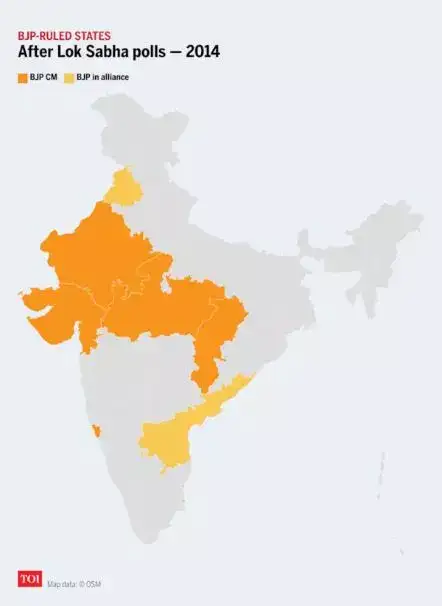
Initially, in 2014, the BJP had governments in 7 states. These included Gujarat, Rajasthan, Madhya Pradesh, Chhattisgarh, and Goa, where the BJP held the chief minister's office, and Andhra Pradesh and Punjab, where it was a junior ally. Today, this number has more than doubled to 15 states and Union Territories, where the BJP is either governing alone or as part of a ruling alliance. These states include Uttar Pradesh, Maharashtra, Madhya Pradesh, Gujarat, Haryana, Uttarakhand, Assam, Tripura, Arunachal Pradesh, Goa, Manipur, Meghalaya, Nagaland, Sikkim, and Puducherry.
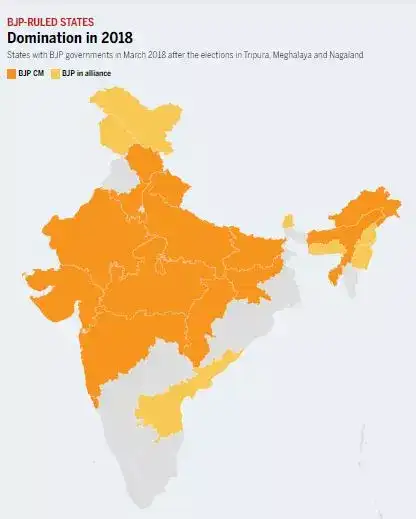
A high point for the BJP came in March 2018, when it was in power in 22 states, showcasing its extensive footprint across the north, east, and west of India. However, the political map shifted later that year when the Congress managed to unseat the BJP in Madhya Pradesh, Rajasthan, and Chhattisgarh.
One of the most notable triumphs for the BJP was its significant victory in Uttar Pradesh. In the 2014 Lok Sabha elections, the party captured 71 out of 80 constituencies, and it solidified this win with a strong performance in the 2017 state elections. PM Modi's leadership was pivotal in this success, and the BJP further cemented its position by retaining power in the 2022 state elections.
The BJP's presence in the northeastern states has been another notable achievement. Before 2014, the party had no significant foothold in this region. However, today, it is part of the government in all northeastern states except Mizoram. The party's rise began with a sweeping victory in the 2016 Assam elections, followed by winning Tripura from Left rule and forging crucial alliances in states like Sikkim, Nagaland, Meghalaya, and Manipur.
Despite its successes, the BJP has faced challenges. In 2018, it suffered a major setback when it lost control of Madhya Pradesh, Rajasthan, and Chhattisgarh to the Congress. Although it later regained Madhya Pradesh, it still needs to reclaim the other heartland states. Furthermore, the BJP has struggled to gain a stronghold in southern India. The 2023 loss in Karnataka left the BJP without a significant presence in the south, and the party remains a minor player in states like Kerala, Tamil Nadu, and Andhra Pradesh.
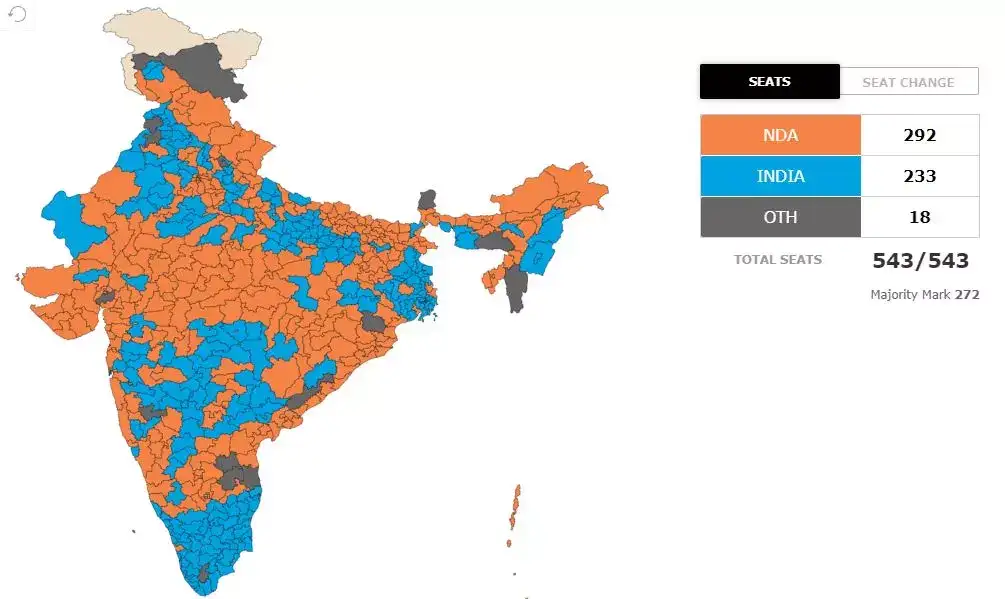
Here, we witness the current dominance of political parties. As the vote counting progresses, the results will reveal whether the BJP can continue its dominance or if the newly formed INDIA bloc will alter the political landscape. The next few days will be crucial in determining the direction of India's governance and its future political trajectory.
Prominent winners have started to emerge: Home Minister Amit Shah secured his seat in Gandhinagar, Gujarat; HD Kumaraswamy triumphed in Karnataka's Mandya; and Rahul Gandhi won from Raebareli. Additionally, the BJP made a notable breakthrough in Kerala with Suresh Gopi winning in Thrissur.
The election, held across 542 constituencies in seven phases from April 19 to June 1, required any party or coalition to secure at least 272 seats to form the government. The BJP's performance, though slightly less dominant than in 2019 when it won 303 seats, still positions it strongly.
In the 2019 general elections, the Bharatiya Janata Party (BJP) alone secured 303 seats, while the National Democratic Alliance (NDA), which it leads, collectively won 353 seats. The Indian National Congress, the principal opposition party, managed 52 seats, with the United Progressive Alliance (UPA) it spearheads garnering a total of 91 seats.
To counter the political dominance of the BJP, several major opposition parties formed a new coalition called the Indian National Developmental Inclusive Alliance (INDIA bloc) last year. This coalition includes the Congress, Samajwadi Party, Aam Aadmi Party, Rashtriya Janata Dal, Trinamool Congress, Dravida Munnetra Kazhagam, Uddhav Thackeray's Shiv Sena faction, the Sharad Pawar-led Nationalist Congress Party, and the Left parties.
You may also like
- "Good memories trouble me the most": Father of Lt Vinay Narwal remembers son on Pahalgam terror attack anniversary
- 2,321 companies of CAPF deployed for Bengal phase 2
- "For acts against India, response is assured," says Indian Army on Pahalgam attack anniversary; recalls Op Sindoor
- Kanpur: Fire breaks out at leather factory in Kanpur's Wajidpur; situation under control
- Rahul rallies in Kolkata, Serampore cancelled as police denies nod
Reflecting on the political landscape over the past decade, a significant transformation can be observed since Narendra Modi first became Prime Minister on May 26, 2014. The swearing-in of PM Modi marked a turning point in Indian politics, heralding a new era of BJP dominance.
Initially, in 2014, the BJP had governments in 7 states. These included Gujarat, Rajasthan, Madhya Pradesh, Chhattisgarh, and Goa, where the BJP held the chief minister's office, and Andhra Pradesh and Punjab, where it was a junior ally. Today, this number has more than doubled to 15 states and Union Territories, where the BJP is either governing alone or as part of a ruling alliance. These states include Uttar Pradesh, Maharashtra, Madhya Pradesh, Gujarat, Haryana, Uttarakhand, Assam, Tripura, Arunachal Pradesh, Goa, Manipur, Meghalaya, Nagaland, Sikkim, and Puducherry.
A high point for the BJP came in March 2018, when it was in power in 22 states, showcasing its extensive footprint across the north, east, and west of India. However, the political map shifted later that year when the Congress managed to unseat the BJP in Madhya Pradesh, Rajasthan, and Chhattisgarh.
One of the most notable triumphs for the BJP was its significant victory in Uttar Pradesh. In the 2014 Lok Sabha elections, the party captured 71 out of 80 constituencies, and it solidified this win with a strong performance in the 2017 state elections. PM Modi's leadership was pivotal in this success, and the BJP further cemented its position by retaining power in the 2022 state elections.
The BJP's presence in the northeastern states has been another notable achievement. Before 2014, the party had no significant foothold in this region. However, today, it is part of the government in all northeastern states except Mizoram. The party's rise began with a sweeping victory in the 2016 Assam elections, followed by winning Tripura from Left rule and forging crucial alliances in states like Sikkim, Nagaland, Meghalaya, and Manipur.
Despite its successes, the BJP has faced challenges. In 2018, it suffered a major setback when it lost control of Madhya Pradesh, Rajasthan, and Chhattisgarh to the Congress. Although it later regained Madhya Pradesh, it still needs to reclaim the other heartland states. Furthermore, the BJP has struggled to gain a stronghold in southern India. The 2023 loss in Karnataka left the BJP without a significant presence in the south, and the party remains a minor player in states like Kerala, Tamil Nadu, and Andhra Pradesh.
Here, we witness the current dominance of political parties. As the vote counting progresses, the results will reveal whether the BJP can continue its dominance or if the newly formed INDIA bloc will alter the political landscape. The next few days will be crucial in determining the direction of India's governance and its future political trajectory.






More from our partners


Loving Newspoint? Download the app now
