
33 Hindu Gods Explained: What the Vedas Really Say


There are few ideas in Indian spiritual thought that are as widely repeated and yet as deeply misunderstood as the idea of “33 Hindu gods.” Many people grow up hearing that Hinduism speaks of 33 crore deities, a number so vast that it almost feels impossible to grasp. Yet when you return to the original Vedic sources, a very different and far more precise picture begins to emerge, one that is not about overwhelming numbers, but about structure, symbolism, and the way ancient thinkers understood the universe itself.
The Origin of the “33 Deities” in Vedic Texts
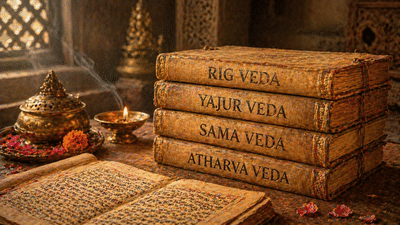 The earliest references to the 33 deities appear in Vedic literature such as the Brihadaranyaka Upanishad and other early texts, where the number is not presented as an endless list of gods, but as a defined grouping. These texts describe thirty-three principal deities who represent fundamental forces of existence, both visible and invisible. This is where one of the biggest misunderstandings begins. The Sanskrit word “koti” used in later interpretations can mean “type” or “category,” not necessarily “crore” in the numerical sense. This means the original idea was not about millions of gods, but about thirty-three fundamental forms or expressions of the divine.
The Structure Behind the 33 Deities
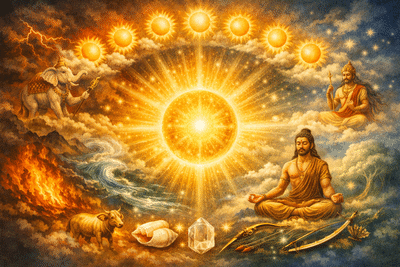
 The Vedic tradition organizes these thirty-three deities into four distinct groups, each representing a different aspect of the cosmos and human experience. These include the eight Vasus, the eleven Rudras, the twelve Adityas, along with Indra and Prajapati.
The eight Vasus are associated with natural elements and physical existence, reflecting the building blocks of the material world. The eleven Rudras are often linked to life force, transformation, and the inner workings of the human being, especially aspects connected to breath, emotion, and change. The twelve Adityas are connected to cosmic order, time, and the movement of the sun, representing the cyclical nature of existence.
Indra, often described as the king of the gods in Vedic literature, represents power, leadership, and the forces that govern the heavens, while Prajapati symbolises creation and the generative principle behind life itself.
Not Just Gods, But Forces of Reality
What makes this concept truly fascinating is that these thirty-three are not simply “gods” in the modern sense of individual personalities. They are better understood as principles, forces, or manifestations of a deeper reality. Vedic thought does not separate the natural world from the divine. Instead, it sees everything, from fire and wind to time and consciousness, as expressions of a single underlying truth. This is why the Vedas often move from many to one. While they describe multiple deities, they also repeatedly point toward a single ultimate reality, often referred to as Brahman. The many forms are not contradictions, but reflections of that one source.
How the Idea Became Misinterpreted Over Time
Over centuries, as language evolved and interpretations spread, the phrase “33 koti devata” began to be understood as “33 crore gods,” especially in popular storytelling and modern retellings. This shift, while culturally widespread, does not reflect the original philosophical meaning found in Vedic texts. This misunderstanding is not entirely accidental. Hindu tradition is vast, layered, and open to multiple interpretations, which means symbolic ideas can sometimes be taken literally. However, when viewed through the lens of the original texts, the emphasis is clearly on categorization and meaning, not numerical exaggeration.
Why This Idea Still Matters Today
The concept of the thirty-three deities is not just an ancient classification system. It reflects a way of thinking that sees unity in diversity, a way of understanding existence that does not reduce reality to a single form, but also does not lose sight of its underlying unity. In a modern world that often separates science, spirituality, and philosophy, this idea feels surprisingly relevant. It suggests that different forces, whether natural, psychological, or cosmic, are interconnected, and that understanding them requires both observation and introspection.
Conclusion: Beyond Numbers, Toward Understanding
So who are the 33 Hindu deities of the Vedas?
They are not a crowd of separate gods competing for attention. They are a structured expression of how ancient Indian thought understood the universe, dividing it into fundamental forces while still pointing toward a single, unified reality. What appears at first to be a number is actually a framework. What seems like mythology is, at its core, philosophy. And perhaps that is the most important truth hidden within this idea. It is not about how many gods exist. It is about how deeply we understand existence itself.
Unlock insightful tips and inspiration on personal growth, productivity, and well-being. Stay motivated and updated with the latest at My Life XP.
The Origin of the “33 Deities” in Vedic Texts
The Structure Behind the 33 Deities
The eight Vasus are associated with natural elements and physical existence, reflecting the building blocks of the material world. The eleven Rudras are often linked to life force, transformation, and the inner workings of the human being, especially aspects connected to breath, emotion, and change. The twelve Adityas are connected to cosmic order, time, and the movement of the sun, representing the cyclical nature of existence.
Indra, often described as the king of the gods in Vedic literature, represents power, leadership, and the forces that govern the heavens, while Prajapati symbolises creation and the generative principle behind life itself.
Not Just Gods, But Forces of Reality
What makes this concept truly fascinating is that these thirty-three are not simply “gods” in the modern sense of individual personalities. They are better understood as principles, forces, or manifestations of a deeper reality. Vedic thought does not separate the natural world from the divine. Instead, it sees everything, from fire and wind to time and consciousness, as expressions of a single underlying truth. This is why the Vedas often move from many to one. While they describe multiple deities, they also repeatedly point toward a single ultimate reality, often referred to as Brahman. The many forms are not contradictions, but reflections of that one source.
How the Idea Became Misinterpreted Over Time
Over centuries, as language evolved and interpretations spread, the phrase “33 koti devata” began to be understood as “33 crore gods,” especially in popular storytelling and modern retellings. This shift, while culturally widespread, does not reflect the original philosophical meaning found in Vedic texts. This misunderstanding is not entirely accidental. Hindu tradition is vast, layered, and open to multiple interpretations, which means symbolic ideas can sometimes be taken literally. However, when viewed through the lens of the original texts, the emphasis is clearly on categorization and meaning, not numerical exaggeration.
Why This Idea Still Matters Today
The concept of the thirty-three deities is not just an ancient classification system. It reflects a way of thinking that sees unity in diversity, a way of understanding existence that does not reduce reality to a single form, but also does not lose sight of its underlying unity. In a modern world that often separates science, spirituality, and philosophy, this idea feels surprisingly relevant. It suggests that different forces, whether natural, psychological, or cosmic, are interconnected, and that understanding them requires both observation and introspection.
Conclusion: Beyond Numbers, Toward Understanding
So who are the 33 Hindu deities of the Vedas?
They are not a crowd of separate gods competing for attention. They are a structured expression of how ancient Indian thought understood the universe, dividing it into fundamental forces while still pointing toward a single, unified reality. What appears at first to be a number is actually a framework. What seems like mythology is, at its core, philosophy. And perhaps that is the most important truth hidden within this idea. It is not about how many gods exist. It is about how deeply we understand existence itself.
Unlock insightful tips and inspiration on personal growth, productivity, and well-being. Stay motivated and updated with the latest at My Life XP.
Next Story