
5 Powerful Temples Where Maa Durga Is Worshipped Without an Idol


We often go to a temple expecting a face, a weapon, a lion, a familiar image of the Goddess. But some shrines do something deeper. They take away the human-shaped idol and leave us standing before fire, stone, eyes, or a form that almost unsettles the mind. That is where worship changes. It stops being only about seeing the Goddess and starts becoming about understanding what power really is. These temples matter because they remind us that Maa Durga is not limited to one image. She appears as energy, instinct, sacrifice, awareness, and creation itself. And that is why these unusual forms stay with people long after darshan is over.
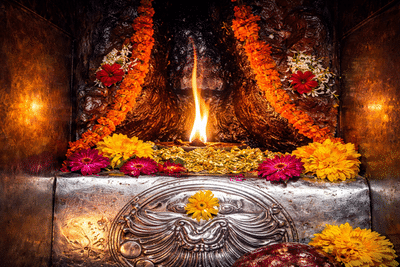
Kamakhya Temple, Assam
At Kamakhya, there is no conventional idol of the Goddess. She is worshipped in the form of a yoni-shaped stone in a cave, kept moist by a natural spring. The temple’s own tradition connects this form with fertility, desire, and the power of creation.
This is not merely symbolism. It is a direct spiritual statement: life begins in the feminine, and the sacred is not separate from the body. In a world that often teaches people to feel shame around natural processes, Kamakhya asks for the opposite. It asks for reverence. It teaches that creation is holy, and that what gives life should never be treated as lesser.
Jwalamukhi Temple, Himachal Pradesh
At Jwalamukhi, there is no idol at all. The Goddess is worshipped as natural flames emerging from the rock, and official descriptions of the shrine emphasize that these jyotis themselves are the object of worship. Fire is one of the most honest symbols in spiritual life. It warms, reveals, purifies, and destroys illusion.
Many people go through periods when life burns away comfort, ego, or certainty. Jwalamukhi gives such moments a sacred meaning. Sometimes destruction is not punishment. Sometimes it is cleansing. Sometimes the Goddess appears not to comfort us first, but to remove what can no longer remain.
Vaishno Devi, Jammu and Kashmir
Inside the holy cave of Vaishno Devi, the Divine Mother is worshipped in the form of three natural pindies, understood by the shrine board as manifestations of Maha Kali, Maha Lakshmi, and Maha Saraswati. This form is powerful because it speaks to a truth everyone lives with: a complete life needs strength, abundance, and wisdom together.
Power without wisdom becomes harsh. Wealth without strength becomes fragile. Knowledge without courage becomes inactive. The three pindies quietly teach balance. The Goddess is not one mood of life. She is the total force needed to live it fully.
Kalimath, Uttarakhand
Kalimath is revered as a powerful goddess shrine where the goddess is worshipped without an idol; instead, a sacred Sri Yantra or covered kund marks her presence. This is perhaps the most difficult lesson of all: not every absence is emptiness. Sometimes what is hidden is being protected.
Sometimes what is unseen is too powerful to be constantly displayed. This applies not just to religion, but to human character. The deepest people are not always the loudest. The strongest love is not always the most performative. The holiest truths are often the least eager to show themselves.
Ambaji Temple, Gujarat
At Ambaji, the goddess is not worshipped through an idol. The central object of reverence is the sacred Shri Yantra, not a visible murti. A yantra is geometry charged with meaning. It tells us that truth is not always emotional or dramatic. Sometimes it is pattern. Alignment. Inner order.
Many human problems begin when life becomes scattered: too much noise, too many wants, too little stillness. Ambaji reminds us that spiritual power is not only in feeling intensely. It is also in becoming inwardly arranged.
Kamakhya Temple, Assam
At Kamakhya, there is no conventional idol of the Goddess. She is worshipped in the form of a yoni-shaped stone in a cave, kept moist by a natural spring. The temple’s own tradition connects this form with fertility, desire, and the power of creation.
This is not merely symbolism. It is a direct spiritual statement: life begins in the feminine, and the sacred is not separate from the body. In a world that often teaches people to feel shame around natural processes, Kamakhya asks for the opposite. It asks for reverence. It teaches that creation is holy, and that what gives life should never be treated as lesser.
Jwalamukhi Temple, Himachal Pradesh
At Jwalamukhi, there is no idol at all. The Goddess is worshipped as natural flames emerging from the rock, and official descriptions of the shrine emphasize that these jyotis themselves are the object of worship. Fire is one of the most honest symbols in spiritual life. It warms, reveals, purifies, and destroys illusion.
Many people go through periods when life burns away comfort, ego, or certainty. Jwalamukhi gives such moments a sacred meaning. Sometimes destruction is not punishment. Sometimes it is cleansing. Sometimes the Goddess appears not to comfort us first, but to remove what can no longer remain.
Vaishno Devi, Jammu and Kashmir
Inside the holy cave of Vaishno Devi, the Divine Mother is worshipped in the form of three natural pindies, understood by the shrine board as manifestations of Maha Kali, Maha Lakshmi, and Maha Saraswati. This form is powerful because it speaks to a truth everyone lives with: a complete life needs strength, abundance, and wisdom together.
Power without wisdom becomes harsh. Wealth without strength becomes fragile. Knowledge without courage becomes inactive. The three pindies quietly teach balance. The Goddess is not one mood of life. She is the total force needed to live it fully.
Kalimath, Uttarakhand
Kalimath is revered as a powerful goddess shrine where the goddess is worshipped without an idol; instead, a sacred Sri Yantra or covered kund marks her presence. This is perhaps the most difficult lesson of all: not every absence is emptiness. Sometimes what is hidden is being protected.
Sometimes what is unseen is too powerful to be constantly displayed. This applies not just to religion, but to human character. The deepest people are not always the loudest. The strongest love is not always the most performative. The holiest truths are often the least eager to show themselves.
Ambaji Temple, Gujarat
At Ambaji, the goddess is not worshipped through an idol. The central object of reverence is the sacred Shri Yantra, not a visible murti. A yantra is geometry charged with meaning. It tells us that truth is not always emotional or dramatic. Sometimes it is pattern. Alignment. Inner order.
Many human problems begin when life becomes scattered: too much noise, too many wants, too little stillness. Ambaji reminds us that spiritual power is not only in feeling intensely. It is also in becoming inwardly arranged.
Next Story