
'Being honest with the story is the only way forward in this world of AI'


A compelling conversation unfolded between actor-writer Dhruv Sehgal and novelist-screenwriter Bilal Siddiqi at the Bengaluru Art Weekend . Moderated by Gurmehar Kaur , the fireside chat steered clear of dramatic plot twists and cinematic spectacle. Instead, it stayed rooted in something far more intimate — the unsaid, the in-between, and the elusive truth that writers spend years trying to capture. What emerged was an honest, often humourous, and deeply reflective exploration of writing today — from finding one’s voice and navigating collaboration to resisting shortcuts and adapting to an ever-evolving industry.
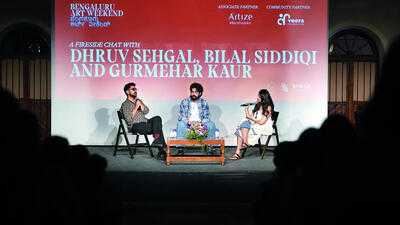
The beauty of storytelling lies in the small things: Dhruv Sehgal
For Dhruv, whose show Little Things became a defining slice-of-life romance, writing has always revolved around one central question: truth. “The inner dialogue is pretty much the same for all my roles — writer, creator, actor. It’s always: what is the truth of this moment? What is it really about?” he says. He explains that while Little Things began as a conscious attempt to embrace subtlety and subtext, it evolved through collaboration — and compromise. “We were trying to say that the everydayness of life is the real life. But you’re constantly steering that ship against many currents. The beauty of storytelling lies in the small things — the quiet joys, the unspoken tensions, the seemingly insignificant moments that shape relationships,” he adds.
Writing differs from medium to medium: Bilal Siddiqi
Bilal Siddiqi, whose work spans novels like The Bard of Blood and screen projects like Ba**ds of Bollywood, approaches storytelling from a genre-driven lens — but arrives at a similar truth. “In a book, you can write entire paragraphs about what a character is thinking without them saying anything. But in a film or show, you need interaction. You have to externalise that. Every genre comes with its own trappings. The only thing that makes it interesting is the characters,” he says.
He is candid about the contrast between writing novels and writing for the screen. “A book is solitary. It’s your voice, your timeline. But a show or film? There are producers, directors, actors… everyone has something to say.” Despite this, he admits he finds screenwriting easier. “You’re only writing what’s necessary. With books, you’re writing so much more," he says.
Each season of Little Things explored a different aspect of love: Dhruv Sehgal
One of the most common assumptions about Little Things is that it is autobiographical. Dhruv clarifies that it isn’t. “It’s not inspired by my life. It’s inspired by the questions in my head. Each season explores a different aspect of love. If something doesn’t fit that theme, it doesn’t make the cut.” His focus, he says, is on making the audience feel seen, explaining, “Even if it’s alienating, the viewer should feel seen. That’s very important to me.”
‘AI has a one-size-fits-all approach’
When the conversation turned to AI, both writers were clear — curious, but cautious. “I used it as a research engine. But now I’ve mostly stopped,” shares Dhruv. His concern runs deeper than usage. “I read scripts now with no mistakes, and I instantly know it’s AI. But what worries me is — how much of it is AI?” He also questions the industry’s attitude. “There’s no shame in not using your mind anymore. That’s a big problem,” he states.
Bilal echoes the sentiment, albeit from a more practical standpoint. “The output is only as good as the input. If you don’t know math, you can’t use a calculator.” For both, the fear isn’t competition, but homogenisation. “It has a one-size-fits-all approach,” Bilal says. “No one wants to see robotic work in art.”
‘Unique voices and stories find their audience’
With shrinking attention spans and evolving audience habits, do writers adapt? “If the market is hot for something I don’t have, I try to adapt. Reinventing yourself is part of the fun,” says Dhruv. Bilal, however, believes audience awareness is inevitable, but shouldn’t dominate the writing process. “If you’re writing for an audience, it will come to mind. But your first draft should be the truest form of your story. I write what I would like to see. If your voice is unique, it will find an audience,” he states.
The beauty of storytelling lies in the small things: Dhruv Sehgal
For Dhruv, whose show Little Things became a defining slice-of-life romance, writing has always revolved around one central question: truth. “The inner dialogue is pretty much the same for all my roles — writer, creator, actor. It’s always: what is the truth of this moment? What is it really about?” he says. He explains that while Little Things began as a conscious attempt to embrace subtlety and subtext, it evolved through collaboration — and compromise. “We were trying to say that the everydayness of life is the real life. But you’re constantly steering that ship against many currents. The beauty of storytelling lies in the small things — the quiet joys, the unspoken tensions, the seemingly insignificant moments that shape relationships,” he adds.
Writing differs from medium to medium: Bilal Siddiqi
Bilal Siddiqi, whose work spans novels like The Bard of Blood and screen projects like Ba**ds of Bollywood, approaches storytelling from a genre-driven lens — but arrives at a similar truth. “In a book, you can write entire paragraphs about what a character is thinking without them saying anything. But in a film or show, you need interaction. You have to externalise that. Every genre comes with its own trappings. The only thing that makes it interesting is the characters,” he says.
Each season of Little Things explored a different aspect of love: Dhruv Sehgal
One of the most common assumptions about Little Things is that it is autobiographical. Dhruv clarifies that it isn’t. “It’s not inspired by my life. It’s inspired by the questions in my head. Each season explores a different aspect of love. If something doesn’t fit that theme, it doesn’t make the cut.” His focus, he says, is on making the audience feel seen, explaining, “Even if it’s alienating, the viewer should feel seen. That’s very important to me.”
‘AI has a one-size-fits-all approach’
When the conversation turned to AI, both writers were clear — curious, but cautious. “I used it as a research engine. But now I’ve mostly stopped,” shares Dhruv. His concern runs deeper than usage. “I read scripts now with no mistakes, and I instantly know it’s AI. But what worries me is — how much of it is AI?” He also questions the industry’s attitude. “There’s no shame in not using your mind anymore. That’s a big problem,” he states.
Bilal echoes the sentiment, albeit from a more practical standpoint. “The output is only as good as the input. If you don’t know math, you can’t use a calculator.” For both, the fear isn’t competition, but homogenisation. “It has a one-size-fits-all approach,” Bilal says. “No one wants to see robotic work in art.”
‘Unique voices and stories find their audience’
With shrinking attention spans and evolving audience habits, do writers adapt? “If the market is hot for something I don’t have, I try to adapt. Reinventing yourself is part of the fun,” says Dhruv. Bilal, however, believes audience awareness is inevitable, but shouldn’t dominate the writing process. “If you’re writing for an audience, it will come to mind. But your first draft should be the truest form of your story. I write what I would like to see. If your voice is unique, it will find an audience,” he states.
Next Story