
Faster Than You Think: How a Chameleon’s Tongue Reaches 60 mph Instantly

Nature is full of surprises, and sometimes the most incredible abilities belong to the smallest creatures. The chameleon, widely known for its colour-changing skin, hides another astonishing talent that often goes unnoticed. Its tongue can shoot out, catch prey, and return in a split second, making it one of the fastest biological movements ever recorded.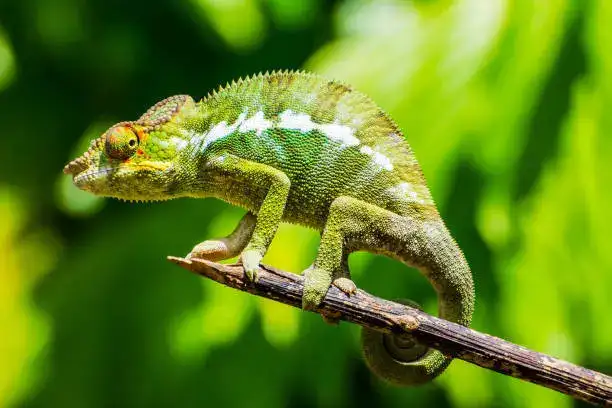
This tiny reptile does not chase its food. Instead, it relies on precision, timing, and an almost unbelievable burst of speed.
A Speed That Defies Imagination
The chameleon’s tongue can accelerate to nearly 60 miles per hour in just 0.01 seconds. This level of speed is remarkable, even when compared to high-performance machines.
Scientists studying this behaviour found that smaller chameleon species can produce extraordinary levels of power during tongue projection. A study published in Current Biology highlighted this unique ability, stating that chameleons are capable of producing “extremely high power output during tongue projection, exceeding that of any known vertebrate muscle.”
This makes the chameleon’s tongue not only one of the fastest movements in nature but also one of the most powerful relative to body size.
The Secret Behind This Lightning-Fast Movement
The real magic lies in the chameleon’s biological design. Unlike humans, who depend mainly on muscle contractions, chameleons use a specialised system that stores and releases energy.
Their tongue works like a natural spring. Elastic tissues inside the tongue build up energy and release it almost instantly. This rapid release propels the tongue forward at incredible speed. This mechanism is known as elastic recoil, a concept widely studied in Biomechanics.
At the tip of the tongue is a sticky, suction-like pad. This helps the chameleon grip its prey firmly the moment contact is made. Once the insect is caught, the tongue retracts just as quickly, pulling the prey back into the mouth.
Why This Speed Is So Important
Insects are fast and highly sensitive to movement. For a predator like the chameleon, speed is essential. A delay of even a fraction of a second could mean missing a meal.
The chameleon’s rapid tongue strike allows it to catch prey before it has a chance to escape. This also means the animal does not need to move much, conserving energy in the process.
This strategy is especially useful in environments where food is not always easy to find. By waiting patiently and striking at the perfect moment, chameleons maximise their chances of success.
Interestingly, smaller chameleons often have even faster tongue projections relative to their size. This gives them a competitive edge, proving that being small does not mean being weak.
A Source of Inspiration for Science
The chameleon’s tongue is not just fascinating for biologists. Engineers and scientists are also studying it to develop new technologies.
By understanding how chameleons store and release energy so efficiently, researchers hope to design faster robotic systems and tools. These could be used in fields ranging from medicine to industrial automation.
The ability to achieve rapid movement without relying solely on motors or heavy machinery could lead to more efficient and innovative designs.
The chameleon’s tongue is far more than a simple feeding tool. It is a highly specialised system built for speed, precision, and efficiency. Reaching up to 60 miles per hour in just 0.01 seconds, it stands among the fastest natural movements known.
This tiny reptile is a powerful reminder that nature often hides its most impressive abilities in the most unexpected places.
This tiny reptile does not chase its food. Instead, it relies on precision, timing, and an almost unbelievable burst of speed.
A Speed That Defies Imagination
The chameleon’s tongue can accelerate to nearly 60 miles per hour in just 0.01 seconds. This level of speed is remarkable, even when compared to high-performance machines.Scientists studying this behaviour found that smaller chameleon species can produce extraordinary levels of power during tongue projection. A study published in Current Biology highlighted this unique ability, stating that chameleons are capable of producing “extremely high power output during tongue projection, exceeding that of any known vertebrate muscle.”
This makes the chameleon’s tongue not only one of the fastest movements in nature but also one of the most powerful relative to body size.
The Secret Behind This Lightning-Fast Movement
The real magic lies in the chameleon’s biological design. Unlike humans, who depend mainly on muscle contractions, chameleons use a specialised system that stores and releases energy. Their tongue works like a natural spring. Elastic tissues inside the tongue build up energy and release it almost instantly. This rapid release propels the tongue forward at incredible speed. This mechanism is known as elastic recoil, a concept widely studied in Biomechanics.
At the tip of the tongue is a sticky, suction-like pad. This helps the chameleon grip its prey firmly the moment contact is made. Once the insect is caught, the tongue retracts just as quickly, pulling the prey back into the mouth.
Why This Speed Is So Important
Insects are fast and highly sensitive to movement. For a predator like the chameleon, speed is essential. A delay of even a fraction of a second could mean missing a meal.The chameleon’s rapid tongue strike allows it to catch prey before it has a chance to escape. This also means the animal does not need to move much, conserving energy in the process.
This strategy is especially useful in environments where food is not always easy to find. By waiting patiently and striking at the perfect moment, chameleons maximise their chances of success.
Interestingly, smaller chameleons often have even faster tongue projections relative to their size. This gives them a competitive edge, proving that being small does not mean being weak.
A Source of Inspiration for Science
The chameleon’s tongue is not just fascinating for biologists. Engineers and scientists are also studying it to develop new technologies. By understanding how chameleons store and release energy so efficiently, researchers hope to design faster robotic systems and tools. These could be used in fields ranging from medicine to industrial automation.
The ability to achieve rapid movement without relying solely on motors or heavy machinery could lead to more efficient and innovative designs.
The chameleon’s tongue is far more than a simple feeding tool. It is a highly specialised system built for speed, precision, and efficiency. Reaching up to 60 miles per hour in just 0.01 seconds, it stands among the fastest natural movements known.
This tiny reptile is a powerful reminder that nature often hides its most impressive abilities in the most unexpected places.
Next Story