
From courts to catwalks: Traditional angrakha gets a modern flair


Angrakha is a voluminous, tunic-like garment. Derived from the Sanskrit word angaraksha, meaning body protector, the angrakha traces its origin to the Mughal era. Peshwas, Rajputs and Mughal emperors wore this garment as a practical attire for movement and modesty.
It is a flowing, tunic-like garment defined by its distinctive cross-over front, secured with ties at the shoulder or waist. It usually has a shaped upper panel, called the purdah, that adds structure and detail to the outfit.
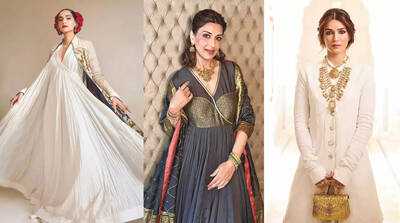
EVERY REGION HAS ITS OWN STYLE
While the core tailoring of the silhouette largely stays the same, its design and detailing vary across regions. Rahul Khanna, fashion designer, tells us, “Each region has given the angrakha its own personality. In Rajasthan and Gujarat, it was shorter, lighter, and more practical, ideal for the heat and ease of movement. In northern India, it became longer and more fluid.”
Madhuri Singh, a celebrity fashion stylist, adds, “In Eastern India, angrakhas were crafted from fine silks, adorned with local techniques like Kantha embroidery. In the southern states, the silhouette often incorporated rich silks, gold threadwork, and temple-inspired motifs. While Tamil Nadu and Kerala favoured opulent silk versions, Karnataka and Andhra Pradesh leaned toward lighter cottons and linens in vibrant hues and geometric designs. The Deccan region’s angrakha used luxurious textiles like mashru a unique silk-and-cotton weave prized for both comfort and sheen.”
INDIAN DESIGNERS & CINEMA REVIVE THE TIMELESS ATTIRE
This traditional tunic has made its way on fashion runways and red carpets. Designers like Anamika Khanna and Abu Jani Sandeep Khosla have presented this rooted craft on a global stage. At the recently concluded London Fashion Week, Khanna featured an angrakha in her collection. Additionally, Abu Jani Sandeep Khosla showcased their reimagination of the angrakha when Tabu donned their beautiful crushed-silk silhouette at the premiere of Dune: Prophecy in New York.
Nishtha Parwani, celebrity fashion stylist, says, “Couturiers and fashion designers like Rohit Bal, Abu Jani and Tarun Tahiliani have also experimented with the attire in their own way using dramatic embellishments and intricate prints, traditional fabrics and embroidery, fluid drapes, metallic threads, and asymmetrical hems, blending traditional Indian sensibilities with modern silhouettes.”
Period cinema like Bajirao Mastani, Padmavat, Jodha Akbar, and Panipat are prominent examples of how costume designers have played a key role in preserving the timeless allure of one of India’s oldest silhouettes. Parwani adds, “Celebrities and social influencers wearing them off-duty have further normalised it as a chic alternative.”
MODERN ANGRAKHA IS GENDER FLUID
Originally a male garment, this traditional silhouette is now gender fluid. Khanna says, “The silhouette’s easy wrap and natural drape make it inherently gender-neutral. Both men and women are drawn to it due to its comfort and versatility; it allows for expression without boundaries.”
According to Mitali Ambekar, a celebrity stylist, angarkha’s transformation into gender-fluid attire is also part of a broader trend toward androgyny in fashion – blurring the lines between traditionally male and female clothing. It focuses on style and expression over gender.
ENDLESS DESIGN POSSIBILITIES
The contemporary angarkha explorations are exciting. Chandan Allen, fashion designer and founder of a luxury clothing brand, says, “Designers are reinterpreting the outfit’s core elements for modern life. I’ve experimented with cropped, jacket-style versions, floor-length evening silhouettes, and everything in between.”
Singh takes us deeper into the various fabrics that an angrakha comes in, which makes it wearable for almost every occasion. She says, "Cotton remains the most widely used fabric for its breathability. Linen offers a crisp, airy alternative for summer, while khadi lends an earthy, traditional charm. Modern versions also incorporate rayon, silk, brocade, velvet, georgette, chiffon, and organza, each giving the silhouette a unique look.”
TIPS TO ADD IT TO YOUR WARDROBE
For evening or more formal events, play with textures and accessories like metallic threads, embroidered borders, or statement jewellery like oversized earrings or stacked bangles (As suggested by Mitali Ambekar & Nishtha Parwani)
It is a flowing, tunic-like garment defined by its distinctive cross-over front, secured with ties at the shoulder or waist. It usually has a shaped upper panel, called the purdah, that adds structure and detail to the outfit.
EVERY REGION HAS ITS OWN STYLE
While the core tailoring of the silhouette largely stays the same, its design and detailing vary across regions. Rahul Khanna, fashion designer, tells us, “Each region has given the angrakha its own personality. In Rajasthan and Gujarat, it was shorter, lighter, and more practical, ideal for the heat and ease of movement. In northern India, it became longer and more fluid.”
Madhuri Singh, a celebrity fashion stylist, adds, “In Eastern India, angrakhas were crafted from fine silks, adorned with local techniques like Kantha embroidery. In the southern states, the silhouette often incorporated rich silks, gold threadwork, and temple-inspired motifs. While Tamil Nadu and Kerala favoured opulent silk versions, Karnataka and Andhra Pradesh leaned toward lighter cottons and linens in vibrant hues and geometric designs. The Deccan region’s angrakha used luxurious textiles like mashru a unique silk-and-cotton weave prized for both comfort and sheen.”
INDIAN DESIGNERS & CINEMA REVIVE THE TIMELESS ATTIRE
This traditional tunic has made its way on fashion runways and red carpets. Designers like Anamika Khanna and Abu Jani Sandeep Khosla have presented this rooted craft on a global stage. At the recently concluded London Fashion Week, Khanna featured an angrakha in her collection. Additionally, Abu Jani Sandeep Khosla showcased their reimagination of the angrakha when Tabu donned their beautiful crushed-silk silhouette at the premiere of Dune: Prophecy in New York.
Nishtha Parwani, celebrity fashion stylist, says, “Couturiers and fashion designers like Rohit Bal, Abu Jani and Tarun Tahiliani have also experimented with the attire in their own way using dramatic embellishments and intricate prints, traditional fabrics and embroidery, fluid drapes, metallic threads, and asymmetrical hems, blending traditional Indian sensibilities with modern silhouettes.”
Period cinema like Bajirao Mastani, Padmavat, Jodha Akbar, and Panipat are prominent examples of how costume designers have played a key role in preserving the timeless allure of one of India’s oldest silhouettes. Parwani adds, “Celebrities and social influencers wearing them off-duty have further normalised it as a chic alternative.”
MODERN ANGRAKHA IS GENDER FLUID
According to Mitali Ambekar, a celebrity stylist, angarkha’s transformation into gender-fluid attire is also part of a broader trend toward androgyny in fashion – blurring the lines between traditionally male and female clothing. It focuses on style and expression over gender.
ENDLESS DESIGN POSSIBILITIES
The contemporary angarkha explorations are exciting. Chandan Allen, fashion designer and founder of a luxury clothing brand, says, “Designers are reinterpreting the outfit’s core elements for modern life. I’ve experimented with cropped, jacket-style versions, floor-length evening silhouettes, and everything in between.”
Singh takes us deeper into the various fabrics that an angrakha comes in, which makes it wearable for almost every occasion. She says, "Cotton remains the most widely used fabric for its breathability. Linen offers a crisp, airy alternative for summer, while khadi lends an earthy, traditional charm. Modern versions also incorporate rayon, silk, brocade, velvet, georgette, chiffon, and organza, each giving the silhouette a unique look.”
TIPS TO ADD IT TO YOUR WARDROBE
- You can pair a cropped angrakha with parallel/ flared pants to create a chic silhouette
- Pair a floor-length open angrakha over a full-length dress to create a layered look
- Combine a sheer, embroidered angrakha over a tube top paired with pencil pants to get a modern yet polished vibe
- An angrakha-style cropped blouse paired with a saree is a unique way to style the garment
- Pair a crisp linen or cotton angarkha with tapered trousers for a smart office look
- Wear a lighter silk version over a midi dress for a casual brunch. Adding a simple belt or contrasting footwear instantly elevates the ensemble
Next Story