
How do snakes 'stand' upright nearly stick-straight: The science behind the gravity-defying trick


On the surface, it would be considered counterintuitive for an animal such as a snake to stand upright since the snake lacks any limbs to help it maintain balance. In addition to this, snakes do not have a stiff skeletal system, which further complicates understanding how snakes can defy gravity. This unique behaviour remained unexplained by scientists for decades. Nevertheless, some recent studies that incorporate knowledge from the fields of biology, physics, and math have started to shed light on this unique trait. The process by which snakes stand upright requires much more than just strength.
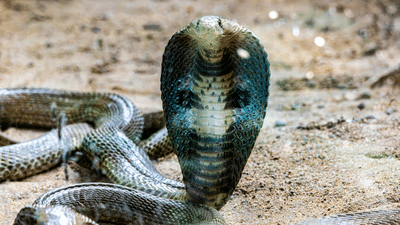
Snake upright posture : Not strength, but smart muscle control
The most interesting thing discovered about these reptiles is that they do not exert themselves using all parts of their body but focus on only one small part. According to the scientists, muscular activity is concentrated at the bottom part of the body, where snakes make contact with a surface and push off from there.
This phenomenon forms a “boundary layer” in which most of the work takes place. In the rest of the body, above this area, snakes keep almost straight and vertical without having to make many muscular efforts.
The study “ Postural control in an upright snake,” shows how snakes save energy because they do not need to tense their whole bodies. They only focus on controlling the essential part of their body to maintain stability and balance. This approach enables some species to lift up 70 percent of their bodies vertically.
Physics of snake movement: How they defy gravity
This trick, however, also works thanks to the laws of physics more than anything else. In cases when the snake forms a near-vertical angle, its weight is no longer enough to keep it on the ground. As a result, the head does not require additional muscles to remain above the surface.
From the ‘ mechanics of slithering locomotion’, it’s known that all snakes are nothing more than "muscular ropes" that can create fantastic positions. However, it all happens based on a specific principle – less tension leads to the lesser possibility of breaking down.
To accomplish such an objective, snakes tend to bend in an S-shape close to their lower end while stretching out the rest of the body upward. The snake then resembles an optimal structure of any engineering solution.
Nevertheless, keeping the posture erect turns out to be a lot harder than simply standing straight. Staying upright requires continuous balance adjustments, resulting in a slight wobbling movement observed in some of these reptiles.
New research on snakes: Insights from biology and robotics
The most recent discoveries are from joint studies that appeared in the Journal of the Royal Society Interface. Scientists from biology, physics, and engineering collaborated on this study.
They conducted experiments using animals such as brown tree snakes and scrub pythons to see how they crossed distances between two raised platforms. By analysing their actions, biologists came up with mathematical equations explaining the behaviour of the snake as an "active elastic filament,” a soft object that can feel and react to its surroundings.
As described by scientists, the combination of muscular activation and proprioception allows the snake to solve complicated balancing problems without relying on any solid support.
However, apart from adding to our knowledge of biology, such a new finding also holds value for engineers incorporating snake-inspired robots capable of navigating complex environments, including disaster sites and even outer space.
In other words, balancing itself like a snake does not require just brute strength but rather optimal expenditure of energy.
Snake upright posture : Not strength, but smart muscle control
The most interesting thing discovered about these reptiles is that they do not exert themselves using all parts of their body but focus on only one small part. According to the scientists, muscular activity is concentrated at the bottom part of the body, where snakes make contact with a surface and push off from there.
This phenomenon forms a “boundary layer” in which most of the work takes place. In the rest of the body, above this area, snakes keep almost straight and vertical without having to make many muscular efforts.
The study “ Postural control in an upright snake,” shows how snakes save energy because they do not need to tense their whole bodies. They only focus on controlling the essential part of their body to maintain stability and balance. This approach enables some species to lift up 70 percent of their bodies vertically.
Physics of snake movement: How they defy gravity
This trick, however, also works thanks to the laws of physics more than anything else. In cases when the snake forms a near-vertical angle, its weight is no longer enough to keep it on the ground. As a result, the head does not require additional muscles to remain above the surface.
From the ‘ mechanics of slithering locomotion’, it’s known that all snakes are nothing more than "muscular ropes" that can create fantastic positions. However, it all happens based on a specific principle – less tension leads to the lesser possibility of breaking down.
To accomplish such an objective, snakes tend to bend in an S-shape close to their lower end while stretching out the rest of the body upward. The snake then resembles an optimal structure of any engineering solution.
Nevertheless, keeping the posture erect turns out to be a lot harder than simply standing straight. Staying upright requires continuous balance adjustments, resulting in a slight wobbling movement observed in some of these reptiles.
New research on snakes: Insights from biology and robotics
The most recent discoveries are from joint studies that appeared in the Journal of the Royal Society Interface. Scientists from biology, physics, and engineering collaborated on this study.
They conducted experiments using animals such as brown tree snakes and scrub pythons to see how they crossed distances between two raised platforms. By analysing their actions, biologists came up with mathematical equations explaining the behaviour of the snake as an "active elastic filament,” a soft object that can feel and react to its surroundings.
As described by scientists, the combination of muscular activation and proprioception allows the snake to solve complicated balancing problems without relying on any solid support.
However, apart from adding to our knowledge of biology, such a new finding also holds value for engineers incorporating snake-inspired robots capable of navigating complex environments, including disaster sites and even outer space.
Next Story