
Meet Ron Garan: NASA astronaut who saw humanity's 'lie' on Earth after 178 days in space


Astronauts leave everything back home to take up space missions, remain in space stations, conduct research, and gaze at the blue gem we live on.
But for one astronaut, days aboard the International Space Station weren't just a mission; they flipped his worldview upside down, seeing wonders like lightning flashes and auroras up close. It's the kind of experience that hits you hard, making borders vanish and problems look tiny from afar.
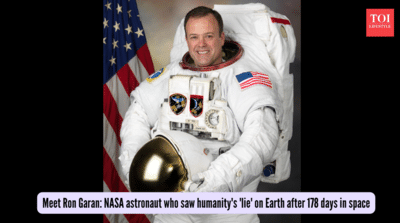
Ron Garan , a former NASA astronaut , calls it the " Overview Effect ," a mind-shift astronauts often describe, revealing how fragile our planet really is.
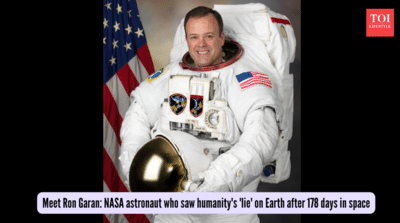 Ron Garan: The ex-NASA astronaut
Ron Garan, a retired NASA astronaut and US Air Force colonel, spent a total of 178 days in space across missions, including nearly six months on the International Space Station (ISS) during Expedition 27/28 in 2011. Launched on April 4 aboard Soyuz TMA-21 from Kazakhstan, he logged 2,842 orbits, making it to over 71 million miles before returning September 16, according to NASA's mission records.
From the ISS window, Garan witnessed Earth's delicate beauty. Speaking to Big Think, he shared, "When we see our planet from the perspective of space, certain things become undeniably clear. We keep trying to deal with issues such as global warming, deforestation, biodiversity loss as stand-alone issues, when in reality they're just symptoms of the underlying root problem. The problem is that we don't see ourselves as planetary."
The "Overview Effect" profoundly impacted him
He saw natural phenomena happening on Earth from space, sharing about which he said, "I saw paparazzi-like flashes of lightning storms, I saw dancing curtains of auroras that seemed so close it was as if we could reach out and touch them, and I saw the unbelievable thinness of our planet's atmosphere," Garan explained. He realised our life-supporting biosphere is a "paper-thin layer."
He says we’re living in a ‘lie’ - but why?
He said in his Think Big interview, "I didn't see the economy. But since our human-made systems treat everything, including the very life-support systems of our planet, as the wholly owned subsidiary of the global economy, it's obvious from the vantage point of space that we're living a lie." Meaning, how we prioritize profit over planetary health.
Post-mission, Garan advocates for change
In that same discussion, he wrapped up by saying, "We're not going to have peace on Earth until we recognise the basic fact of the interrelated structure of all reality." Garan now focuses on building a cleaner, safer, and more peaceful planet by prioritising "planet, society, economy."
But for one astronaut, days aboard the International Space Station weren't just a mission; they flipped his worldview upside down, seeing wonders like lightning flashes and auroras up close. It's the kind of experience that hits you hard, making borders vanish and problems look tiny from afar.
Ron Garan , a former NASA astronaut , calls it the " Overview Effect ," a mind-shift astronauts often describe, revealing how fragile our planet really is.
Ron Garan, a retired NASA astronaut and US Air Force colonel, spent a total of 178 days in space across missions, including nearly six months on the International Space Station (ISS) during Expedition 27/28 in 2011. Launched on April 4 aboard Soyuz TMA-21 from Kazakhstan, he logged 2,842 orbits, making it to over 71 million miles before returning September 16, according to NASA's mission records.
From the ISS window, Garan witnessed Earth's delicate beauty. Speaking to Big Think, he shared, "When we see our planet from the perspective of space, certain things become undeniably clear. We keep trying to deal with issues such as global warming, deforestation, biodiversity loss as stand-alone issues, when in reality they're just symptoms of the underlying root problem. The problem is that we don't see ourselves as planetary."
The "Overview Effect" profoundly impacted him
He saw natural phenomena happening on Earth from space, sharing about which he said, "I saw paparazzi-like flashes of lightning storms, I saw dancing curtains of auroras that seemed so close it was as if we could reach out and touch them, and I saw the unbelievable thinness of our planet's atmosphere," Garan explained. He realised our life-supporting biosphere is a "paper-thin layer."
He says we’re living in a ‘lie’ - but why?
He said in his Think Big interview, "I didn't see the economy. But since our human-made systems treat everything, including the very life-support systems of our planet, as the wholly owned subsidiary of the global economy, it's obvious from the vantage point of space that we're living a lie." Meaning, how we prioritize profit over planetary health.
Post-mission, Garan advocates for change
In that same discussion, he wrapped up by saying, "We're not going to have peace on Earth until we recognise the basic fact of the interrelated structure of all reality." Garan now focuses on building a cleaner, safer, and more peaceful planet by prioritising "planet, society, economy."
Next Story