
No Brain, No Bones, But Highly Dangerous: Inside the World’s 120-Foot Jellyfish

Deep beneath the ocean’s surface drifts a creature that seems almost unreal. The Lion’s Mane jellyfish, scientifically known as Cyanea capillata, holds the title of the largest jellyfish in the world and is among the longest animals ever recorded. What makes it even more fascinating is that it survives and thrives without a brain or bones.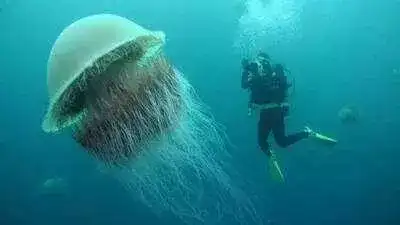
A Giant That Thinks Without a Brain
Unlike most living creatures, the Lion’s Mane jellyfish does not have a central brain or a defined nervous system. Instead, it uses a decentralised nerve network spread across its entire body. This allows it to detect light, movement, and chemical changes in the surrounding water.
Rather than relying on a single control centre, its body works as a whole. Signals travel through this nerve net, helping it coordinate movement and respond to its environment. Its soft, jelly-like body is supported by internal pressure, acting as a natural structure that replaces bones.
Massive in Size and Reach
The scale of this jellyfish is truly remarkable. Its bell, the umbrella-shaped body, can grow wider than 2 meters. But the real spectacle lies in its tentacles.
These thin, trailing strands can extend up to 36.6 meters or about 120 feet. To put this into perspective, some of its tentacles can stretch longer than a Blue Whale, which is widely known as the largest animal on Earth. This incredible reach allows the jellyfish to dominate a large area of water without needing to move much.
The Iconic Flowing Mane
The name “Lion’s Mane” comes from its striking appearance. Its tentacles cluster together in thick, flowing groups that resemble a lion’s mane drifting in the water. This “mane” is not hair, but a complex arrangement of around 1,200 fine tentacles.
These tentacles are grouped into eight distinct clusters and are extremely thin, often just half a millimetre wide. When fully extended, they create a dense, curtain-like structure that gives the jellyfish its signature look and also plays a key role in its survival.
A Patient and Efficient Hunter
Despite lacking a brain, the Lion’s Mane jellyfish is a highly effective predator. It does not chase its prey. Instead, it depends on its sheer size and the reach of its tentacles.
Each tentacle is covered with specialised stinging cells that release venom on contact. When fish or smaller jellyfish brush against them, these cells fire instantly, injecting toxins that paralyse the prey.
Once immobilised, the prey is slowly guided toward the jellyfish’s mouth located beneath its bell. This method allows the jellyfish to feed without actively hunting, relying instead on a passive but highly efficient trap.
Survival Through Simplicity
The Lion’s Mane jellyfish challenges the way we think about survival in the animal kingdom. Without a brain to process thoughts or bones to provide structure, it still manages to sense its surroundings, capture food, and navigate ocean currents.
Its design is simple, yet incredibly effective. By spreading its sensory system across its body and using its tentacles as both a defence and a hunting tool, it thrives in environments where more complex creatures might struggle.
A True Ocean Wonder
The Lion’s Mane jellyfish is more than just a record holder for size. It is a reminder of how diverse and surprising life in the ocean can be. With its flowing tentacles, silent movement, and unusual biology, it stands out as one of the most extraordinary creatures beneath the waves.
In a world where brains and bones are often seen as essential, this giant drifting predator proves that nature has many different ways to create something powerful.
A Giant That Thinks Without a Brain
Unlike most living creatures, the Lion’s Mane jellyfish does not have a central brain or a defined nervous system. Instead, it uses a decentralised nerve network spread across its entire body. This allows it to detect light, movement, and chemical changes in the surrounding water. Rather than relying on a single control centre, its body works as a whole. Signals travel through this nerve net, helping it coordinate movement and respond to its environment. Its soft, jelly-like body is supported by internal pressure, acting as a natural structure that replaces bones.
Massive in Size and Reach
The scale of this jellyfish is truly remarkable. Its bell, the umbrella-shaped body, can grow wider than 2 meters. But the real spectacle lies in its tentacles. These thin, trailing strands can extend up to 36.6 meters or about 120 feet. To put this into perspective, some of its tentacles can stretch longer than a Blue Whale, which is widely known as the largest animal on Earth. This incredible reach allows the jellyfish to dominate a large area of water without needing to move much.
You may also like
The Iconic Flowing Mane
The name “Lion’s Mane” comes from its striking appearance. Its tentacles cluster together in thick, flowing groups that resemble a lion’s mane drifting in the water. This “mane” is not hair, but a complex arrangement of around 1,200 fine tentacles. These tentacles are grouped into eight distinct clusters and are extremely thin, often just half a millimetre wide. When fully extended, they create a dense, curtain-like structure that gives the jellyfish its signature look and also plays a key role in its survival.
A Patient and Efficient Hunter
Despite lacking a brain, the Lion’s Mane jellyfish is a highly effective predator. It does not chase its prey. Instead, it depends on its sheer size and the reach of its tentacles. Each tentacle is covered with specialised stinging cells that release venom on contact. When fish or smaller jellyfish brush against them, these cells fire instantly, injecting toxins that paralyse the prey.
Once immobilised, the prey is slowly guided toward the jellyfish’s mouth located beneath its bell. This method allows the jellyfish to feed without actively hunting, relying instead on a passive but highly efficient trap.
Survival Through Simplicity
The Lion’s Mane jellyfish challenges the way we think about survival in the animal kingdom. Without a brain to process thoughts or bones to provide structure, it still manages to sense its surroundings, capture food, and navigate ocean currents. Its design is simple, yet incredibly effective. By spreading its sensory system across its body and using its tentacles as both a defence and a hunting tool, it thrives in environments where more complex creatures might struggle.
A True Ocean Wonder
The Lion’s Mane jellyfish is more than just a record holder for size. It is a reminder of how diverse and surprising life in the ocean can be. With its flowing tentacles, silent movement, and unusual biology, it stands out as one of the most extraordinary creatures beneath the waves. In a world where brains and bones are often seen as essential, this giant drifting predator proves that nature has many different ways to create something powerful.






More from our partners


Loving Newspoint? Download the app now
