
Real life 'Stranger Things'? Scientists ditch concrete for breathing 3D-printed 'living walls' that grow and heal


Picture this: Walls that don't just stand still, they grow, breathe, and fix their own cracks like living skin, while this looks like a scene out of ‘Stranger Things’, where gothic vines grow, breathe, make ways, and repair themselves.
Scientists have developed a material that integrates 3D printing with cyanobacteria , turning structures into carbon-sucking powerhouses that survive on sunlight.
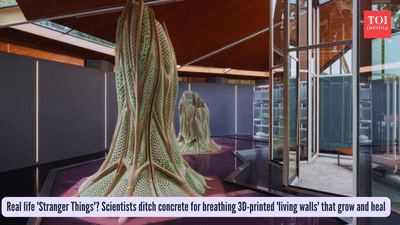
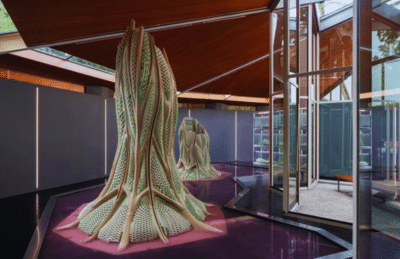
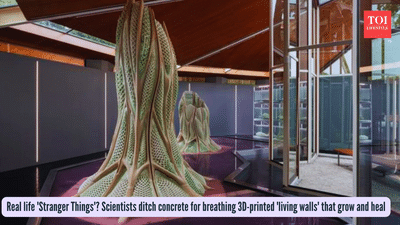 Scientists debut ‘ living walls '
At the 2025 Venice Architecture Biennale's Canada Pavilion, Picoplanktonics, that has an ecology-first design ethos wowed visitors with 3D-printed walls alive with cyanobacteria, needing daily light, humidity, and temperature care to survive, according to ArchDaily. Opened by the Canada Council for the Arts, it ran until November 23, 2025, as "the largest architectural structure made from living materials," with forms hosting microbes for carbon sequestration .
Developed over four years by the Living Room Collective, led by biodesigner Andrea Shin Ling, this was no static display but a test of living systems over inert ones.
How does the ‘living wall’ survive?
On April 23, 2025, a Nature Communications paper explained how an ETH Zurich team, led by Dalia Dranseike, Yifan Cui, and Mark W. Tibbitt, with contributions from Andrea S. Ling and Benjamin Dillenburger, embedded Synechococcus sp. PCC 7002 cyanobacteria into a 3D-printable F127-BUM hydrogel.
Over 400 days, this living material captured 26 ± 7 milligrams of CO₂ per gram of hydrogel through photosynthesis and microbially induced carbonate precipitation (MICP), a big jump from the initial 2.2 ± 0.9 mg/g.
Samples greened up, gained 36% more dry mass than controls after 30 days, and formed strengthening minerals. "The living material sequestered 2.2 ± 0.9 milligrams of CO₂ per gram of hydrogel," initially, the paper noted, with most carbon locked stably.
The method uses smart design tricks
The hydrogel transmitted 76 ± 3% visible light (400-750 nm), letting cyanobacteria photosynthesize deep inside, not just surfaces. Optimal at 5 mm thick, lattice and coral-inspired shapes boosted volume by 150% while keeping cells viable, similar to Picoplanktonics' Venice forms for light and flow.
Lattices stayed green for 365 days, retaining mineralised shapes post-dissolution.
How can it be put to use in the real world?
Unlike fast industrial capture, this runs ambiently on sunlight and air, skipping urea or ammonia waste from other methods. Carbonates reinforced the material over time, meaning that it might be self-healing buildings that harden with age.
Picoplanktonics bridged the lab to life-size, proving scalability. As the authors wrote, "biological sequestration is slower than many industrial carbon-capture systems, but it works under ambient conditions".
Scientists have developed a material that integrates 3D printing with cyanobacteria , turning structures into carbon-sucking powerhouses that survive on sunlight.
At the 2025 Venice Architecture Biennale's Canada Pavilion, Picoplanktonics, that has an ecology-first design ethos wowed visitors with 3D-printed walls alive with cyanobacteria, needing daily light, humidity, and temperature care to survive, according to ArchDaily. Opened by the Canada Council for the Arts, it ran until November 23, 2025, as "the largest architectural structure made from living materials," with forms hosting microbes for carbon sequestration .
Developed over four years by the Living Room Collective, led by biodesigner Andrea Shin Ling, this was no static display but a test of living systems over inert ones.
How does the ‘living wall’ survive?
On April 23, 2025, a Nature Communications paper explained how an ETH Zurich team, led by Dalia Dranseike, Yifan Cui, and Mark W. Tibbitt, with contributions from Andrea S. Ling and Benjamin Dillenburger, embedded Synechococcus sp. PCC 7002 cyanobacteria into a 3D-printable F127-BUM hydrogel.
Over 400 days, this living material captured 26 ± 7 milligrams of CO₂ per gram of hydrogel through photosynthesis and microbially induced carbonate precipitation (MICP), a big jump from the initial 2.2 ± 0.9 mg/g.
Samples greened up, gained 36% more dry mass than controls after 30 days, and formed strengthening minerals. "The living material sequestered 2.2 ± 0.9 milligrams of CO₂ per gram of hydrogel," initially, the paper noted, with most carbon locked stably.
The method uses smart design tricks
The hydrogel transmitted 76 ± 3% visible light (400-750 nm), letting cyanobacteria photosynthesize deep inside, not just surfaces. Optimal at 5 mm thick, lattice and coral-inspired shapes boosted volume by 150% while keeping cells viable, similar to Picoplanktonics' Venice forms for light and flow.
Lattices stayed green for 365 days, retaining mineralised shapes post-dissolution.
How can it be put to use in the real world?
Unlike fast industrial capture, this runs ambiently on sunlight and air, skipping urea or ammonia waste from other methods. Carbonates reinforced the material over time, meaning that it might be self-healing buildings that harden with age.
Picoplanktonics bridged the lab to life-size, proving scalability. As the authors wrote, "biological sequestration is slower than many industrial carbon-capture systems, but it works under ambient conditions".
Next Story