
'Sir, You're the Education Minister': Girl's Bold Reply to Speak in Hindi Demand Goes Viral


A video clip from a public event in Rajasthan is capturing widespread attention on social media after a school student delivered a poised and memorable reply to the state’s Education Minister. The exchange, initially about school conditions, quickly turned into a moment that has sparked online applause and debate.
The incident unfolded when the young girl stood up to speak about the poor infrastructure and quality of learning in government schools. She began her remarks in English, outlining key concerns about classroom conditions and the state of education. Just seconds into her speech, the Education Minister interrupted her and asked her to speak in Hindi instead.
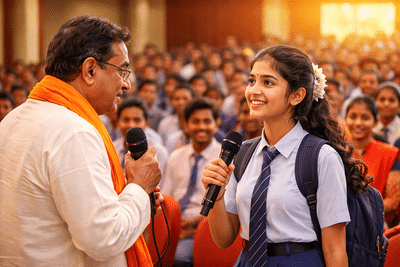
Rather than immediately switching languages, the student calmly shot back:
Even after switching to Hindi, she made it clear that her main concern was not the language she spoke, but the serious issues affecting schools - a message she did not want overshadowed by a debate over English or Hindi. Public Reaction Hits Social Media Netizens quickly took to social platforms to react. Many users applauded the student’s confidence and viewed her reply as a reflection of both maturity and awareness. One commonly shared clip showed the girl asserting that an Education Minister should not have trouble with English, emphasizing that both Hindi and English hold value.
However, not all online commentary was uniform. Some argued the minister’s request stemmed from his own language comfort, while others highlighted that the moment represented a larger conversation about language, representation, and accountability in education. A Moment Beyond Words What started as a critique of educational infrastructure in Rajasthan quickly became much more — a viral exchange blending issues of language preference, leadership responsibility, and a student’s confidence in speaking up. By responding with calm clarity, the girl not only addressed the immediate interruption but also drew attention to deeper concerns about the state of education and communication in public discourse.
The incident unfolded when the young girl stood up to speak about the poor infrastructure and quality of learning in government schools. She began her remarks in English, outlining key concerns about classroom conditions and the state of education. Just seconds into her speech, the Education Minister interrupted her and asked her to speak in Hindi instead.
Rather than immediately switching languages, the student calmly shot back:
“Sir, you are the Education Minister.”Her composed response drew laughter from the audience and soon turned into a viral moment online. Viewers praised her courage and clarity, noting that she appeared unfazed by the interruption and stood her ground before ultimately agreeing to continue in Hindi.
Even after switching to Hindi, she made it clear that her main concern was not the language she spoke, but the serious issues affecting schools - a message she did not want overshadowed by a debate over English or Hindi. Public Reaction Hits Social Media Netizens quickly took to social platforms to react. Many users applauded the student’s confidence and viewed her reply as a reflection of both maturity and awareness. One commonly shared clip showed the girl asserting that an Education Minister should not have trouble with English, emphasizing that both Hindi and English hold value.
However, not all online commentary was uniform. Some argued the minister’s request stemmed from his own language comfort, while others highlighted that the moment represented a larger conversation about language, representation, and accountability in education. A Moment Beyond Words What started as a critique of educational infrastructure in Rajasthan quickly became much more — a viral exchange blending issues of language preference, leadership responsibility, and a student’s confidence in speaking up. By responding with calm clarity, the girl not only addressed the immediate interruption but also drew attention to deeper concerns about the state of education and communication in public discourse.
Next Story