
The bird that kills with a kick: How the 'secretary bird' is changing evolutionary science


Across Africa’s open grasslands, the secretary bird (Sagittarius serpentarius) stands apart from other birds of prey. With crane-like legs and the hunting instincts of an eagle, it stalks the ground to strike snakes, lizards, and small mammals with precision. Scientists have long been intrigued by how these birds use their legs as weapons, but new research published in Current Biology provides the most detailed understanding yet of the mechanics behind their lethal kick. The findings carry implications beyond avian biology, offering insights relevant to robotics, prosthetic design, and evolutionary biomechanics across species.
What does a secretary bird look like: Appearance and unique features
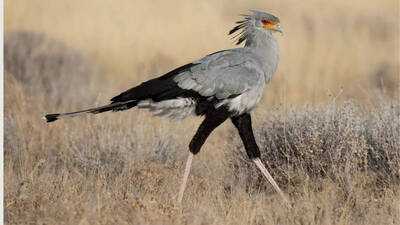
The secretary bird is immediately recognisable by its long legs, distinctive crest of quill-like feathers, and upright gait. Standing up to 1.3 metres tall, it resembles a stork more than a hawk, though genetically it belongs to the raptor family. Its body is streamlined for terrestrial movement, with long tibiotarsus and tarsometatarsus bones that make up over half of its leg length. This adaptation gives the bird a towering stance and the ability to deliver swift, downward strikes. These specific bone structures enhance the bird’s stability and striking force, allowing it to maintain balance while delivering rapid and powerful kicks.
Despite its size, the bird’s wings are relatively broad and short, suitable for gliding rather than prolonged flight. Its face, marked by orange and yellow skin around the eyes, aids visual targeting during hunting. Unlike most birds of prey that dive from the air, the secretary bird uses its long legs to chase and attack prey on foot, a behaviour reflected in its specialised musculoskeletal design. This hunting style reflects a unique evolutionary adaptation among raptors, emphasizing terrestrial locomotion and precise ground striking over aerial attacks.
Habitat and distribution: Life of the secretary bird on the African savannah
The secretary bird is endemic to sub-Saharan Africa, preferring open grasslands and savannahs where visibility is high and vegetation is sparse. It thrives in regions that provide both ample prey and space for ground-based hunting. The species is most commonly found in countries such as South Africa, Kenya, Tanzania, and Botswana, though its range extends across much of the continent. Their wide distribution across diverse African landscapes highlights their adaptability to various savanna ecosystems, aiding in the ecological balance by controlling reptile populations.
Its nesting behaviour contrasts with its terrestrial hunting lifestyle. Secretary birds construct large stick nests in acacia trees, which can reach more than two metres in diameter. These elevated platforms offer safety from predators and a vantage point for surveying the surrounding plains. Pairs are monogamous and often remain together year-round, defending territories that may span several square kilometres. This nesting strategy ensures reproductive success by reducing predation risks and providing optimal surveillance of the habitat.
Eating habits and hunting strategy of the secretary bird: Power, precision and patience
Secretary birds feed primarily on snakes, including venomous species such as cobras and puff adders, but their diet also includes small mammals, amphibians, and large insects. Unlike eagles, which seize prey with their talons, secretary birds rely on repeated, high-force kicks to disable or kill. Their strikes are fast and controlled, allowing them to deliver fatal blows while maintaining a safe distance from a snake’s fangs. The repeated kicking method minimizes risk from venomous prey and showcases the bird’s remarkable combination of power and precision in hunting.
The recent Current Biology study focused on the biomechanics of these strikes using a male bird named Madeleine . Researchers recorded his attacks on a rubber snake using high-speed cameras and a force plate, capturing the most detailed data on the species’ striking force. The results revealed an average peak force exceeding five times the bird’s body weight, or roughly 195 newtons. For comparison, this is greater than the force exerted during high-speed running in other large birds and comparable to the forces produced in maximal leaps. The ability to produce such force quickly and accurately reflects a highly optimized evolutionary trait unique to the secretary bird.
Unique features of the secretary bird: Vision, coordination and control
Each kick delivered by the secretary bird lasts only about fifteen milliseconds, too brief for the brain to receive and process feedback from the legs during impact. This finding suggests that the bird relies not on reflexes but on precise, pre-programmed motor control supported by vision. Observations showed that before each kick, the bird aligns its head and eyes carefully with the target, implying that visual targeting governs the accuracy of its movements. This advanced neuromuscular coordination allows effective predator-prey interactions and demonstrates sophisticated sensory-motor integration.
The researchers propose that this feed-forward system allows the bird to maintain speed and precision without hesitation. Although its long legs could create mechanical delays due to their length, the species appears to have evolved highly efficient neural coordination to compensate. Such integration of vision and movement is rare among ground birds and likely key to its success as a predator of venomous snakes. The evolutionary refinement of this system underlines the balance between anatomical constraints and neurological adaptation in wildlife.
Adaptations for running and survival
The secretary bird’s long-legged design offers both benefits and trade-offs. Its height enables it to spot prey from a distance, but longer limbs also increase rotational inertia, potentially affecting running efficiency. To examine whether this affects locomotion, researchers applied a spring-loaded inverted pendulum model based on the bird’s recorded gait. The simulations indicated that its running mechanics were typical for ground birds, balancing limb stiffness and stride efficiency. The adaptability in its running mechanics allows the secretary bird to efficiently balance energy expenditure with high-impact hunting demands.
This suggests that evolution has fine-tuned the species’ morphology to support both high-impact striking and stable movement. In the wild, this dual capability enhances survival, allowing the bird to chase prey across uneven terrain while conserving energy. Secretary birds also face threats from habitat loss and grassland degradation, but their adaptability and wide range have helped maintain stable populations across much of Africa. Conservation efforts focusing on habitat preservation are critical to sustaining this biologically unique species.
Link to ancient predators: Lessons from evolution
The secretary bird’s hunting method may echo that of extinct relatives known as Phorusrhacidae, or “terror birds,” which once dominated South America. Both share long legs and similar bone structures adapted for striking prey. By analysing the living secretary bird, scientists can better reconstruct how these prehistoric predators might have hunted.
The research challenges assumptions that the greatest limb forces occur only during locomotion, such as running or jumping. In the secretary bird, the most extreme mechanical load arises from a stationary action: the kick. This insight has implications for evolutionary biology, suggesting that species can develop extraordinary force and control for specialised behaviours rather than general movement.
Beyond biology: Lessons for robotics and rehabilitation
The combination of strength, precision, and speed in the secretary bird’s strike provides valuable inspiration for robotics and prosthetic technology. Engineers studying bio-inspired robotics can use these findings to design machines capable of delivering controlled, high-impact motions without losing stability. In medicine, understanding how animals perform rapid, pre-programmed movements could improve the design of prosthetic limbs that replicate natural motion. These biological insights facilitate the development of advanced robotic systems and prostheses that optimize human-machine interface efficiency.
By integrating anatomy, neural control, and mechanical efficiency, the secretary bird offers a living model of evolutionary optimisation, demonstrating how biology continues to inform technology and deepen understanding of movement itself.
From its elegant stride across the savannah to the precision of its lethal kick, the secretary bird embodies how evolution perfects function through form, revealing vital lessons that bridge nature, technology, and survival.
Also Read | Animals with unimaginably long life spans, from Greenland shark to rockfish
What does a secretary bird look like: Appearance and unique features
The secretary bird is immediately recognisable by its long legs, distinctive crest of quill-like feathers, and upright gait. Standing up to 1.3 metres tall, it resembles a stork more than a hawk, though genetically it belongs to the raptor family. Its body is streamlined for terrestrial movement, with long tibiotarsus and tarsometatarsus bones that make up over half of its leg length. This adaptation gives the bird a towering stance and the ability to deliver swift, downward strikes. These specific bone structures enhance the bird’s stability and striking force, allowing it to maintain balance while delivering rapid and powerful kicks.
Despite its size, the bird’s wings are relatively broad and short, suitable for gliding rather than prolonged flight. Its face, marked by orange and yellow skin around the eyes, aids visual targeting during hunting. Unlike most birds of prey that dive from the air, the secretary bird uses its long legs to chase and attack prey on foot, a behaviour reflected in its specialised musculoskeletal design. This hunting style reflects a unique evolutionary adaptation among raptors, emphasizing terrestrial locomotion and precise ground striking over aerial attacks.
Habitat and distribution: Life of the secretary bird on the African savannah
The secretary bird is endemic to sub-Saharan Africa, preferring open grasslands and savannahs where visibility is high and vegetation is sparse. It thrives in regions that provide both ample prey and space for ground-based hunting. The species is most commonly found in countries such as South Africa, Kenya, Tanzania, and Botswana, though its range extends across much of the continent. Their wide distribution across diverse African landscapes highlights their adaptability to various savanna ecosystems, aiding in the ecological balance by controlling reptile populations.
Its nesting behaviour contrasts with its terrestrial hunting lifestyle. Secretary birds construct large stick nests in acacia trees, which can reach more than two metres in diameter. These elevated platforms offer safety from predators and a vantage point for surveying the surrounding plains. Pairs are monogamous and often remain together year-round, defending territories that may span several square kilometres. This nesting strategy ensures reproductive success by reducing predation risks and providing optimal surveillance of the habitat.
Eating habits and hunting strategy of the secretary bird: Power, precision and patience
Secretary birds feed primarily on snakes, including venomous species such as cobras and puff adders, but their diet also includes small mammals, amphibians, and large insects. Unlike eagles, which seize prey with their talons, secretary birds rely on repeated, high-force kicks to disable or kill. Their strikes are fast and controlled, allowing them to deliver fatal blows while maintaining a safe distance from a snake’s fangs. The repeated kicking method minimizes risk from venomous prey and showcases the bird’s remarkable combination of power and precision in hunting.
The recent Current Biology study focused on the biomechanics of these strikes using a male bird named Madeleine . Researchers recorded his attacks on a rubber snake using high-speed cameras and a force plate, capturing the most detailed data on the species’ striking force. The results revealed an average peak force exceeding five times the bird’s body weight, or roughly 195 newtons. For comparison, this is greater than the force exerted during high-speed running in other large birds and comparable to the forces produced in maximal leaps. The ability to produce such force quickly and accurately reflects a highly optimized evolutionary trait unique to the secretary bird.
Unique features of the secretary bird: Vision, coordination and control
Each kick delivered by the secretary bird lasts only about fifteen milliseconds, too brief for the brain to receive and process feedback from the legs during impact. This finding suggests that the bird relies not on reflexes but on precise, pre-programmed motor control supported by vision. Observations showed that before each kick, the bird aligns its head and eyes carefully with the target, implying that visual targeting governs the accuracy of its movements. This advanced neuromuscular coordination allows effective predator-prey interactions and demonstrates sophisticated sensory-motor integration.
The researchers propose that this feed-forward system allows the bird to maintain speed and precision without hesitation. Although its long legs could create mechanical delays due to their length, the species appears to have evolved highly efficient neural coordination to compensate. Such integration of vision and movement is rare among ground birds and likely key to its success as a predator of venomous snakes. The evolutionary refinement of this system underlines the balance between anatomical constraints and neurological adaptation in wildlife.
Adaptations for running and survival
The secretary bird’s long-legged design offers both benefits and trade-offs. Its height enables it to spot prey from a distance, but longer limbs also increase rotational inertia, potentially affecting running efficiency. To examine whether this affects locomotion, researchers applied a spring-loaded inverted pendulum model based on the bird’s recorded gait. The simulations indicated that its running mechanics were typical for ground birds, balancing limb stiffness and stride efficiency. The adaptability in its running mechanics allows the secretary bird to efficiently balance energy expenditure with high-impact hunting demands.
This suggests that evolution has fine-tuned the species’ morphology to support both high-impact striking and stable movement. In the wild, this dual capability enhances survival, allowing the bird to chase prey across uneven terrain while conserving energy. Secretary birds also face threats from habitat loss and grassland degradation, but their adaptability and wide range have helped maintain stable populations across much of Africa. Conservation efforts focusing on habitat preservation are critical to sustaining this biologically unique species.
Link to ancient predators: Lessons from evolution
The secretary bird’s hunting method may echo that of extinct relatives known as Phorusrhacidae, or “terror birds,” which once dominated South America. Both share long legs and similar bone structures adapted for striking prey. By analysing the living secretary bird, scientists can better reconstruct how these prehistoric predators might have hunted.
The research challenges assumptions that the greatest limb forces occur only during locomotion, such as running or jumping. In the secretary bird, the most extreme mechanical load arises from a stationary action: the kick. This insight has implications for evolutionary biology, suggesting that species can develop extraordinary force and control for specialised behaviours rather than general movement.
Beyond biology: Lessons for robotics and rehabilitation
The combination of strength, precision, and speed in the secretary bird’s strike provides valuable inspiration for robotics and prosthetic technology. Engineers studying bio-inspired robotics can use these findings to design machines capable of delivering controlled, high-impact motions without losing stability. In medicine, understanding how animals perform rapid, pre-programmed movements could improve the design of prosthetic limbs that replicate natural motion. These biological insights facilitate the development of advanced robotic systems and prostheses that optimize human-machine interface efficiency.
By integrating anatomy, neural control, and mechanical efficiency, the secretary bird offers a living model of evolutionary optimisation, demonstrating how biology continues to inform technology and deepen understanding of movement itself.
From its elegant stride across the savannah to the precision of its lethal kick, the secretary bird embodies how evolution perfects function through form, revealing vital lessons that bridge nature, technology, and survival.
Also Read | Animals with unimaginably long life spans, from Greenland shark to rockfish
Next Story