
This 300-million-year-old 'octopus' just lost its identity - scientists say it was never an octopus


For over two decades, the 300-million-year-old fossil Pohlsepia mazonensis was celebrated as the world’s oldest octopus ancestor due to its soft, sack-like appearance, but after 20 years of study, it was found using synchrotron X-ray imaging to have been misidentified.
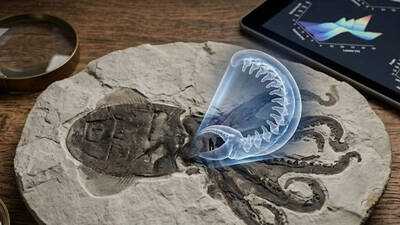
Pohlsepia mazonensis is a soft-bodied creature that has an unusual radula (a specialised toothy tongue) that has, until now, only been used to identify members of the nautilus group. As such, the original specimen was thought to be a soft-bodied invertebrate but is now known to be a shelled relative of the modern nautilus. The nautilus has a hardened exterior that is expected to have decomposed (via dissolution) during the original fossilisation event. So, as a result of this high technology discovery, Pohlsepia is no longer considered to be an octopus; therefore, the evolutionary timeline for these unknown deep-water cephalopods has been dramatically changed.
Why scientists misread this 300-million-year-old fossil as an octopus for decades
According to the University of Reading, the fossil found in Mazon Creek, Illinois, has caused confusion among researchers because the fossil does not show an outer shell or hard body, characteristics that usually come to mind when thinking of an octopus.
Initially, Paleontologists thought this fossil represented an ancient soft-bodied cephalopod; however, the recent scans of this fossil led to new insight that what was interpreted as an ‘octopus’ shape was actually caused during the stages of taphonomic decay and the application of pressure to the fossil - therefore causing it to be entombed into an deceptive morphology, phylogenetically speaking, and resulting in the complete disintegration of the organism's aragonite shell when the fossil was actually created. From digital decompression of the surrounding matrix, scientists recognised that the original anatomy of the animal had no resemblance to the ‘octopus-like’ external form.
Why Pohlsepia is officially a nautiloid
As written in Royal Society Publishing, the important turning point in this study was when a particle accelerator called a synchrotron was used to aid scientists in seeing through rock by producing intense light via an intense beam of light.
This allowed for mapping the chemical signatures related to the organism's mouthparts. A radula (the feeding organ of molluscs) was identified as having nine teeth in one row. That number of teeth does not correspond to that of the octopus, but does record nautiloids effectively. Whether the physical separation between octopuses and or cephalopod may have actually happened a long time before now; however, now science has discovered that Pohlsepia had the rigid feeding organs of nautiloids, which means they are now different groups on that branch of the tree of life.
What Pohlsepia tells us about Octopus history
With evidence demonstrating that Pohlsepia preserves elements of nautiloid anatomy, it eliminates the last known oldest linked organism in the octopod lineage. Thus, according to the Natural History Museum, there is now an enormous gap in the fossil record for octopuses, indicating that they could have developed their soft-bodied characteristics far more recently than 300 million years ago.
This finding illustrates how dangerous it can be to rely only on the external morphology of fossils and how modern technology can help rectify decades of scientific inaccuracies by providing knowledge regarding internal structure that was not previously visible to the naked eye. In addition to this, the reclassification of Pohlsepia will require scientists to rethink the timing of the loss of shells from cephalopods and, therefore, how cephalopods evolved into the fast-moving predatory creatures now present in our oceans.
Pohlsepia mazonensis is a soft-bodied creature that has an unusual radula (a specialised toothy tongue) that has, until now, only been used to identify members of the nautilus group. As such, the original specimen was thought to be a soft-bodied invertebrate but is now known to be a shelled relative of the modern nautilus. The nautilus has a hardened exterior that is expected to have decomposed (via dissolution) during the original fossilisation event. So, as a result of this high technology discovery, Pohlsepia is no longer considered to be an octopus; therefore, the evolutionary timeline for these unknown deep-water cephalopods has been dramatically changed.
Why scientists misread this 300-million-year-old fossil as an octopus for decades
According to the University of Reading, the fossil found in Mazon Creek, Illinois, has caused confusion among researchers because the fossil does not show an outer shell or hard body, characteristics that usually come to mind when thinking of an octopus.
Initially, Paleontologists thought this fossil represented an ancient soft-bodied cephalopod; however, the recent scans of this fossil led to new insight that what was interpreted as an ‘octopus’ shape was actually caused during the stages of taphonomic decay and the application of pressure to the fossil - therefore causing it to be entombed into an deceptive morphology, phylogenetically speaking, and resulting in the complete disintegration of the organism's aragonite shell when the fossil was actually created. From digital decompression of the surrounding matrix, scientists recognised that the original anatomy of the animal had no resemblance to the ‘octopus-like’ external form.
Why Pohlsepia is officially a nautiloid
As written in Royal Society Publishing, the important turning point in this study was when a particle accelerator called a synchrotron was used to aid scientists in seeing through rock by producing intense light via an intense beam of light.
This allowed for mapping the chemical signatures related to the organism's mouthparts. A radula (the feeding organ of molluscs) was identified as having nine teeth in one row. That number of teeth does not correspond to that of the octopus, but does record nautiloids effectively. Whether the physical separation between octopuses and or cephalopod may have actually happened a long time before now; however, now science has discovered that Pohlsepia had the rigid feeding organs of nautiloids, which means they are now different groups on that branch of the tree of life.
What Pohlsepia tells us about Octopus history
With evidence demonstrating that Pohlsepia preserves elements of nautiloid anatomy, it eliminates the last known oldest linked organism in the octopod lineage. Thus, according to the Natural History Museum, there is now an enormous gap in the fossil record for octopuses, indicating that they could have developed their soft-bodied characteristics far more recently than 300 million years ago.
This finding illustrates how dangerous it can be to rely only on the external morphology of fossils and how modern technology can help rectify decades of scientific inaccuracies by providing knowledge regarding internal structure that was not previously visible to the naked eye. In addition to this, the reclassification of Pohlsepia will require scientists to rethink the timing of the loss of shells from cephalopods and, therefore, how cephalopods evolved into the fast-moving predatory creatures now present in our oceans.
Next Story