Why “Doordarshan” Was First Imagined in the Mahabharata, Not Modern Media


When India named its first national television network “Doordarshan,” it was not a poetic coincidence or a branding experiment. It was a deliberate civilizational choice. Long before screens, satellites, and live broadcasts, Indian thought had already imagined the idea of seeing events unfold across distance and time. The word Doordarshan itself literally means seeing from afar. This concept was not born in studios or science labs but in the epic narrative of the Mahabharata, where vision transcended physical limitations and knowledge traveled without movement.
Modern media often claims novelty, but the Mahabharata reveals that the philosophical foundation of remote vision, real time witnessing, and mediated truth existed thousands of years ago. To understand why Doordarshan is not a modern invention, one must return to Kurukshetra.
1. The Meaning of Doordarshan in Sanskrit ThoughtThe word Doordarshan is derived from two Sanskrit roots. Door meaning distant and Darshan meaning vision or witnessing. Darshan is not merely seeing with the eyes. In Indian philosophy, it implies perception, understanding, and revelation. When combined, Doordarshan refers to the ability to perceive events occurring far beyond one’s physical presence.
2. Sanjaya and the First Recorded Doordarshan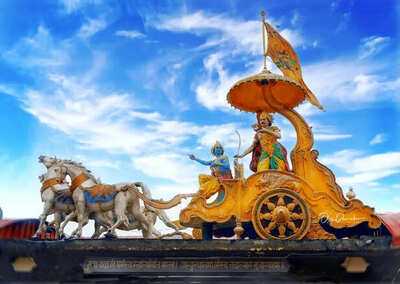 Mahabharatas lesson
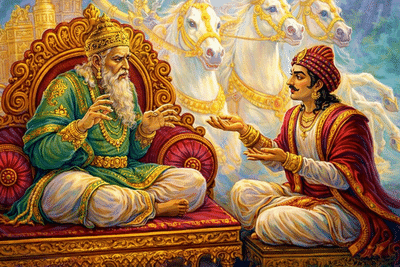
The clearest articulation of Doordarshan appears in the Mahabharata through Sanjaya, the charioteer and narrator in King Dhritarashtra’s court. Blessed by the sage Vyasa with divine vision, Sanjaya was able to witness the Kurukshetra war in real time while remaining physically distant.
This was not storytelling after the fact. Sanjaya described ongoing events as they happened, including troop movements, warrior dialogues, strategies, and outcomes. The king, blind from birth, relied entirely on this mediated vision to understand the war.
From a conceptual standpoint, this is live broadcasting. There is a source, a transmitter, a medium of perception, and a receiver. The Mahabharata does not frame this as fantasy but as a divine capability rooted in higher awareness.
3. Vyasa’s Role as the Architect of VisionVyasa, the compiler of the Mahabharata, plays a central role in establishing the logic of Doordarshan. He offers Dhritarashtra the divine sight himself, which the king declines. Instead, the power is transferred to Sanjaya.
This moment is philosophically significant. Vision is not forced. It is granted and chosen. The epic emphasizes that knowledge carries responsibility and consequence. Dhritarashtra’s refusal suggests that seeing truth does not guarantee acceptance or action.
In modern media terms, access to information does not ensure moral clarity. The Mahabharata recognized this tension long before the age of mass communication.
4. Doordarshan as Witnessing, Not Entertainment He reflects every individuals dilemma between duty and emotion.
A critical difference between ancient Doordarshan and modern media lies in purpose. Sanjaya’s vision was not meant to entertain. It was meant to bear witness. His narration was factual, emotionally restrained, and ethically grounded.
The Mahabharata positions Doordarshan as a tool for accountability. Dhritarashtra could not claim ignorance. He heard the consequences of decisions made by his sons in real time. Knowledge removed plausible deniability.
This contrasts sharply with contemporary media culture, where distance often creates emotional detachment. The original Doordarshan was morally immersive, not passive.
5. The Bhagavad Gita as the Highest Form of DoordarshanThe Bhagavad Gita itself is an extension of this concept. When Krishna grants Arjuna divine vision to witness his Vishvarupa, it is another form of expanded perception beyond human limits.
Here, Doordarshan is not about distance but scale. Arjuna sees time, creation, destruction, and cosmic order simultaneously. The message is clear. True vision transcends physical sight. It reveals reality as it is, not as one wishes it to be.
This reinforces that Doordarshan in the Mahabharata is fundamentally about truth access, whether across space, time, or metaphysical dimensions.
6. Why Independent India Chose the Name DoordarshanWhen television arrived in India in the mid 20th century, policymakers deliberately rejected foreign terminology. Instead of adopting words like television or broadcast, India chose Doordarshan.
This was not linguistic nationalism alone. It reflected continuity. Television was seen as an extension of an ancient idea, not a rupture from tradition. The name acknowledged that while technology was modern, the underlying concept was deeply Indian.
By naming the network Doordarshan, India anchored modern media within its philosophical heritage, asserting that innovation does not require cultural amnesia.
7. Doordarshan and the Ethics of SeeingPerhaps the most relevant lesson for modern media lies in the ethical framing of Doordarshan. Sanjaya narrates without distortion. He does not sensationalize suffering or glorify violence. His role is to inform, not provoke.
The Mahabharata implicitly asks a question that modern media still struggles with. What is the responsibility of the one who shows events to others. Seeing creates power. Power demands restraint.
In this sense, the ancient idea of Doordarshan offers a moral blueprint that remains largely unfulfilled today.
Modern media often claims novelty, but the Mahabharata reveals that the philosophical foundation of remote vision, real time witnessing, and mediated truth existed thousands of years ago. To understand why Doordarshan is not a modern invention, one must return to Kurukshetra.
1. The Meaning of Doordarshan in Sanskrit ThoughtThe word Doordarshan is derived from two Sanskrit roots. Door meaning distant and Darshan meaning vision or witnessing. Darshan is not merely seeing with the eyes. In Indian philosophy, it implies perception, understanding, and revelation. When combined, Doordarshan refers to the ability to perceive events occurring far beyond one’s physical presence.
2. Sanjaya and the First Recorded Doordarshan
The clearest articulation of Doordarshan appears in the Mahabharata through Sanjaya, the charioteer and narrator in King Dhritarashtra’s court. Blessed by the sage Vyasa with divine vision, Sanjaya was able to witness the Kurukshetra war in real time while remaining physically distant.
This was not storytelling after the fact. Sanjaya described ongoing events as they happened, including troop movements, warrior dialogues, strategies, and outcomes. The king, blind from birth, relied entirely on this mediated vision to understand the war.
From a conceptual standpoint, this is live broadcasting. There is a source, a transmitter, a medium of perception, and a receiver. The Mahabharata does not frame this as fantasy but as a divine capability rooted in higher awareness.
3. Vyasa’s Role as the Architect of VisionVyasa, the compiler of the Mahabharata, plays a central role in establishing the logic of Doordarshan. He offers Dhritarashtra the divine sight himself, which the king declines. Instead, the power is transferred to Sanjaya.
This moment is philosophically significant. Vision is not forced. It is granted and chosen. The epic emphasizes that knowledge carries responsibility and consequence. Dhritarashtra’s refusal suggests that seeing truth does not guarantee acceptance or action.
In modern media terms, access to information does not ensure moral clarity. The Mahabharata recognized this tension long before the age of mass communication.
4. Doordarshan as Witnessing, Not Entertainment
A critical difference between ancient Doordarshan and modern media lies in purpose. Sanjaya’s vision was not meant to entertain. It was meant to bear witness. His narration was factual, emotionally restrained, and ethically grounded.
The Mahabharata positions Doordarshan as a tool for accountability. Dhritarashtra could not claim ignorance. He heard the consequences of decisions made by his sons in real time. Knowledge removed plausible deniability.
This contrasts sharply with contemporary media culture, where distance often creates emotional detachment. The original Doordarshan was morally immersive, not passive.
5. The Bhagavad Gita as the Highest Form of DoordarshanThe Bhagavad Gita itself is an extension of this concept. When Krishna grants Arjuna divine vision to witness his Vishvarupa, it is another form of expanded perception beyond human limits.
Here, Doordarshan is not about distance but scale. Arjuna sees time, creation, destruction, and cosmic order simultaneously. The message is clear. True vision transcends physical sight. It reveals reality as it is, not as one wishes it to be.
This reinforces that Doordarshan in the Mahabharata is fundamentally about truth access, whether across space, time, or metaphysical dimensions.
6. Why Independent India Chose the Name DoordarshanWhen television arrived in India in the mid 20th century, policymakers deliberately rejected foreign terminology. Instead of adopting words like television or broadcast, India chose Doordarshan.
This was not linguistic nationalism alone. It reflected continuity. Television was seen as an extension of an ancient idea, not a rupture from tradition. The name acknowledged that while technology was modern, the underlying concept was deeply Indian.
By naming the network Doordarshan, India anchored modern media within its philosophical heritage, asserting that innovation does not require cultural amnesia.
7. Doordarshan and the Ethics of SeeingPerhaps the most relevant lesson for modern media lies in the ethical framing of Doordarshan. Sanjaya narrates without distortion. He does not sensationalize suffering or glorify violence. His role is to inform, not provoke.
The Mahabharata implicitly asks a question that modern media still struggles with. What is the responsibility of the one who shows events to others. Seeing creates power. Power demands restraint.
In this sense, the ancient idea of Doordarshan offers a moral blueprint that remains largely unfulfilled today.
Next Story