
Why Lord Ram Never Ate Before Feeding Others


The exact sentence that Lord Ram “never ate before feeding others” does not appear as a single famous line in the Valmiki Ramayana. But the idea comes from the way the epic consistently presents his character. He is shown as someone who does not treat food as a private pleasure, but as part of relationship, responsibility, restraint, and dharma. In the text, Rama is even described as a person who would not partake of the choicest food without Lakshmana by his side. That detail is small, but it reveals something large. For Ram, eating was not about the self first. It was about togetherness, order, and shared affection.
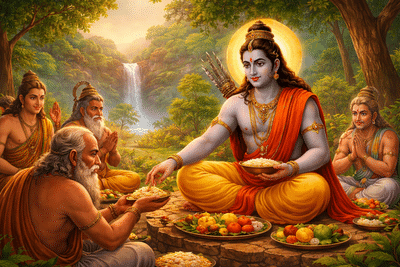
1. For Lord Ram, food was never separate from dharma
In the Indian sacred imagination, food is not just nourishment. It is grace, hospitality, duty, and moral order. The broader dharmic culture reflected in epic literature treats hospitality as sacred, and the Ramayana repeatedly shows this world of reverence, where guests are welcomed with water, food, and honor. Rama belongs fully to that moral universe. That is why the belief that he would not eat before ensuring others were cared for feels so natural to devotees. It matches the ethical rhythm of his life.
2. He is shown putting relationships before personal enjoymentOne of the clearest textual hints comes early in the Ramayana, where Rama is described as being so deeply bonded with Lakshmana that he would not even eat the finest food without him. This is not merely affection between brothers. It reflects a larger principle. Rama does not act like a person entitled to consume first and think later. Even within family life, he is portrayed as one who shares, includes, and values companionship over indulgence. That is one of the strongest foundations behind the traditional belief that he would always ensure others were fed or cared for first.
3. His forest life teaches restraint, not appetiteA powerful example appears when Guha, the Nishada king, welcomes Rama with deep love and brings many kinds of food, drink, bedding, and provisions. Rama responds with warmth, but he does not accept these comforts for himself. He explains that he is now living like an ascetic in the forest, dressed in bark, sustained by fruits and roots, and devoted to dharma. He asks only that the horses be fed, saying that if they are cared for, he will consider himself honored. Soon after, the text says Rama partook only of water brought by Lakshmana. This episode is extremely revealing. Even when offered abundance, Rama turns his attention first to duty, vows, and the needs of those dependent on him.
4. Lord Ram understood hospitality as sacred exchangeAnother telling moment comes in the Shabari episode. When Rama and Lakshmana arrive at her hermitage, Shabari receives them properly with water for washing the feet and water for sipping, exactly according to sacred custom. She tells Rama that she has gathered forest food for him. Rama accepts her devotion and honors her offering. This scene matters because it shows how food in the Ramayana is not reduced to hunger alone. It is tied to affection, service, and spiritual recognition. Rama’s greatness lies not in demanding to be served, but in dignifying the love with which food is offered.
5. Feeding others comes from the nature of an ideal ruler Lakshmana didnt merely follow Rama—he walked every step beside him, through joy, pain, and exile. At times, he was a brother.
Rama is not remembered only as an obedient son or loving husband. He is also the model king. In the Valmiki Ramayana’s summary of Rama’s future reign, his rule is described as one in which people are prosperous, safe, and free from severe suffering. Traditional commentary on this section explicitly describes Rama’s rule as one with no fear from hunger and no dearth of food. Whether one reads this literally, poetically, or civilizationally, the message is clear. A ruler worthy of the name does not feast while his people lack nourishment. In the memory of Rama Rajya, the well-fed king is not ideal. The caring king is.
6. Compassion, not privilege, defines his characterWhen sages in the forest approach Rama seeking protection from destructive beings, he listens and accepts their plea. That response may not be directly about food, but it reveals the same ethical instinct. Rama’s nature is to respond to the vulnerable first. He does not stand apart from others’ suffering. He enters it, carries it, and acts upon it. This is the same moral logic behind the popular belief that he would feed others before eating himself. People remember Ram not as a figure of royal privilege, but as one whose first impulse was responsibility toward others.
7. Why this belief became so powerful in public memoryAcross generations, devotees often preserve truth not only through literal quotation, but through lived understanding. So even if the exact modern wording is not a direct one-line quotation from Valmiki, it expresses something profoundly faithful to Rama’s image in scripture. He is dharma embodied. He shares before he consumes. He restrains himself when duty demands it. He honors those who offer with love. He places dependents, companions, guests, and subjects within the circle of care. That is why the cultural memory of “Ram never ate before feeding others” has endured. It captures his spirit with emotional accuracy, even if it is not a line from one single verse.
1. For Lord Ram, food was never separate from dharma
In the Indian sacred imagination, food is not just nourishment. It is grace, hospitality, duty, and moral order. The broader dharmic culture reflected in epic literature treats hospitality as sacred, and the Ramayana repeatedly shows this world of reverence, where guests are welcomed with water, food, and honor. Rama belongs fully to that moral universe. That is why the belief that he would not eat before ensuring others were cared for feels so natural to devotees. It matches the ethical rhythm of his life.
2. He is shown putting relationships before personal enjoymentOne of the clearest textual hints comes early in the Ramayana, where Rama is described as being so deeply bonded with Lakshmana that he would not even eat the finest food without him. This is not merely affection between brothers. It reflects a larger principle. Rama does not act like a person entitled to consume first and think later. Even within family life, he is portrayed as one who shares, includes, and values companionship over indulgence. That is one of the strongest foundations behind the traditional belief that he would always ensure others were fed or cared for first.
3. His forest life teaches restraint, not appetiteA powerful example appears when Guha, the Nishada king, welcomes Rama with deep love and brings many kinds of food, drink, bedding, and provisions. Rama responds with warmth, but he does not accept these comforts for himself. He explains that he is now living like an ascetic in the forest, dressed in bark, sustained by fruits and roots, and devoted to dharma. He asks only that the horses be fed, saying that if they are cared for, he will consider himself honored. Soon after, the text says Rama partook only of water brought by Lakshmana. This episode is extremely revealing. Even when offered abundance, Rama turns his attention first to duty, vows, and the needs of those dependent on him.
4. Lord Ram understood hospitality as sacred exchangeAnother telling moment comes in the Shabari episode. When Rama and Lakshmana arrive at her hermitage, Shabari receives them properly with water for washing the feet and water for sipping, exactly according to sacred custom. She tells Rama that she has gathered forest food for him. Rama accepts her devotion and honors her offering. This scene matters because it shows how food in the Ramayana is not reduced to hunger alone. It is tied to affection, service, and spiritual recognition. Rama’s greatness lies not in demanding to be served, but in dignifying the love with which food is offered.
5. Feeding others comes from the nature of an ideal ruler
Rama is not remembered only as an obedient son or loving husband. He is also the model king. In the Valmiki Ramayana’s summary of Rama’s future reign, his rule is described as one in which people are prosperous, safe, and free from severe suffering. Traditional commentary on this section explicitly describes Rama’s rule as one with no fear from hunger and no dearth of food. Whether one reads this literally, poetically, or civilizationally, the message is clear. A ruler worthy of the name does not feast while his people lack nourishment. In the memory of Rama Rajya, the well-fed king is not ideal. The caring king is.
6. Compassion, not privilege, defines his characterWhen sages in the forest approach Rama seeking protection from destructive beings, he listens and accepts their plea. That response may not be directly about food, but it reveals the same ethical instinct. Rama’s nature is to respond to the vulnerable first. He does not stand apart from others’ suffering. He enters it, carries it, and acts upon it. This is the same moral logic behind the popular belief that he would feed others before eating himself. People remember Ram not as a figure of royal privilege, but as one whose first impulse was responsibility toward others.
7. Why this belief became so powerful in public memoryAcross generations, devotees often preserve truth not only through literal quotation, but through lived understanding. So even if the exact modern wording is not a direct one-line quotation from Valmiki, it expresses something profoundly faithful to Rama’s image in scripture. He is dharma embodied. He shares before he consumes. He restrains himself when duty demands it. He honors those who offer with love. He places dependents, companions, guests, and subjects within the circle of care. That is why the cultural memory of “Ram never ate before feeding others” has endured. It captures his spirit with emotional accuracy, even if it is not a line from one single verse.
Next Story