
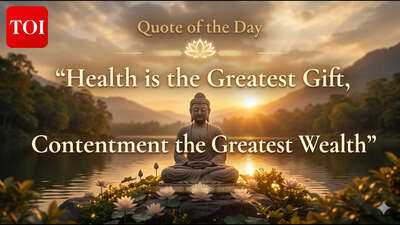
Quote of the day by Buddha: "Health is the greatest gift, contentment the greatest wealth"


Gautama Buddha and his teachings continue to resonate with millions around the world. From inner peace to mindfulness, his words have been a source of inspiration for many. Among his hundreds of quotes, today's quote of the day is one of his famous words on health and contentment .
“Health is the greatest gift, contentment the greatest wealth."
According to Buddha, the greatest gift one can have is nothing but good health . In this line, he emphasizes that physical and mental health are the two building blocks on which one depends. Without good health, no matter whether you are rich or wise, you will not be able to know its real value. The second line of the quote emphasizes contentment, a quality everyone should have. Being happy with what they have is not an easy task. But if you manage to be in that space, everything around you will look more beautiful. In short, the quote says true well-being comes not from material accumulation but from balance, mindfulness, and appreciation of what one already has.
A deeper understanding of the quote
As per Buddhist teachings, health supports clarity of mind and spiritual practice, while contentment reduces the restless pursuit of external rewards. No matter how much money or recognition you have, you can enjoy them only if you have good health. The quote motivates people to stay healthy, both physically and emotionally. Having regular exercise, mindful eating, meditation, and other practices can help one keep their mind and body fresh.
On the other hand, being in a state of contentment is something one should achieve. It is indeed the basic idea of gratitude that the spiritual teacher has mentioned here, too. In Buddhism, desire and attachment are often seen as sources of suffering. Buddha’s message suggests that happiness does not lie in acquiring more possessions, status, or power.
“Health is the greatest gift, contentment the greatest wealth."
According to Buddha, the greatest gift one can have is nothing but good health . In this line, he emphasizes that physical and mental health are the two building blocks on which one depends. Without good health, no matter whether you are rich or wise, you will not be able to know its real value. The second line of the quote emphasizes contentment, a quality everyone should have. Being happy with what they have is not an easy task. But if you manage to be in that space, everything around you will look more beautiful. In short, the quote says true well-being comes not from material accumulation but from balance, mindfulness, and appreciation of what one already has.
A deeper understanding of the quote
As per Buddhist teachings, health supports clarity of mind and spiritual practice, while contentment reduces the restless pursuit of external rewards. No matter how much money or recognition you have, you can enjoy them only if you have good health. The quote motivates people to stay healthy, both physically and emotionally. Having regular exercise, mindful eating, meditation, and other practices can help one keep their mind and body fresh.
On the other hand, being in a state of contentment is something one should achieve. It is indeed the basic idea of gratitude that the spiritual teacher has mentioned here, too. In Buddhism, desire and attachment are often seen as sources of suffering. Buddha’s message suggests that happiness does not lie in acquiring more possessions, status, or power.
Next Story