
Why do most people visit the Shani Shingnapur temple? Can it actually help reduce the effects of Shani Dosha?


Are you struggling with obstacles and hurdles in life? Then visiting this temple in Maharashtra may change your fate and help you seek the blessing of Lord Shani , the God of Karma and justice. Here’s all you need to know why millions devotees visit this Shani temple every year; read on to find out…
The divine shrine
Located in the Nevasa Taluka in Ahmednagar, Maharashtra, this holy shrine is believed to be one of the most powerful Shani temples in the country. According to the Vedic beliefs, this temple is also famous worldwide as the village where houses have no doors because of a profound faith in Lord Shani’s protection. People visit this temple specifically to seek relief from the " Shani Dosha " or " Sade Sati " period, believing that the deity’s elemental power at this temple can neutralize bad karma. Unlike most temples, the energy here isn't hidden behind ornate walls; it is out in the open, mirroring the transparent justice that Saturn represents.


The Swayambhu Idol and Raw Energy
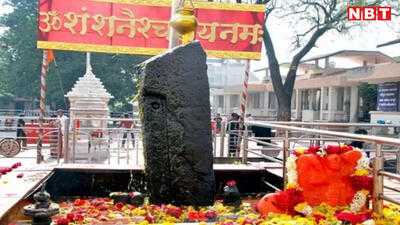
The primary reason for the temple’s reputation is that the idol is Swayambhu, meaning it emerged naturally from the earth rather than being carved by human hands. It is a simple, massive black stone slab that stands out in the open air, braving the sun, rain, and wind. Devotees believe that because the deity is not enclosed in a "Garbhagriha", the energy is unrestricted and potent. For someone suffering from Saturn’s heavy influence, coming into direct contact with this raw, grounded vibration is thought to "ground" their own turbulent energy.
The Abhishekam
The most significant ritual at Shani Shingnapur is the Tel-Abhishekam , or the pouring of mustard oil over the black stone. Saturn, or Shani Dev, is associated with the element of oil, and in Vedic mythology, oil is used to soothe his wounds and appease his stern nature. By performing this act, devotees symbolically offer their own hardships and "friction" to the deity. It is believed that as the oil flows over the idol, it absorbs the "heat" of the devotee's Saturn-related problems, bringing immediate relief.
Truth and Transparency
Saturn is the planet of truth, and Shani Shingnapur is perhaps the only place in the world that lives by Saturn’s strict moral code. The lack of doors and locks in the village is a living testament to the belief that anyone who steals or deceives will face immediate karmic justice from Shani Dev. People visiting for Dosha relief find that being in an environment of such absolute honesty helps them realign their lives. Saturn often punishes those who are dishonest; by visiting this "land of truth," a person subconsciously commits to a more ethical path, which is the fastest way to gain Saturn's favor.
Surrender
For those undergoing the seven-and-a-half-year period of Sade Sati, life can feel like an endless series of delays and uphill battles. Visiting this temple offers a psychological and spiritual sense of surrender. There is a specific peace in standing before the massive black stone and acknowledging that some things are beyond human control. This act of humility is precisely what Saturn demands. When a person stops resisting the lessons of Saturn and instead bows before the "Great Taskmaster" at Shingnapur, the "Dosha" is said to lose its sting, turning a period of suffering into one of profound personal growth.
The divine shrine
Located in the Nevasa Taluka in Ahmednagar, Maharashtra, this holy shrine is believed to be one of the most powerful Shani temples in the country. According to the Vedic beliefs, this temple is also famous worldwide as the village where houses have no doors because of a profound faith in Lord Shani’s protection. People visit this temple specifically to seek relief from the " Shani Dosha " or " Sade Sati " period, believing that the deity’s elemental power at this temple can neutralize bad karma. Unlike most temples, the energy here isn't hidden behind ornate walls; it is out in the open, mirroring the transparent justice that Saturn represents.
The Swayambhu Idol and Raw Energy
The primary reason for the temple’s reputation is that the idol is Swayambhu, meaning it emerged naturally from the earth rather than being carved by human hands. It is a simple, massive black stone slab that stands out in the open air, braving the sun, rain, and wind. Devotees believe that because the deity is not enclosed in a "Garbhagriha", the energy is unrestricted and potent. For someone suffering from Saturn’s heavy influence, coming into direct contact with this raw, grounded vibration is thought to "ground" their own turbulent energy.
The Abhishekam
The most significant ritual at Shani Shingnapur is the Tel-Abhishekam , or the pouring of mustard oil over the black stone. Saturn, or Shani Dev, is associated with the element of oil, and in Vedic mythology, oil is used to soothe his wounds and appease his stern nature. By performing this act, devotees symbolically offer their own hardships and "friction" to the deity. It is believed that as the oil flows over the idol, it absorbs the "heat" of the devotee's Saturn-related problems, bringing immediate relief.
Truth and Transparency
Saturn is the planet of truth, and Shani Shingnapur is perhaps the only place in the world that lives by Saturn’s strict moral code. The lack of doors and locks in the village is a living testament to the belief that anyone who steals or deceives will face immediate karmic justice from Shani Dev. People visiting for Dosha relief find that being in an environment of such absolute honesty helps them realign their lives. Saturn often punishes those who are dishonest; by visiting this "land of truth," a person subconsciously commits to a more ethical path, which is the fastest way to gain Saturn's favor.
Surrender
For those undergoing the seven-and-a-half-year period of Sade Sati, life can feel like an endless series of delays and uphill battles. Visiting this temple offers a psychological and spiritual sense of surrender. There is a specific peace in standing before the massive black stone and acknowledging that some things are beyond human control. This act of humility is precisely what Saturn demands. When a person stops resisting the lessons of Saturn and instead bows before the "Great Taskmaster" at Shingnapur, the "Dosha" is said to lose its sting, turning a period of suffering into one of profound personal growth.
Next Story