Australia Cricket Chief Slams DRS Error After Ashes Test Controversy

Cricket Australia’s board chief, Todd Greenberg, has openly criticised the Decision Review Cricket Australia’s board chief Todd Greenberg has openly criticised the Decision Review System (DRS) after a major technological error during the third Ashes Test at the Adelaide Oval reignited concerns over the reliability of cricket’s review mechanisms. The incident, which allowed Australian wicketkeeper Alex Carey to survive a caught-behind appeal and later score a century, drew sharp condemnation from Greenberg, who labelled it “not good enough” and unacceptable for elite international cricket.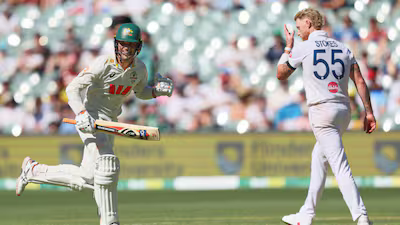
The controversy unfolded on the opening day of the Adelaide Test when England fast bowler Josh Tongue induced an edge from Carey, only for the on-field umpire’s decision to be upheld following a DRS review. The Snicko technology, which synchronises audio and video to detect faint edges, registered a sound spike that did not align with the ball passing the bat. Despite the apparent mis-timing, the third umpire upheld the not-out verdict, allowing Carey to continue his innings.
Carey made full use of his reprieve, eventually scoring 106 runs, the highest individual score in Australia’s first-innings total of 371. The decision proved pivotal, shifting momentum in the match as Australia moved into a commanding position with a 2-0 lead in the Ashes series. The incident also sparked widespread frustration among players, officials and fans. England’s bowling coach David Saker publicly questioned the calibration of the technology, suggesting it had “hurt” his team at a crucial stage of the contest.
Speaking to local radio station SEN, Greenberg stressed that the core purpose of technological aids such as DRS is to eliminate clear umpiring errors, not create fresh controversies. “It certainly caused me some heartburn because the whole idea of technology is to take away the clanger or the howler,” he said, referring to both the on-field call and the subsequent technological failure. Greenberg described the issue as human error and raised concerns over the effectiveness of fail-safe mechanisms designed to prevent such mistakes in high-stakes Test matches.
The provider of the Snicko system, BBG Sports, accepted responsibility for the error, admitting that the wrong stump microphone had been selected during the audio analysis. This incorrect input distorted the sound signature and contributed to confusion in the third umpire’s interpretation of the evidence. The episode highlights the delicate balance between human intervention and automated systems, where reliance on manual processes can undermine the accuracy that DRS technology is meant to deliver.
The Adelaide Oval controversy followed earlier questions surrounding Snicko’s performance in the ongoing Ashes series, adding to growing concerns from both camps. England players and support staff have pointed to inconsistencies in review outcomes, while former cricketers and commentators have debated whether Snicko’s methodology - which relies heavily on precise audio-visual synchronisation - is sufficiently robust for top-level Test cricket.
Despite the backlash, some voices within the cricketing fraternity have urged restraint, reminding fans that technology is intended to support, not replace, on-field umpires. Former England captain Mike Atherton noted that human error has always been part of the game and that technology, even when imperfect, still reduces the overall margin for mistakes.
As the Ashes series continues, attention will now turn to whether cricket’s governing bodies push for a deeper review of DRS systems like Snicko or explore alternative solutions such as UltraEdge, which employs advanced ball-tracking and higher frame-rate imaging. For now, the Adelaide incident serves as a stark reminder that even in the digital era, technology can falter - and when it does, the impact is felt on cricket’s biggest stage.
The controversy unfolded on the opening day of the Adelaide Test when England fast bowler Josh Tongue induced an edge from Carey, only for the on-field umpire’s decision to be upheld following a DRS review. The Snicko technology, which synchronises audio and video to detect faint edges, registered a sound spike that did not align with the ball passing the bat. Despite the apparent mis-timing, the third umpire upheld the not-out verdict, allowing Carey to continue his innings.
Carey made full use of his reprieve, eventually scoring 106 runs, the highest individual score in Australia’s first-innings total of 371. The decision proved pivotal, shifting momentum in the match as Australia moved into a commanding position with a 2-0 lead in the Ashes series. The incident also sparked widespread frustration among players, officials and fans. England’s bowling coach David Saker publicly questioned the calibration of the technology, suggesting it had “hurt” his team at a crucial stage of the contest.
You may also like
- Triple silver glory for Team India as Shruti Vora excels in equestrian dressage
- Centre approves Rs 887 crore Mumbai Marina development
- MoS Kirti Vardhan Singh and Afghan health minister discuss healthcare cooperation
- Utilise AI-based systems to effectively curb tax evasion: Uttarakhand CM Dhami instructs officials
- Prodigal Ishan Kishan picks the right stage for a ton, but will it help?
Speaking to local radio station SEN, Greenberg stressed that the core purpose of technological aids such as DRS is to eliminate clear umpiring errors, not create fresh controversies. “It certainly caused me some heartburn because the whole idea of technology is to take away the clanger or the howler,” he said, referring to both the on-field call and the subsequent technological failure. Greenberg described the issue as human error and raised concerns over the effectiveness of fail-safe mechanisms designed to prevent such mistakes in high-stakes Test matches.
The provider of the Snicko system, BBG Sports, accepted responsibility for the error, admitting that the wrong stump microphone had been selected during the audio analysis. This incorrect input distorted the sound signature and contributed to confusion in the third umpire’s interpretation of the evidence. The episode highlights the delicate balance between human intervention and automated systems, where reliance on manual processes can undermine the accuracy that DRS technology is meant to deliver.
The Adelaide Oval controversy followed earlier questions surrounding Snicko’s performance in the ongoing Ashes series, adding to growing concerns from both camps. England players and support staff have pointed to inconsistencies in review outcomes, while former cricketers and commentators have debated whether Snicko’s methodology - which relies heavily on precise audio-visual synchronisation - is sufficiently robust for top-level Test cricket.
Despite the backlash, some voices within the cricketing fraternity have urged restraint, reminding fans that technology is intended to support, not replace, on-field umpires. Former England captain Mike Atherton noted that human error has always been part of the game and that technology, even when imperfect, still reduces the overall margin for mistakes.
As the Ashes series continues, attention will now turn to whether cricket’s governing bodies push for a deeper review of DRS systems like Snicko or explore alternative solutions such as UltraEdge, which employs advanced ball-tracking and higher frame-rate imaging. For now, the Adelaide incident serves as a stark reminder that even in the digital era, technology can falter - and when it does, the impact is felt on cricket’s biggest stage.






More from our partners


Loving Newspoint? Download the app now
