
China discovers rare Moon mineral that could revolutionise LED technology on Earth


Researchers in China have discovered the 11th new lunar mineral, ‘ Cerium–Magnesium Changesite ,’ from the first Moon meteorites recovered in China. This important advancement, announced by the China Geological Survey, represents a major development within extraterrestrial geology . The new mineral is colourless, transparent and brittle, with unusual physical characteristics such as a distinct fluorescence effect and generally small grain sizes (less than 10 micrometres) as noted in a study on Bastille Post.
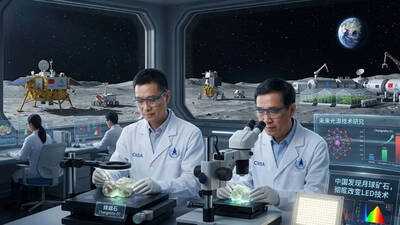
Experts believe that the new mineral provides scientists with an important blueprint for investigation into synthesising materials based on the conditions under which the minerals form (pressure and temperature) on the Moon. Importantly, the new mineral has practical, usable applications that will hopefully lead to innovative industrial use in the future, especially with respect to producing high-efficiency LED technology .
Characteristics of the newly discovered rare lunar mineral
According to the study published in Bastille Post, identified from a 44-gram solid, spherical, meteorite with a dark molten shell, Cerium-Magnesium Changesite is a new mineral showing signs of being formed in very distinctive geological environments not yet discovered on Earth. The unusual crystalline form and ratio of rare earth Elements in this new mineral indicate that it has been subjected to geologic processes not found on Earth, providing scientists with a unique opportunity to study the types of events that happen in outer space.
How this mineral could advance LED technology
Due to its fluorescent qualities, the Commission on New Minerals and Mineral Names believes this mineral is a potential source for next-generation LED products. Additionally, the composition and structure will aid scientists in creating novel formulas to help improve the quality and efficiency of synthetic materials used in present-day electronics.
How lunar mineralogy informs the future of space resource utilisation
The discovery of this mineral provides the opportunity for researchers to create links between the geological history of the Earth and the Moon. By determining how cerium and magnesium react under lunar environmental conditions, scientists will gain insights into the formation of the Moon, which will ultimately assist scientists in developing strategies for space exploration and researching the use of natural resources in space.
Experts believe that the new mineral provides scientists with an important blueprint for investigation into synthesising materials based on the conditions under which the minerals form (pressure and temperature) on the Moon. Importantly, the new mineral has practical, usable applications that will hopefully lead to innovative industrial use in the future, especially with respect to producing high-efficiency LED technology .
Characteristics of the newly discovered rare lunar mineral
According to the study published in Bastille Post, identified from a 44-gram solid, spherical, meteorite with a dark molten shell, Cerium-Magnesium Changesite is a new mineral showing signs of being formed in very distinctive geological environments not yet discovered on Earth. The unusual crystalline form and ratio of rare earth Elements in this new mineral indicate that it has been subjected to geologic processes not found on Earth, providing scientists with a unique opportunity to study the types of events that happen in outer space.
How this mineral could advance LED technology
Due to its fluorescent qualities, the Commission on New Minerals and Mineral Names believes this mineral is a potential source for next-generation LED products. Additionally, the composition and structure will aid scientists in creating novel formulas to help improve the quality and efficiency of synthetic materials used in present-day electronics.
How lunar mineralogy informs the future of space resource utilisation
The discovery of this mineral provides the opportunity for researchers to create links between the geological history of the Earth and the Moon. By determining how cerium and magnesium react under lunar environmental conditions, scientists will gain insights into the formation of the Moon, which will ultimately assist scientists in developing strategies for space exploration and researching the use of natural resources in space.
Next Story