
Deepinder Goyal exits as Eternal CEO, and other top stories


Happy Thursday! Deepinder Goyal steps down as Eternal CEO, with Albinder Dhindsa set to take over. This and more in today’s ETtech Morning Disptach.
Also in the letter:
■ Amagi’s weak debut
■ IT firms’ AI reality
■ ETtech Done Deals
Deepinder Goyal resigns as Eternal CEO; company names Albinder Dhindsa as successor
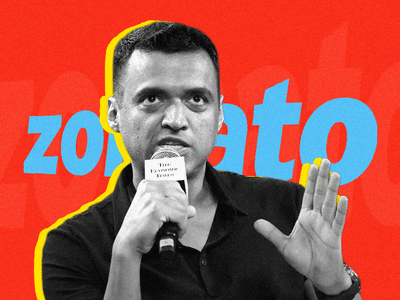
In a surprise leadership move, Deepinder Goyal has stepped down as chief executive of Eternal, the parent company of Zomato and Blinkit, the company disclosed in a stock exchange filing. Goyal will transition to the role of vice-chairman, while remaining on Eternal's board.

Blinkit founder and CEO Albinder Dhindsa has been appointed the new CEO of Eternal. The change will take effect from February 1.
Goyal's reasoning: In a letter to shareholders, Goyal said the decision echoes a shift in where he wants to spend his time rather than a retreat from the company he founded.

He also sought to reassure investors, stressing that the move represents a change in role, “not in commitment towards outcomes.”
 Blinkit CEO Albinder Dhindsa
Why Dhindsa: Dhindsa's elevation shows continuity at a time when Blinkit has become one of Eternal’s fastest-growing businesses. As founder and CEO of Blinkit, he has overseen its turnaround (from its Grofers days) and scale-up within the group, making him a natural successor to run the broader Eternal portfolio.
Beyond Eternal: Goyal's comments underline his growing involvement in ventures beyond Eternal's core operations. While Eternal spans Zomato, Blinkit, District (going-out), and the B2B supply arm Hyperpure, Goyal has also been backing and founding “higher risk” experimental startups.
Here are some of the ventures he is currently involved in:
Also Read: As Eternal names a new CEO, a look back at Zomato’s journey
Financials: Eternal delivered a strong set of earnings on Wednesday, with profit and revenue rising sharply.
Also Read: Blinkit turns Ebitda positive in Q3FY26
PSU banks counting on QR-based payments to breach a fintech fort

Public sector banks are sharpening their push into QR code-based merchant payments, stepping into a turf long dominated by fintech players such as BharatPe, PhonePe and Paytm.
What’s happening? After private lenders like ICICI Bank, HDFC Bank, and Axis Bank began directly onboarding merchants for QR-led payments, state-owned banks are now following suit. State Bank of India, Punjab National Bank and Central Bank of India are committing capital and teams to build out merchant capital at scale, industry executives told us.
Why the interest?The numbers explain the urgency:
Fintech companies have already demonstrated the monetisation playbook.
Quote, unquote: “Banks are focusing on making their payment platforms more relevant through features like instant onboarding and on-demand settlement. With an existing strong banking relationship, once the payment layer is solid, adding credit and related products becomes much easier,” said Raman Khanduja, cofounder of Mintoak.
Amagi’s muted listing cuts valuation 41% to $821 million
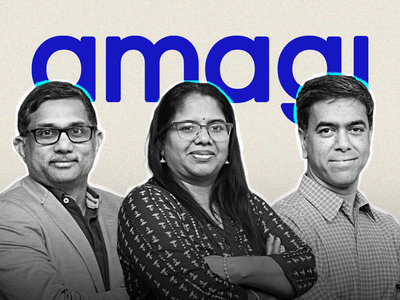 (L-R) Baskar Subramanian, Srividhya Srinivasan and KA Srinivasan, founders, Amagi Media Labs
Software-as-a-service (SaaS) firm Amagi Media Labs made a muted stock market debut on Tuesday, listing at a discount to its IPO price amid fragile market sentiment.
What happened: Amagi's shares debuted at Rs 317 on the BSE, a 12.1% discount to the issue price of Rs 361. The stock later recovered some ground to close at Rs 348. At listing, the company’s market capitalisation stood at about $821 million, more than 40% lower than its last private valuation of $1.4 billion.
Context check: The subdued debut came amid a broader market selloff. Global equities were under pressure after US President Donald Trump’s comments on Greenland-related tariffs revived fears of an escalating trade war.
Journey to IPO: Amagi became a unicorn in 2022 after raising $100 million from General Atlantic. While the IPO marked a key milestone, the public market pricing suggests a broader valuation reset for late-stage tech firms.
CEO view: Calling the listing “the start of a long journey”, cofounder and CEO Baskar Subramanian downplayed the significance of day-one performance. He urged investors to focus on long-term execution rather than the opening price.
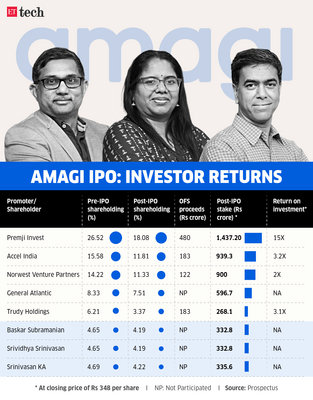
Investor impact: The listing trimmed paper gains for early backers and founders:
 Other Top Stories By Our Reporters

Forrester picks holes in IT’s AI story, says just 10-15% pilots scale:Research firm Forrester says only 10-15% of AI projects make it into long-term production use, though companies claim rapid adoption across their operations.
Escape Plan raises $25 million: New-age travel accessories platform Escape Plan has raised $25 million in a funding round led by Jungle Ventures, with participation from Fireside Ventures and IndiGo Ventures, the venture capital (VC) arm of IndiGo Airlines.
Aerem raises $15 million: Solar platform Aerem Solutions has raised $15 million (Rs 136 crore) in a round led by the SMBC Asia Rising Fund, the VC arm of Japan’s Sumitomo Mitsui Banking Corporation.
Global Picks We Are Reading
■ The US and China are collaborating more closely on AI than you think ( Wired)
■ Big Tech is racing to own Africa’s internet ( Rest of the World)
■ Why Elon Musk is racing to take SpaceX public ( WSJ)
Also in the letter:
■ Amagi’s weak debut
■ IT firms’ AI reality
■ ETtech Done Deals
Deepinder Goyal resigns as Eternal CEO; company names Albinder Dhindsa as successor
In a surprise leadership move, Deepinder Goyal has stepped down as chief executive of Eternal, the parent company of Zomato and Blinkit, the company disclosed in a stock exchange filing. Goyal will transition to the role of vice-chairman, while remaining on Eternal's board.
Blinkit founder and CEO Albinder Dhindsa has been appointed the new CEO of Eternal. The change will take effect from February 1.
Goyal's reasoning: In a letter to shareholders, Goyal said the decision echoes a shift in where he wants to spend his time rather than a retreat from the company he founded.
He also sought to reassure investors, stressing that the move represents a change in role, “not in commitment towards outcomes.”
Why Dhindsa: Dhindsa's elevation shows continuity at a time when Blinkit has become one of Eternal’s fastest-growing businesses. As founder and CEO of Blinkit, he has overseen its turnaround (from its Grofers days) and scale-up within the group, making him a natural successor to run the broader Eternal portfolio.
Beyond Eternal: Goyal's comments underline his growing involvement in ventures beyond Eternal's core operations. While Eternal spans Zomato, Blinkit, District (going-out), and the B2B supply arm Hyperpure, Goyal has also been backing and founding “higher risk” experimental startups.
Here are some of the ventures he is currently involved in:
- Continue Research: A health-focused venture exploring simple biological leverage points that could influence ageing.
- Temple: An experimental deeptech device designed to continuously monitor brain blood flow.
- LAT Aerospace: An aviation startup cofounded by Goyal and former Zomato executive Surobhi Das, working on low-cost short takeoff and landing (STOL) aircraft to improve regional air connectivity.
Also Read: As Eternal names a new CEO, a look back at Zomato’s journey
Financials: Eternal delivered a strong set of earnings on Wednesday, with profit and revenue rising sharply.
- Net profit: Up 73% year-on-year (YoY) at Rs 102 crore.
- Revenue from operations: Rose a sharp 201% YoY to Rs 16,315 crore.
Also Read: Blinkit turns Ebitda positive in Q3FY26
PSU banks counting on QR-based payments to breach a fintech fort
Public sector banks are sharpening their push into QR code-based merchant payments, stepping into a turf long dominated by fintech players such as BharatPe, PhonePe and Paytm.
What’s happening? After private lenders like ICICI Bank, HDFC Bank, and Axis Bank began directly onboarding merchants for QR-led payments, state-owned banks are now following suit. State Bank of India, Punjab National Bank and Central Bank of India are committing capital and teams to build out merchant capital at scale, industry executives told us.
- Banks are rolling out dedicated merchant apps and servicing teams.
- Soundboxes are being bundled with QR onboarding.
- QR-led acquisition is being treated as a front-line distribution channel, not an add-on to current accounts.
Why the interest?
- India has about 728 million QR codes deployed across the country, versus just 11 million point-of-sale terminals, RBI data shows.
- While many merchants display multiple QR codes, the sheer scale makes QR codes the default acceptance layer for small businesses.
Fintech companies have already demonstrated the monetisation playbook.
- Paytm, for instance, has said it disburses around Rs 4,500 crore every quarter to merchants, with over 13.7 million subscribers to its devices.
- Banks believe they can tap this market, offering lower-cost capital and better rates to win share from non-bank lenders.
Quote, unquote: “Banks are focusing on making their payment platforms more relevant through features like instant onboarding and on-demand settlement. With an existing strong banking relationship, once the payment layer is solid, adding credit and related products becomes much easier,” said Raman Khanduja, cofounder of Mintoak.
Software-as-a-service (SaaS) firm Amagi Media Labs made a muted stock market debut on Tuesday, listing at a discount to its IPO price amid fragile market sentiment.
What happened: Amagi's shares debuted at Rs 317 on the BSE, a 12.1% discount to the issue price of Rs 361. The stock later recovered some ground to close at Rs 348. At listing, the company’s market capitalisation stood at about $821 million, more than 40% lower than its last private valuation of $1.4 billion.
Context check: The subdued debut came amid a broader market selloff. Global equities were under pressure after US President Donald Trump’s comments on Greenland-related tariffs revived fears of an escalating trade war.
Journey to IPO: Amagi became a unicorn in 2022 after raising $100 million from General Atlantic. While the IPO marked a key milestone, the public market pricing suggests a broader valuation reset for late-stage tech firms.
CEO view: Calling the listing “the start of a long journey”, cofounder and CEO Baskar Subramanian downplayed the significance of day-one performance. He urged investors to focus on long-term execution rather than the opening price.
Investor impact: The listing trimmed paper gains for early backers and founders:
Forrester picks holes in IT’s AI story, says just 10-15% pilots scale:
Escape Plan raises $25 million: New-age travel accessories platform Escape Plan has raised $25 million in a funding round led by Jungle Ventures, with participation from Fireside Ventures and IndiGo Ventures, the venture capital (VC) arm of IndiGo Airlines.
Aerem raises $15 million: Solar platform Aerem Solutions has raised $15 million (Rs 136 crore) in a round led by the SMBC Asia Rising Fund, the VC arm of Japan’s Sumitomo Mitsui Banking Corporation.
Global Picks We Are Reading
■ The US and China are collaborating more closely on AI than you think ( Wired)
■ Big Tech is racing to own Africa’s internet ( Rest of the World)
■ Why Elon Musk is racing to take SpaceX public ( WSJ)
Next Story