
Flipkart, Amazon expand dark stores as profit check slows quick commerce majors


Horizontal ecommerce majors Flipkart and Amazon – relatively late entrants into quick commerce– are rapidly expanding their dark store networks even as some of the larger incumbents in the 10-minute delivery space take their foot off the pedal to focus on the service line's profitability.
The quick-commerce foray of Flipkart and Amazon appears to have coincided with the profitability check at pioneers in this space -Swiggy and IPO-bound Zepto – and amid a broader debate over employment conditions in the last-mile, instant delivery revenue stream.

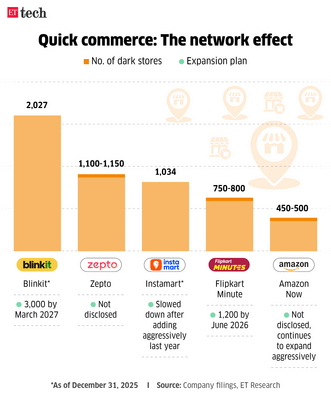
Walmart-owned Flipkart, which launched its quick commerce service Minutes in August 2024, has been adding around 100 dark stores every month this year and the pace of additions would last until June, people in the know said. That would take its network to roughly 1,200 dark stores from 750-800 this month, bringing the network on a par with Zepto’s and Swiggy’s Instamart.
“Minutes is currently present in 70 cities and will expand to around 250 cities by June. It is recording 16-18% month-on-month growth in the number of orders per day currently doing around 1,000-1,100 orders per day per dark store on an average,” a person in the know said.
Some of Minutes’ mature dark stores are servicing a higher number of orders.
“Apart from an aggressive geographical expansion into tier-II and tier-III towns, the company is also doubling down on urban users in key large cities, where Blinkit is dominant,” the person added. Currently present in 70-75 cities, Minutes is planning to expand to 220-250 cities by June.
This comes as Flipkart prepares for a potential initial public offering as early as this year, while quick commerce continues to cannibalise into traditional ecommerce growth, particularly in high-frequency categories like groceries and fast-moving consumer goods.
Flipkart did not respond to ET’s queries.
In January, ET reported that both Amazon and Flipkart had stepped up discounting to challenge incumbents Blinkit, Zepto and Instamart, sparking a fresh price war in the segment.
Amazon, meanwhile, has also scaled up its Now service and is soon expected to have 500 dark stores after accelerating expansion from December, adding about two facilities a day, another person familiar with the development said. The company is clocking 300,000-350,000 orders per day across its network, this person said.
Quick & Easy
In response to queries by ET, an Amazon spokesperson said that the company continues to have an aggressive expansion plan.
“Our rapid scale-up reflects our commitment to serving more neighborhoods with the speed and selection customers expect from Amazon – from essentials in minutes through Amazon Now and a broader selection with deliveries in a few hours, the same day or next day,” the spokesperson said.
In December, Amit Agarwal, Amazon’s senior vice-president for emerging markets, had told ET that the company had seen strong traction in cities where its quick commerce service has been launched, taking on Eternal-owned Blinkit, Instamart and Zepto in an increasingly competitive fight for customer wallet-share in India’s top urban markets.
Currently, both Zepto and Instamart have around 1,100-1,150 dark stores each on their networks, while market leader Blinkit has close to 2,100. The Gurugram-based quick commerce firm has set a target of having 3,000 dark stores by March 2027, in what is the most aggressive scale-up for a large player in the space.
"Late entrants are finding it harder and more expensive to secure real estate and labour, given that four or five players are already present in most urban markets...But both Flipkart and Amazon are still pushing ahead because leadership in quick commerce is strategically important for them," a senior quick commerce executive said.
In its October-December quarter earnings, Swiggy had said that the primary criteria for the large expansion in its quick commerce network over the past was geographical coverage and densification, while also increasing hyperlocal selection. “Having achieved that, new store additions will be a derivative of hyperlocal growth and network utilisation,” it said. “The availability of capital was never a criterion or a constraint for store rollouts, and our store network strategy remains unchanged.”
Also Read: Instamart's market share growth is self-driven, not rival-led: Swiggy group CEO Majety
“In 2025, the performance gap between leaders Blinkit, Instamart, Zepto and challengers Flipkart, Amazon, BigBasket, and JioMart grew materially. We expect higher competitive intensity in 2026 with collective focus by leaders on core customer cohorts to lock-in unit economics and effort by challengers to establish a foothold before it is too late. We expect aggressive discounting, especially in H1-2026 and store expansion all across,” a recent research note by brokerage firm Bernstein said.
Also Read: Reliance’s JioMart hits 1.6 million daily orders, claims to be second-largest qcomm player in India
The quick-commerce foray of Flipkart and Amazon appears to have coincided with the profitability check at pioneers in this space -Swiggy and IPO-bound Zepto – and amid a broader debate over employment conditions in the last-mile, instant delivery revenue stream.
Walmart-owned Flipkart, which launched its quick commerce service Minutes in August 2024, has been adding around 100 dark stores every month this year and the pace of additions would last until June, people in the know said. That would take its network to roughly 1,200 dark stores from 750-800 this month, bringing the network on a par with Zepto’s and Swiggy’s Instamart.
“Minutes is currently present in 70 cities and will expand to around 250 cities by June. It is recording 16-18% month-on-month growth in the number of orders per day currently doing around 1,000-1,100 orders per day per dark store on an average,” a person in the know said.
Some of Minutes’ mature dark stores are servicing a higher number of orders.
“Apart from an aggressive geographical expansion into tier-II and tier-III towns, the company is also doubling down on urban users in key large cities, where Blinkit is dominant,” the person added. Currently present in 70-75 cities, Minutes is planning to expand to 220-250 cities by June.
This comes as Flipkart prepares for a potential initial public offering as early as this year, while quick commerce continues to cannibalise into traditional ecommerce growth, particularly in high-frequency categories like groceries and fast-moving consumer goods.
Flipkart did not respond to ET’s queries.
In January, ET reported that both Amazon and Flipkart had stepped up discounting to challenge incumbents Blinkit, Zepto and Instamart, sparking a fresh price war in the segment.
Amazon, meanwhile, has also scaled up its Now service and is soon expected to have 500 dark stores after accelerating expansion from December, adding about two facilities a day, another person familiar with the development said. The company is clocking 300,000-350,000 orders per day across its network, this person said.
Quick & Easy
In response to queries by ET, an Amazon spokesperson said that the company continues to have an aggressive expansion plan.
“Our rapid scale-up reflects our commitment to serving more neighborhoods with the speed and selection customers expect from Amazon – from essentials in minutes through Amazon Now and a broader selection with deliveries in a few hours, the same day or next day,” the spokesperson said.
In December, Amit Agarwal, Amazon’s senior vice-president for emerging markets, had told ET that the company had seen strong traction in cities where its quick commerce service has been launched, taking on Eternal-owned Blinkit, Instamart and Zepto in an increasingly competitive fight for customer wallet-share in India’s top urban markets.
Currently, both Zepto and Instamart have around 1,100-1,150 dark stores each on their networks, while market leader Blinkit has close to 2,100. The Gurugram-based quick commerce firm has set a target of having 3,000 dark stores by March 2027, in what is the most aggressive scale-up for a large player in the space.
"Late entrants are finding it harder and more expensive to secure real estate and labour, given that four or five players are already present in most urban markets...But both Flipkart and Amazon are still pushing ahead because leadership in quick commerce is strategically important for them," a senior quick commerce executive said.
In its October-December quarter earnings, Swiggy had said that the primary criteria for the large expansion in its quick commerce network over the past was geographical coverage and densification, while also increasing hyperlocal selection. “Having achieved that, new store additions will be a derivative of hyperlocal growth and network utilisation,” it said. “The availability of capital was never a criterion or a constraint for store rollouts, and our store network strategy remains unchanged.”
Also Read: Instamart's market share growth is self-driven, not rival-led: Swiggy group CEO Majety
“In 2025, the performance gap between leaders Blinkit, Instamart, Zepto and challengers Flipkart, Amazon, BigBasket, and JioMart grew materially. We expect higher competitive intensity in 2026 with collective focus by leaders on core customer cohorts to lock-in unit economics and effort by challengers to establish a foothold before it is too late. We expect aggressive discounting, especially in H1-2026 and store expansion all across,” a recent research note by brokerage firm Bernstein said.
Also Read: Reliance’s JioMart hits 1.6 million daily orders, claims to be second-largest qcomm player in India
Next Story
