
Is this why aliens haven't reached us?


We may have been missing signals from intelligent aliens because of solar winds. Researchers from the Search for Extraterrestrial Intelligence (SETI) Institute say this means we have been watching for the wrong type of signal, potentially failing to spot promising evidence of extraterrestrial life, but the chances of a future discovery are now higher. The not-for-profit organisation carries out research to help prove the existence of alien life, which includes listening for extraterrestrial radio signals that cannot be explained by natural cosmological phenomena.
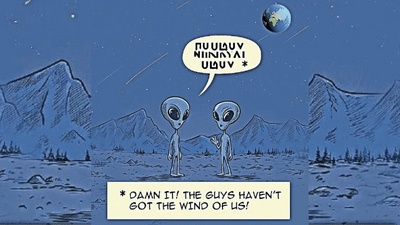
Such a signal was previously expected to be a sharp, distinct radio signal in a narrow frequency range. But the new research suggests that any such signal sent from a distant planet may end up being made fainter and wider in the frequency band – essentially blurred slightly – as they pass through the plasma winds of stars.
Vishal Gajjar and Grayce Brown at the SETI Institute calculated the scale of the effect on radio transmissions from spacecraft in our solar system, then extrapolated that to other stellar environments. They found that a 100-megahertz signal could be widened as much as 100 hertz – enough to "fall below traditional detection thresholds" (The Astrophysical Journal). A space weather event can similarly increase the amount of broadening experienced by a signal by several orders of magnitude.
John Elliott at the University of St Andrews, UK, says he sees the news as the glass being half-full, not half-empty: it means previous searches may have missed evidence, but also means that future searches will be more likely to succeed. “It's over 50 years that we've been actively researching and that’s a blink of the eye, isn't it, when you think about it,” says Elliott.
(Matthew Sparkes, New Scientist, distributed by Tribune Content Agency)
Such a signal was previously expected to be a sharp, distinct radio signal in a narrow frequency range. But the new research suggests that any such signal sent from a distant planet may end up being made fainter and wider in the frequency band – essentially blurred slightly – as they pass through the plasma winds of stars.
Vishal Gajjar and Grayce Brown at the SETI Institute calculated the scale of the effect on radio transmissions from spacecraft in our solar system, then extrapolated that to other stellar environments. They found that a 100-megahertz signal could be widened as much as 100 hertz – enough to "fall below traditional detection thresholds" (The Astrophysical Journal). A space weather event can similarly increase the amount of broadening experienced by a signal by several orders of magnitude.
John Elliott at the University of St Andrews, UK, says he sees the news as the glass being half-full, not half-empty: it means previous searches may have missed evidence, but also means that future searches will be more likely to succeed. “It's over 50 years that we've been actively researching and that’s a blink of the eye, isn't it, when you think about it,” says Elliott.
(Matthew Sparkes, New Scientist, distributed by Tribune Content Agency)
Next Story