
Less is more for AI companies scaling their revenues with a lean workforce


AI-native startups in India are building market-ready products with far smaller teams, with AI tools helping them hit revenue milestones faster while keeping headcount and capital requirements low, according to founders.
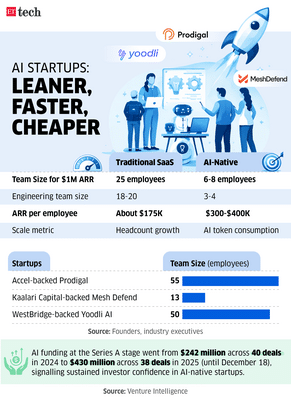
Shantanu Gangal, founder of Prodigal, which builds intelligence software for loan servicing and collections, said the company has reorganised itself around smaller, more productive teams. “We’ve restructured the company such that engineering pods of three to four people run large business lines. Earlier, these teams would have been closer to 18 people,” he said.

The startup has raised $12 million in a series A round led by Menlo Ventures.
“Typical industry benchmarks for SaaS put ARR (annual recurring revenue) per employee roughly at around $175,000. With AI, you can make each person far more productive,” said Varun Puri, cofounder and chief executive of Yoodli AI, a voice AI startup backed by WestBridge Capital.
Yoodli altered team economics at later stages of growth and its “ARR per employee numbers are reaching $300,000 to $400,000, if not higher,” Puri told ET.
The startup, which has raised close to $60 million and tripled its valuation to about $300 million in six months, operates with a lean workforce of around 50 employees, he said.
According to Ankur Capital’s Deep Science Report, 2025, Indian startups benefit from a “lean launch” advantage that accelerates the time-to-market.
“Unlike (larger) enterprises that require months of legal negotiations and relationship building, SMEs care about two things: does the product perform and is the price right?” the report said. This allows startups to launch faster and burn less capital.
The report also highlighted that Indian startups build pilot projects at roughly one-eighth the cost of global peers and commercial facilities at about one-fourth the cost, aided by SME partnerships, government grants, and domestic intellectual property creation.
In 2021, a B2B SaaS startup typically required a team of about 25 people across engineering, sales, operations, and marketing to reach $1 million in annual recurring revenue (ARR), according to benchmarks highlighted by Jason Lemkin, founder of SaaStr, a global B2B SaaS community.
In 2025-26, many AI-native startups are hitting the same milestone with six to eight employees by embedding AI across code generation, customer support, and sales outreach.
“Today, if you’re building an AI company and targeting either enterprises or consumers, given how capable the models have become, it is fairly easy to build a strong starting platform with a very small team,” said Suvonil Chatterjee, former chief technology and product officer at Ola Electric, who is now building enterprise robotics startup Manav.
Bengaluru-based Even Healthcare, which recently raised $20 million to expand its managed-care hospital network, said a lean-team approach has been central to its strategy.
Growth has a new metric
The trend is visible even in the early stages. Bengaluru-based Mesh Defend, which raised $2.3 million in a pre-seed round led by Kalaari Capital, operates with a core team of around 13 people. Founded in 2025 by former Dell executives Tejas Pandit and Ravi Chitloor, the startup has built an AI-driven platform to manage enterprise data infrastructure.
“With AI-enabled development, one engineer can be equal to 10,” said Pandit. “Smaller teams are making startups far more capital-efficient.”
For many AI startups, scale is increasingly measured differently.
“Scaling today also means how many tokens we consume. We recently got a block from OpenAI, and it’s not even our biggest AI vendor,” Gangal of Prodigal said. “Token consumption is a real metric of scale because it replaces work that would earlier require more headcount. Revenue growth still matters most, but we’re able to scale revenue without scaling headcount as before,” he explained.
Puri of Yoodli said leaner teams do not necessarily mean fewer hires, but different ones. “We now look for hyper-generalists or people who can orchestrate AI agents. Roles like go-to-market engineers or marketing orchestrators of AI agents were not typical earlier,” he said.
At Yoodli, around 80% of employees actively use AI tools, with spending on AI infrastructure accounting for about 8–10% of overall costs.
Fundraising is changing
The lean operating model is also influencing fundraising. Several AI startup founders told ET they do not see the need to raise multiple rounds of capital after securing early funding from friends, family, or angel investors.
One founder building an AI-based fitness accountability platform said the startup raised Rs 10 lakh in seed funding around four months ago and has since turned cash-flow positive. “We are already generating revenues from around 50 users, and our product development cost has been almost negligible,” the founder said.
Some investors and founders describe these shifts as early signs of “seed-strapping.”
A term popular in Silicon Valley, seed-strapping refers to a hybrid fundraising approach where a startup raises one meaningful early-stage round – typically between $500,000 and $2 million – and then focuses on becoming revenue-backed or profitable without continuous follow-on rounds.
While the model is sector-agnostic, founders said it is increasingly visible among AI-native SaaS startups where lower costs, faster execution and early revenues are defining scale and capital efficiency.
“Seed-strapping is more relevant for AI SaaS companies that can leverage the generative AI infrastructure already available to them, without carrying the legacy costs of large teams,” said Manu Iyer, managing director of Blue Hill VC.
These startups are able to get to market faster and generate credible revenues early, creating a self-reinforcing cycle of growth without an immediate need for large external capital, he said.
The shift is not driven by AI alone. Building startups has also become cheaper in India.
India’s Digital Public Infrastructure (DPI), including UPI, Aadhaar-based e-KYC, DigiLocker, the Account Aggregator framework, ONDC, etc., have sharply reduced the cost of onboarding customers and meeting regulatory requirements, lowering the capital needed to reach early revenue milestones.
Shantanu Gangal, founder of Prodigal, which builds intelligence software for loan servicing and collections, said the company has reorganised itself around smaller, more productive teams. “We’ve restructured the company such that engineering pods of three to four people run large business lines. Earlier, these teams would have been closer to 18 people,” he said.
The startup has raised $12 million in a series A round led by Menlo Ventures.
“Typical industry benchmarks for SaaS put ARR (annual recurring revenue) per employee roughly at around $175,000. With AI, you can make each person far more productive,” said Varun Puri, cofounder and chief executive of Yoodli AI, a voice AI startup backed by WestBridge Capital.
Yoodli altered team economics at later stages of growth and its “ARR per employee numbers are reaching $300,000 to $400,000, if not higher,” Puri told ET.
The startup, which has raised close to $60 million and tripled its valuation to about $300 million in six months, operates with a lean workforce of around 50 employees, he said.
According to Ankur Capital’s Deep Science Report, 2025, Indian startups benefit from a “lean launch” advantage that accelerates the time-to-market.
“Unlike (larger) enterprises that require months of legal negotiations and relationship building, SMEs care about two things: does the product perform and is the price right?” the report said. This allows startups to launch faster and burn less capital.
The report also highlighted that Indian startups build pilot projects at roughly one-eighth the cost of global peers and commercial facilities at about one-fourth the cost, aided by SME partnerships, government grants, and domestic intellectual property creation.
In 2021, a B2B SaaS startup typically required a team of about 25 people across engineering, sales, operations, and marketing to reach $1 million in annual recurring revenue (ARR), according to benchmarks highlighted by Jason Lemkin, founder of SaaStr, a global B2B SaaS community.
In 2025-26, many AI-native startups are hitting the same milestone with six to eight employees by embedding AI across code generation, customer support, and sales outreach.
“Today, if you’re building an AI company and targeting either enterprises or consumers, given how capable the models have become, it is fairly easy to build a strong starting platform with a very small team,” said Suvonil Chatterjee, former chief technology and product officer at Ola Electric, who is now building enterprise robotics startup Manav.
Bengaluru-based Even Healthcare, which recently raised $20 million to expand its managed-care hospital network, said a lean-team approach has been central to its strategy.
Growth has a new metric
The trend is visible even in the early stages. Bengaluru-based Mesh Defend, which raised $2.3 million in a pre-seed round led by Kalaari Capital, operates with a core team of around 13 people. Founded in 2025 by former Dell executives Tejas Pandit and Ravi Chitloor, the startup has built an AI-driven platform to manage enterprise data infrastructure.
“With AI-enabled development, one engineer can be equal to 10,” said Pandit. “Smaller teams are making startups far more capital-efficient.”
For many AI startups, scale is increasingly measured differently.
“Scaling today also means how many tokens we consume. We recently got a block from OpenAI, and it’s not even our biggest AI vendor,” Gangal of Prodigal said. “Token consumption is a real metric of scale because it replaces work that would earlier require more headcount. Revenue growth still matters most, but we’re able to scale revenue without scaling headcount as before,” he explained.
Puri of Yoodli said leaner teams do not necessarily mean fewer hires, but different ones. “We now look for hyper-generalists or people who can orchestrate AI agents. Roles like go-to-market engineers or marketing orchestrators of AI agents were not typical earlier,” he said.
At Yoodli, around 80% of employees actively use AI tools, with spending on AI infrastructure accounting for about 8–10% of overall costs.
Fundraising is changing
The lean operating model is also influencing fundraising. Several AI startup founders told ET they do not see the need to raise multiple rounds of capital after securing early funding from friends, family, or angel investors.
One founder building an AI-based fitness accountability platform said the startup raised Rs 10 lakh in seed funding around four months ago and has since turned cash-flow positive. “We are already generating revenues from around 50 users, and our product development cost has been almost negligible,” the founder said.
Some investors and founders describe these shifts as early signs of “seed-strapping.”
A term popular in Silicon Valley, seed-strapping refers to a hybrid fundraising approach where a startup raises one meaningful early-stage round – typically between $500,000 and $2 million – and then focuses on becoming revenue-backed or profitable without continuous follow-on rounds.
While the model is sector-agnostic, founders said it is increasingly visible among AI-native SaaS startups where lower costs, faster execution and early revenues are defining scale and capital efficiency.
“Seed-strapping is more relevant for AI SaaS companies that can leverage the generative AI infrastructure already available to them, without carrying the legacy costs of large teams,” said Manu Iyer, managing director of Blue Hill VC.
These startups are able to get to market faster and generate credible revenues early, creating a self-reinforcing cycle of growth without an immediate need for large external capital, he said.
The shift is not driven by AI alone. Building startups has also become cheaper in India.
India’s Digital Public Infrastructure (DPI), including UPI, Aadhaar-based e-KYC, DigiLocker, the Account Aggregator framework, ONDC, etc., have sharply reduced the cost of onboarding customers and meeting regulatory requirements, lowering the capital needed to reach early revenue milestones.
Next Story