
Rapid fashion companies dress to kill...how fit is the model?


A new crop of venture-backed startups is testing the quick-commerce playbook in fashion, delivering clothing, footwear and accessories in under an hour in metro cities, but high cash burn and uncertain demand are raising questions about the model’s scalability.
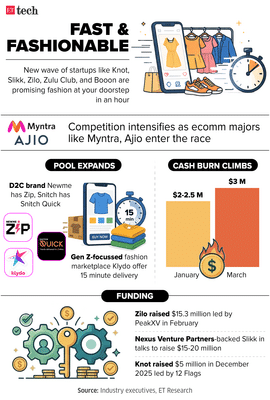
Startups such as Knot, Slikk and Zilo along with quick-delivery arms of online fashion players Myntra, Ajio and Newme are burning cash on heavy discounting to attract customers. These ‘rapid fashion’ startups together burned $2-2.5 million in January alone, which rose to $3 million in March, multiple industry executives told ET.

Despite the cash burn, the segment has gathered the attention of investors who bet on it becoming the next quick commerce breakthrough. In February, Zilo raised $15.3 million funding led by Peak XV. Slikk, which is backed by Lightspeed and Nexus Venture Partners, is in talks to raise $15-20 million more, ET reported in March. Knot raised a $5 million round led by 12 Flags in December.
The segment evolved from quick-commerce platforms such as Zepto, Instamart and Blinkit, which offered basic fashion items for last-minute purchases. Then emerged vertical fashion commerce startups offering a larger portfolio for party, work and festive wear with rapid delivery.
Newly-launched fast fashion marketplace Klydo offers delivery in 15-30 minutes in Bengaluru while Gen Z-focused direct-to-consumer (D2C) brand Newme’s Zip offers 30-minute delivery and men’s D2C fashion brand Snitch has launched ‘Snitch Quick’. Launched in 2024, Myntra’s rapid commerce arm M-Now, was driving 10% of orders in locations where the service was live as of last November. Taking it one step further, these rapid fashion players have launched ‘try and buy’ and ‘virtual try-on’ options to tackle the return problems.
Investors upbeat
Investors believe the growing segment has high potential and room for a number of successful players. “Online fashion hasn't meaningfully evolved in a decade,” said Sunitha Viswanathan, partner at Kae Capital, which invested in Mumbai-based Knot last December.
Ecommerce has a strong fashion catalogue but the experience—waiting for days for delivery and hoping the fit works—“doesn’t resonate with young shoppers who are driven by impulse and influenced by social media,” she noted.
The quick commerce market size for fashion is about $1.7-2 billion currently, according to Kae Capital. “The price of the pie is much larger,” Viswanathan said.
Some said high enough order density to justify the infrastructure within a tight catchment is key for the model’s success.
“This will only work when there is an additional value proposition of better products and better portfolio,” said Dipanjan Basu, cofounder and partner at Fireside Ventures, which has invested in Newme. “Convenience alone cannot be the mode for this business.”
Also Read: Scroll, spot, buy: Why fashion and lifestyle shopping is growing on Instagram
Also, keeping up with ever-changing fashion preferences remains a major hurdle, experts said.
Platforms are using artificial intelligence (AI) to predict design and demand to be more efficient with space and inventory. However, these AI tools built for reducing returns haven’t been able to make significant headway.
“The inventory issue is very real. Platforms are unable to solve this using AI,” an investor in one of these startups said on condition of anonymity. “Users want to see more options in rapid commerce because they are tuned to seeing thousands of options in fashion for years.”
Different approaches
Unlike most platforms in the segment that use dark stores for inventory, platforms like Zilo and Booon have partnered with brand stores to improve their stock keeping units (SKUs).
“Like the horizontal and vertical players, we also launched our business powered by dark stores. Parallelly, we integrated brand stores to our network as well,” said Bhavik Jhaveri, founder of Zilo. “This way, users get access to a larger choice, which is integral to the customer in this segment.”
He explained that dark stores can only hold 7,000–8,000 styles and marketing as a ‘last minute’ store, a firm can get one or two transactions from each user.
Booon, founded by former Myntra executive Arun Kumar, has taken a similar approach to operate on a zero dark store model. “Unlike others, this segment needs a large number of SKUs because consumers want choices for every occasion, price-point and more,” Kumar said.
The platform is currently in talks to raise its first funding round.
Also Read: India’s beauty and personal care market set to grow to $39 billion in FY30: Report
Startups such as Knot, Slikk and Zilo along with quick-delivery arms of online fashion players Myntra, Ajio and Newme are burning cash on heavy discounting to attract customers. These ‘rapid fashion’ startups together burned $2-2.5 million in January alone, which rose to $3 million in March, multiple industry executives told ET.
Despite the cash burn, the segment has gathered the attention of investors who bet on it becoming the next quick commerce breakthrough. In February, Zilo raised $15.3 million funding led by Peak XV. Slikk, which is backed by Lightspeed and Nexus Venture Partners, is in talks to raise $15-20 million more, ET reported in March. Knot raised a $5 million round led by 12 Flags in December.
The segment evolved from quick-commerce platforms such as Zepto, Instamart and Blinkit, which offered basic fashion items for last-minute purchases. Then emerged vertical fashion commerce startups offering a larger portfolio for party, work and festive wear with rapid delivery.
Newly-launched fast fashion marketplace Klydo offers delivery in 15-30 minutes in Bengaluru while Gen Z-focused direct-to-consumer (D2C) brand Newme’s Zip offers 30-minute delivery and men’s D2C fashion brand Snitch has launched ‘Snitch Quick’. Launched in 2024, Myntra’s rapid commerce arm M-Now, was driving 10% of orders in locations where the service was live as of last November. Taking it one step further, these rapid fashion players have launched ‘try and buy’ and ‘virtual try-on’ options to tackle the return problems.
Investors upbeat
Investors believe the growing segment has high potential and room for a number of successful players. “Online fashion hasn't meaningfully evolved in a decade,” said Sunitha Viswanathan, partner at Kae Capital, which invested in Mumbai-based Knot last December.
Ecommerce has a strong fashion catalogue but the experience—waiting for days for delivery and hoping the fit works—“doesn’t resonate with young shoppers who are driven by impulse and influenced by social media,” she noted.
The quick commerce market size for fashion is about $1.7-2 billion currently, according to Kae Capital. “The price of the pie is much larger,” Viswanathan said.
Some said high enough order density to justify the infrastructure within a tight catchment is key for the model’s success.
“This will only work when there is an additional value proposition of better products and better portfolio,” said Dipanjan Basu, cofounder and partner at Fireside Ventures, which has invested in Newme. “Convenience alone cannot be the mode for this business.”
Also Read: Scroll, spot, buy: Why fashion and lifestyle shopping is growing on Instagram
Also, keeping up with ever-changing fashion preferences remains a major hurdle, experts said.
Platforms are using artificial intelligence (AI) to predict design and demand to be more efficient with space and inventory. However, these AI tools built for reducing returns haven’t been able to make significant headway.
“The inventory issue is very real. Platforms are unable to solve this using AI,” an investor in one of these startups said on condition of anonymity. “Users want to see more options in rapid commerce because they are tuned to seeing thousands of options in fashion for years.”
Different approaches
Unlike most platforms in the segment that use dark stores for inventory, platforms like Zilo and Booon have partnered with brand stores to improve their stock keeping units (SKUs).
“Like the horizontal and vertical players, we also launched our business powered by dark stores. Parallelly, we integrated brand stores to our network as well,” said Bhavik Jhaveri, founder of Zilo. “This way, users get access to a larger choice, which is integral to the customer in this segment.”
He explained that dark stores can only hold 7,000–8,000 styles and marketing as a ‘last minute’ store, a firm can get one or two transactions from each user.
Booon, founded by former Myntra executive Arun Kumar, has taken a similar approach to operate on a zero dark store model. “Unlike others, this segment needs a large number of SKUs because consumers want choices for every occasion, price-point and more,” Kumar said.
The platform is currently in talks to raise its first funding round.
Also Read: India’s beauty and personal care market set to grow to $39 billion in FY30: Report
Next Story