
Sam Altman vs Elon Musk: The billion-dollar feud


On April 27, the companies led by two of the most powerful figures in the tech world will face each other: not on social media or a podcast, but in a courtroom. Elon Musk , the world's richest man and owner of Tesla, SpaceX and X, will go to trial against Sam Altman , the CEO of OpenAI , the company behind ChatGPT. The lawsuit – which Musk filed in early 2024; then withdrew in the same year and revived the action in early 2026 – is not about money in the traditional sense. It is about a ‘broken promise’, as per Musk. His central argument is that OpenAI was founded as a nonprofit dedicated to developing artificial intelligence (AI) for the benefit of all humanity. He claimed that Altman, along with the company’s board and co-founders, abandoned that mission in pursuit of profit.
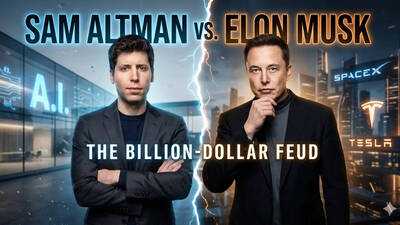
Altman and OpenAI, for their part, have pushed back hard, calling the lawsuit a distraction driven by competitive jealousy. They have pointed out that Musk is now building a rival AI company called xAI, which competes directly with OpenAI, and this trial is one of the ways he wants to block the success of the ChatGPT-maker. The trial is expected to be one of the most closely watched legal battles in Silicon Valley history. But to understand why it matters, you have to go back to the beginning.
The birth of OpenAI
By the mid-2010s, a small, influential group of researchers and technologists were working on artificial intelligence (AI). Google had acquired DeepMind, one of the world’s foremost AI research labs, in 2014. Facebook, Amazon, and other tech giants were pouring billions into their own AI divisions. There was a fear that if the most powerful AI in the world was being built inside a handful of trillion-dollar corporations, they would control the future.
Elon Musk shared this fear, so he decided to rope in a bunch of AI researchers, including Sam Altman, who at the time was the president of Y Combinator, Silicon Valley's most prestigious startup accelerator. They, along with a group of researchers and investors, including Greg Brockman, Ilya Sutskever, Wojciech Zaremba, and others, decided to do establish a non-profit entity.
In December 2015, OpenAI was formally announced as a nonprofit AI research company. The founding pledge was over a billion dollars in committed funding from its founders, including Musk and Peter Thiel, with Musk contributing around $100 million over time. The mission was stated clearly: to ensure that artificial general intelligence, or AGI, would benefit all of humanity rather than a select few. That’s why it was called OpenAI.
Musk was a co-founder and co-chair. Altman joined the board. Ilya Sutskever, one of the most respected AI researchers in the world, left Google to become OpenAI’s chief scientist. The team set up shop in San Francisco and got to work.
The company published its research openly, sharing findings with the wider scientific community. It attracted some of the brightest minds in the field, including Anthropic CEO Dario Amodei, who joined the company in 2016. He was an employee at Baidu, a Chinese tech giant, and Google. He quickly rose to become the vice president of research, playing a key role in developing GPT-2 and GPT-3.
However, the mission quickly ran into finance-related problems. Training cutting-edge AI models requires enormous amounts of computing power, which means enormous amounts of money. By 2018, Musk and the board began to disagree over the company’s direction. Musk reportedly wanted more control and pushed for the CEO role. The board declined. In early 2019, Musk resigned from OpenAI's board.
Shortly after his departure, OpenAI made a decision that would later become the key point of contention of Musk’s lawsuit. Altman-led company created a “capped profit” subsidiary - a for-profit arm designed to attract external investment, while still claiming to serve the original nonprofit mission. Altman became CEO, and the company began raising serious money.
In 2021, Amodei also left the company to find Anthropic, which is one of biggest AI companies in the world and launched the popular Claude AI.
ChatGPT arrives and tech revolution begins
For most of its early years, OpenAI was known primarily within AI research circles. That changed on November 30, 2022, when the company released ChatGPT to the public. The response? It was unlike anything the tech world had seen in years. Within five days, ChatGPT had one million users. Within two months, it had crossed 100 million, making it the fastest-growing consumer application in history, according to a UBS study.
The report, citing data from analytics firm Similarweb, said an average of about 13 million unique visitors had used ChatGPT per day in January, more than double the levels of December. To put the numbers in perspective, it took TikTok about nine months after its global launch to reach 100 million users and Instagram 2-1/2 years, according to data from Sensor Tower.
People were using it to write essays, debug code, compose emails, draft legal documents, plan holidays, and have thoughtful conversations.
But there was panic inside Google. The search giant – that became an AI-first company in 2016 and was working with two teams: Google Brain and DeepMind – had spent years building its own AI capabilities, but had held back from releasing powerful consumer-facing AI tools. Reports said, and later CEO Sundar Pichai confirmed that Google had an AI chatbot like ChatGPT but did not release it partly out of concern that they were not ready and partly out of fear of the reputational risk of a chatbot saying something wrong or harmful.
Two things happened: ChatGPT’s success implied that the world was ready for the technological transformation and a cautious strategy look dangerously naive overnight. Google’s leadership reportedly declared a state of internal emergency, which was quickly dubbed “Code Red” in press reports. Co-founders Larry Page and Sergey Brin , who had largely stepped back from the company's day-to-day operations, were reportedly called back in to help coordinate the response. Google fast-tracked the development of Bard, its own AI chatbot, and began integrating AI features into its core search product.
It was a remarkable turn of events. Google invented the ‘T’ in GPT - and had published the 2017 research paper on “Transformer” architecture that made ChatGPT possible in the first place.
Microsoft bets big: $13 Billion and a partnership
For OpenAI and Altman, Google’s ‘Code Red’ was validation that the company was on the right track but it tasted success when Microsoft came calling. Microsoft had made an initial $1 billion investment in OpenAI back in 2019 but after ChatGPT's explosive arrival, in January 2023, Microsoft announced a new multi-year, multi-billion-dollar investment in OpenAI, a deal widely reported to be worth around $13 billion in total over time. This gave Microsoft approximately 49% of OpenAI's for-profit arm and exclusive rights to integrate OpenAI's technology into its products.

For Microsoft CEO Satya Nadella , it was the most important strategic move of his tenure. Microsoft moved fast. It integrated OpenAI's GPT models into its Bing search engine, briefly making Bing genuinely interesting for the first time in its history.
“We competed today. Today we brought more competition to search. I've been waiting 20 years for this. They're still the 800-pound gorilla in search,” Nadella said, on launching AI-powered Bing Search.
More significantly, it launched Copilot — an AI assistant embedded across its entire suite of Office products, including Word, Excel, PowerPoint, Outlook, and Teams.
“I hope that, with our innovation, they'll come out and show they can dance. And I want people to know-we made them dance. That would be a great day,” Nadella added pointedly.
Elon Musk watched OpenAI going from non-profit to for-profit
Elon Musk had been watching all of this unfold with growing fury. From his perspective, everything he had feared was coming true. In his words, the organisation he had helped found, funded started to become a for-profit enterprise. In 2023, Musk launched xAI, his own AI company. His chatbot, Grok, was integrated into X, formerly Twitter.
Musk started to accuse Altman of betraying OpenAI’s founding mission, called the Microsoft deal a corruption of everything the organisation was meant to stand for, and questioned whether the AI being built behind closed doors at OpenAI was truly safe or aligned with human interests. Altman pushed back, and the exchanges on X grew increasingly sharp, with both men trading accusations and Altman even revealing internal emails to paint a bad picture of Musk.
Inside OpenAI: Chaos, an ousting and a comeback
While the public feud played out, something extraordinary was happening inside OpenAI itself. In November 2023, a year after ChatGPT’s launch, the company's board of directors fired Sam Altman, citing a lack of transparency with the board. Microsoft's Nadella publicly expressed support for Altman and offered him a position at Microsoft if he wanted one. Within five days, Altman was back as CEO. Several board members who had voted to fire him were gone.

The following months saw a wave of high-profile departures with Ilya Sutskever leaving in May 2024 and Mira Murati , the CTO who had briefly served as interim CEO during the chaos, resigned in September 2024. Several other senior researchers followed, citing concerns about the company's direction and safety culture. By that time, Musk had sued OpenAI for the second time.
As the AI companies became hungrier for AI infrastructure, Altman went on a fundraising and dealmaking run. SoftBank committed $500 million to OpenAI, with others include Amazon, Nvidia, and Oracle with which Project Stargate was announced with an investment of $500 billion in AI infrastructure in the US over four years.
Google fights back
Google, stung by its early stumbles with Bard, regrouped and launched its flagship AI model Gemini, which quickly closed the gap on GPT-4. By the time Gemini Ultra and later iterations arrived, the narrative had shifted. Benchmarks showed Google's models competing seriously with OpenAI's best.
The company had won Search case in September, pushing its stocks. In November 2025, Google launched Gemini 3 and became a huge success, launching the company to become one of the leaders in the AI industry. The “Code Red” phrase began appearing in reports about OpenAI's internal culture.
Back to the Courtroom: Which brings us back to April 27. Elon Musk's lawsuit against Sam Altman and OpenAI has gone through several iterations and legal challenges since it was first filed. At its core, the case rests on Musk’s claim that he was induced to donate tens of millions of dollars to OpenAI based on a nonprofit structure, open research, a mission to benefit humanity.
He argues that OpenAI's transformation into a for-profit entity with its partnership with Microsoft. OpenAI and Altman have moved to dismiss the case multiple times, arguing that Musk's claims are legally and factually weak, driven by competitive motivation rather than genuine grievance.
Altman and OpenAI, for their part, have pushed back hard, calling the lawsuit a distraction driven by competitive jealousy. They have pointed out that Musk is now building a rival AI company called xAI, which competes directly with OpenAI, and this trial is one of the ways he wants to block the success of the ChatGPT-maker. The trial is expected to be one of the most closely watched legal battles in Silicon Valley history. But to understand why it matters, you have to go back to the beginning.
The birth of OpenAI
By the mid-2010s, a small, influential group of researchers and technologists were working on artificial intelligence (AI). Google had acquired DeepMind, one of the world’s foremost AI research labs, in 2014. Facebook, Amazon, and other tech giants were pouring billions into their own AI divisions. There was a fear that if the most powerful AI in the world was being built inside a handful of trillion-dollar corporations, they would control the future.
Elon Musk shared this fear, so he decided to rope in a bunch of AI researchers, including Sam Altman, who at the time was the president of Y Combinator, Silicon Valley's most prestigious startup accelerator. They, along with a group of researchers and investors, including Greg Brockman, Ilya Sutskever, Wojciech Zaremba, and others, decided to do establish a non-profit entity.
In December 2015, OpenAI was formally announced as a nonprofit AI research company. The founding pledge was over a billion dollars in committed funding from its founders, including Musk and Peter Thiel, with Musk contributing around $100 million over time. The mission was stated clearly: to ensure that artificial general intelligence, or AGI, would benefit all of humanity rather than a select few. That’s why it was called OpenAI.
Musk was a co-founder and co-chair. Altman joined the board. Ilya Sutskever, one of the most respected AI researchers in the world, left Google to become OpenAI’s chief scientist. The team set up shop in San Francisco and got to work.
The company published its research openly, sharing findings with the wider scientific community. It attracted some of the brightest minds in the field, including Anthropic CEO Dario Amodei, who joined the company in 2016. He was an employee at Baidu, a Chinese tech giant, and Google. He quickly rose to become the vice president of research, playing a key role in developing GPT-2 and GPT-3.
However, the mission quickly ran into finance-related problems. Training cutting-edge AI models requires enormous amounts of computing power, which means enormous amounts of money. By 2018, Musk and the board began to disagree over the company’s direction. Musk reportedly wanted more control and pushed for the CEO role. The board declined. In early 2019, Musk resigned from OpenAI's board.
Shortly after his departure, OpenAI made a decision that would later become the key point of contention of Musk’s lawsuit. Altman-led company created a “capped profit” subsidiary - a for-profit arm designed to attract external investment, while still claiming to serve the original nonprofit mission. Altman became CEO, and the company began raising serious money.
In 2021, Amodei also left the company to find Anthropic, which is one of biggest AI companies in the world and launched the popular Claude AI.
ChatGPT arrives and tech revolution begins
For most of its early years, OpenAI was known primarily within AI research circles. That changed on November 30, 2022, when the company released ChatGPT to the public. The response? It was unlike anything the tech world had seen in years. Within five days, ChatGPT had one million users. Within two months, it had crossed 100 million, making it the fastest-growing consumer application in history, according to a UBS study.
The report, citing data from analytics firm Similarweb, said an average of about 13 million unique visitors had used ChatGPT per day in January, more than double the levels of December. To put the numbers in perspective, it took TikTok about nine months after its global launch to reach 100 million users and Instagram 2-1/2 years, according to data from Sensor Tower.
People were using it to write essays, debug code, compose emails, draft legal documents, plan holidays, and have thoughtful conversations.
But there was panic inside Google. The search giant – that became an AI-first company in 2016 and was working with two teams: Google Brain and DeepMind – had spent years building its own AI capabilities, but had held back from releasing powerful consumer-facing AI tools. Reports said, and later CEO Sundar Pichai confirmed that Google had an AI chatbot like ChatGPT but did not release it partly out of concern that they were not ready and partly out of fear of the reputational risk of a chatbot saying something wrong or harmful.
Two things happened: ChatGPT’s success implied that the world was ready for the technological transformation and a cautious strategy look dangerously naive overnight. Google’s leadership reportedly declared a state of internal emergency, which was quickly dubbed “Code Red” in press reports. Co-founders Larry Page and Sergey Brin , who had largely stepped back from the company's day-to-day operations, were reportedly called back in to help coordinate the response. Google fast-tracked the development of Bard, its own AI chatbot, and began integrating AI features into its core search product.
It was a remarkable turn of events. Google invented the ‘T’ in GPT - and had published the 2017 research paper on “Transformer” architecture that made ChatGPT possible in the first place.
Microsoft bets big: $13 Billion and a partnership
For OpenAI and Altman, Google’s ‘Code Red’ was validation that the company was on the right track but it tasted success when Microsoft came calling. Microsoft had made an initial $1 billion investment in OpenAI back in 2019 but after ChatGPT's explosive arrival, in January 2023, Microsoft announced a new multi-year, multi-billion-dollar investment in OpenAI, a deal widely reported to be worth around $13 billion in total over time. This gave Microsoft approximately 49% of OpenAI's for-profit arm and exclusive rights to integrate OpenAI's technology into its products.
For Microsoft CEO Satya Nadella , it was the most important strategic move of his tenure. Microsoft moved fast. It integrated OpenAI's GPT models into its Bing search engine, briefly making Bing genuinely interesting for the first time in its history.
“We competed today. Today we brought more competition to search. I've been waiting 20 years for this. They're still the 800-pound gorilla in search,” Nadella said, on launching AI-powered Bing Search.
More significantly, it launched Copilot — an AI assistant embedded across its entire suite of Office products, including Word, Excel, PowerPoint, Outlook, and Teams.
“I hope that, with our innovation, they'll come out and show they can dance. And I want people to know-we made them dance. That would be a great day,” Nadella added pointedly.
Elon Musk watched OpenAI going from non-profit to for-profit
Musk started to accuse Altman of betraying OpenAI’s founding mission, called the Microsoft deal a corruption of everything the organisation was meant to stand for, and questioned whether the AI being built behind closed doors at OpenAI was truly safe or aligned with human interests. Altman pushed back, and the exchanges on X grew increasingly sharp, with both men trading accusations and Altman even revealing internal emails to paint a bad picture of Musk.
Inside OpenAI: Chaos, an ousting and a comeback
While the public feud played out, something extraordinary was happening inside OpenAI itself. In November 2023, a year after ChatGPT’s launch, the company's board of directors fired Sam Altman, citing a lack of transparency with the board. Microsoft's Nadella publicly expressed support for Altman and offered him a position at Microsoft if he wanted one. Within five days, Altman was back as CEO. Several board members who had voted to fire him were gone.
The following months saw a wave of high-profile departures with Ilya Sutskever leaving in May 2024 and Mira Murati , the CTO who had briefly served as interim CEO during the chaos, resigned in September 2024. Several other senior researchers followed, citing concerns about the company's direction and safety culture. By that time, Musk had sued OpenAI for the second time.
As the AI companies became hungrier for AI infrastructure, Altman went on a fundraising and dealmaking run. SoftBank committed $500 million to OpenAI, with others include Amazon, Nvidia, and Oracle with which Project Stargate was announced with an investment of $500 billion in AI infrastructure in the US over four years.
Google fights back
Google, stung by its early stumbles with Bard, regrouped and launched its flagship AI model Gemini, which quickly closed the gap on GPT-4. By the time Gemini Ultra and later iterations arrived, the narrative had shifted. Benchmarks showed Google's models competing seriously with OpenAI's best.
The company had won Search case in September, pushing its stocks. In November 2025, Google launched Gemini 3 and became a huge success, launching the company to become one of the leaders in the AI industry. The “Code Red” phrase began appearing in reports about OpenAI's internal culture.
Back to the Courtroom: Which brings us back to April 27. Elon Musk's lawsuit against Sam Altman and OpenAI has gone through several iterations and legal challenges since it was first filed. At its core, the case rests on Musk’s claim that he was induced to donate tens of millions of dollars to OpenAI based on a nonprofit structure, open research, a mission to benefit humanity.
He argues that OpenAI's transformation into a for-profit entity with its partnership with Microsoft. OpenAI and Altman have moved to dismiss the case multiple times, arguing that Musk's claims are legally and factually weak, driven by competitive motivation rather than genuine grievance.
Next Story