
Samsung Galaxy Buds 4 Pro review: These really want you to own a Galaxy phone


Samsung has been at this for a while—trying to build a pair of wireless earbuds that don't make Android users feel like they're settling. The Galaxy Buds 4 Pro might be the version that finally makes that argument stick. A promise of better sound, noise cancellation that Samsung says it's finally cracked, and enough features to keep you busy in the settings menu for a good while. It sounds promising, and honestly, a lot of it is. But there's a catch—there's always a catch—and it has everything to do with what phone is sitting in your pocket right now.

Yes, they look familiar.
The design conversation around the Buds 4 Pro is a short one—they look a lot like a certain earbuds, Samsung knows it, and nobody in that boardroom seems particularly worried about it. Fair enough. The oval tips, the stem, the sensor dots on the housing—it's familiar territory. But familiar isn't the same as bad.
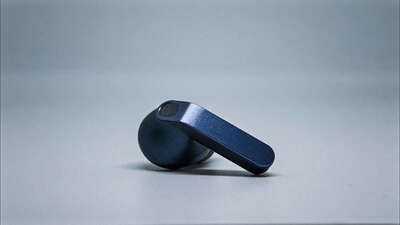
What's different this year is that Samsung has cleaned things up considerably. The LED strip on the Buds 3 Pro always felt like Samsung trying too hard to stand out—it's gone now, replaced by a metal accent along the stem that looks like it actually belongs there.
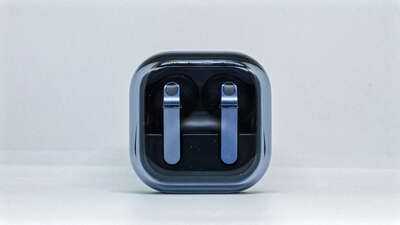
The charging case has been rethought too. It's now a compact square with a transparent clamshell lid—you can see both buds sitting inside without even opening it. You wouldn't think that would matter until you're hunting for your earbuds at 7am, half asleep, and you just know they're in the case without having to flip it open. Small thing. Good thing.
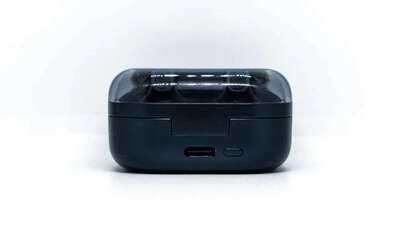
The case charges wirelessly or via USB-C, though Samsung still hasn't managed to include a cable in the box. At Rs 21,999, that's not an oversight—it's just a bit cheeky.

Each bud weighs 5.1 grams, which sounds like a spec sheet number until you actually put them in and forget they're there twenty minutes later. I wore these through a three-hour writing session one afternoon and genuinely had to check whether they were still in my ears.
The IP57 rating means you don't have to think twice in the rain or at the gym. The case, though—the case is on its own.

Fit is one of the Buds 4 Pro's quieter wins. They go in cleanly, seal well, and don't shift around during long sessions or light activity. No twisting, no adjusting, no that-doesn't-feel-right moment. The medium tips worked without any fuss, and Samsung says it used computational design to refine the earbud shape this year. Whatever that process involved, it worked.
Controls are a pinch-and-swipe setup—squeeze the stem for playback, swipe for volume, hold to cycle between sound modes. Mostly fine. The volume swipe tends to jump in big steps rather than small ones, which makes fine-tuning mildly annoying, and the hold gesture misfires just often enough to notice.
I accidentally cycled into transparency mode mid-song more times than I'd like to admit. It's the one part of using these earbuds that doesn't feel finished. The voice controls, buried in the Galaxy Wearable app settings, are actually more consistent—and they work on iPhones too, which is a welcome surprise.
Put something good on. Seriously.
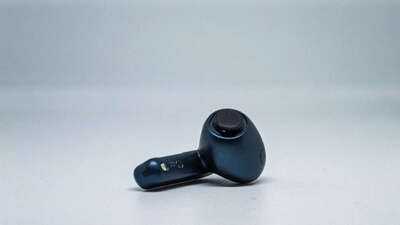
Samsung put two drivers inside each earbud—an 11mm woofer for the lows and a 5.5mm planar tweeter for the highs. Most earbuds at this price use a single driver. The difference isn't subtle.
There's a layered, almost three-dimensional quality to the sound that you notice immediately and then can't stop noticing.
The bass is the dominant personality trait here, and it has a lot of personality. I put on Daft Punk's "Get Lucky" first, mostly out of habit, and the bass line hit with a weight I wasn't expecting. On Kendrick Lamar's "HUMBLE.," the 808s land like they're supposed to—felt as much as heard. On Raye's "Escapism," the low-end builds into something that feels almost physical by the final minute of the song.
If you listen to a lot of pop, hip-hop, or anything with a heavy bottom end, this tuning will make you very happy.
If you're used to something flatter—more studio monitor than club speaker—the nine-band EQ in the Galaxy Wearable app is where you'll want to spend your first fifteen minutes. Drop the lower bass bands a couple of notches and the whole sound tightens up into something more controlled without losing its energy. I ended up settling about 2dB lower on the first two bass bands and left everything else alone.
The treble is detailed and present without tipping into harshness. On Fleetwood Mac's "The Chain," the guitar intro comes through with real clarity—each note separate and clean. Cymbal hits on jazz recordings, like Miles Davis's "So What," shimmer rather than sting.
Vocals sit upfront and clear—AR Rahman's layered arrangements on "Jai Ho" are a good stress test, and the Buds 4 Pro handle the density well, keeping each layer distinct rather than blending everything into a wall of sound.
Where things get occasionally messy is in busier, mid-heavy mixes. Arijit Singh's voice on slower, string-heavy tracks like "Tum Hi Ho" sounds slightly forward—which most people will actually enjoy—but acoustic guitar work can sometimes sound a touch splashy when there's a lot happening around it. It's a tuning choice more than a flaw, and one the EQ can largely correct if it bothers you.
Samsung phone users on a Galaxy S23 or newer also get the SSC UHQ codec—24-bit/96kHz audio streamed over Bluetooth. I tested this back to back with standard AAC on a few well-recorded tracks and the difference is real but modest.
On Pink Floyd's "Brain Damage," the hi-res version had a slightly wider, more open quality—like the room the recording was made in got just a little bigger. Worth having, not worth agonising over.
Non-Samsung Android users get SBC and AAC. No LDAC, no aptX, no exceptions.
The noise cancellation is good. The transparency mode is great.
The ANC has taken a clear step forward from the Buds 3 Pro, and you feel it most in the situations where you really want it—on a flight, on a train, anywhere with a constant low hum in the background.
I tested these on a particularly loud Delhi Metro ride during rush hour, and the rail noise dropped to a manageable murmur with ANC on full. Samsung claims 3dB better attenuation than last year, and that tracks in practice.
The trouble is in the mid-frequency range—roughly where voices, office chatter, and the higher register of machinery sit. More of that gets through than the Sony or the Bose's would allow.
My building's water pump, which sits in an unfortunately audible frequency range, cut through more than I'd have liked during a work-from-home afternoon. In a quiet cafe or on a flight it barely matters. In a noisy open-plan office, it does.
The transparency mode, on the other hand, is genuinely impressive—some of the most natural-sounding ambient audio in this segment. No tinny edge, no processed quality, just the world coming through clearly.
I wore these on a walk through a busy market in ambient mode and felt completely aware of everything around me—conversations, horns, the works. The Voice Detect feature automatically drops your music and opens up ambient sound the moment you start talking to someone nearby. I used it constantly without thinking about it, and then switched to a different pair of earbuds for a day and spent the entire time pulling one earbud out to have conversations like it was 2019.
Calls are where it gets complicated. On a call from a busy street, the person on the other end had no idea where I was—no traffic, no wind, nothing. That's legitimately impressive.
The catch is that all that noise processing makes your voice sound slightly digitised on the other end. My colleague described it as sounding like I was calling from inside a tin box—clear enough to follow, just not quite natural. On a Galaxy S26 with Super Wideband mode turned on, it improves. Not dramatically, but enough to notice if you're comparing recordings side by side.
These work best when you're already living inside Samsung's galaxy.
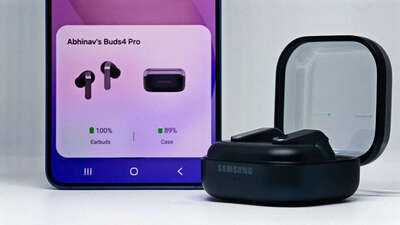
The feature set on the Buds 4 Pro is deep—but how deep depends almost entirely on what phone you're holding.
On a Galaxy phone, the list is long: hi-res audio via SSC UHQ, auto-switching between Samsung devices, head gestures for call management, Gemini and Bixby voice wakeup, live interpreter translation, Auracast, Find My Earbuds, and 360 Audio with head tracking. It's a cohesive, well-thought-out experience that feels like every feature was designed with the Galaxy ecosystem in mind—because it was.
On non-Samsung Android, the Galaxy Wearable app gets you most of that, minus hi-res audio. On anything else—a Windows laptop, an iPhone, a gaming console—you're down to ANC, ambient mode, and the basics.
There's also no multipoint Bluetooth outside Samsung's ecosystem, which means switching between your phone and laptop is a manual process every single time. Small thing, but it adds up.
Samsung has clearly built these earbuds with one person in mind—the Galaxy phone owner—and that focus shows in how well everything clicks together. If that's you, the Buds 4 Pro stop feeling like an accessory and start feeling like part of the phone. If it isn't, you're still getting a very good pair of earbuds. Just not the full version of them.
The battery gets you through the day—just about.
Six hours of playback with ANC on, seven without. The case holds about three full recharges, landing at 26-27 hours total with noise cancellation running. In real-world use, you'll get just above six hours with ANC active before the case needs to come out.
I ran out of charge during a long travel day—a two-hour flight followed by an afternoon of back-to-back meetings—and had to spend twenty minutes with the case in my pocket while the buds topped up. Not a disaster, but an inconvenience that wouldn't have happened with the best earbuds in the segment, which comfortably hit eight hours on a single charge.
That two-hour difference sounds small until it's the difference between making it through the day and not.
Quick charging helps a little—ten minutes in the case gets you roughly an hour of playback, which is useful when you're rushing out the door. But Samsung's own earbuds hit eleven hours of battery life a few generations ago. Six hours in 2026, at Rs 21,999, feels like something that should have been sorted out by now.
Samsung's best earbuds—and it shows.
The Galaxy Buds 4 Pro are the best earbuds Samsung has made, and that's not the faint praise it used to be. The sound is excellent—genuinely so, not just for Samsung earbuds but for earbuds at this price full stop. The fit is comfortable over long sessions. The transparency mode is among the best in the segment.
And if you own a Galaxy phone, the feature set is deep, polished, and cohesive enough to make these an extremely easy recommendation.
There are things that could be better—the ANC has room to grow, the battery life could do with another hour or two, and the controls occasionally remind you that they're not quite finished. None of it is enough to walk away from these, but it's enough to keep them from being a clean sweep.
At Rs 21,999, Galaxy phone owners don't really need to think too hard—nothing integrates better with your setup, and the sound quality alone is worth the price. For everyone else, these earbuds will do a good job—but they'll spend the whole time quietly making the case for a Galaxy phone. And honestly, they're convincing enough that you might just listen.
Our rating: 4.5/5
Yes, they look familiar.
The design conversation around the Buds 4 Pro is a short one—they look a lot like a certain earbuds, Samsung knows it, and nobody in that boardroom seems particularly worried about it. Fair enough. The oval tips, the stem, the sensor dots on the housing—it's familiar territory. But familiar isn't the same as bad.
What's different this year is that Samsung has cleaned things up considerably. The LED strip on the Buds 3 Pro always felt like Samsung trying too hard to stand out—it's gone now, replaced by a metal accent along the stem that looks like it actually belongs there.
The charging case has been rethought too. It's now a compact square with a transparent clamshell lid—you can see both buds sitting inside without even opening it. You wouldn't think that would matter until you're hunting for your earbuds at 7am, half asleep, and you just know they're in the case without having to flip it open. Small thing. Good thing.
The case charges wirelessly or via USB-C, though Samsung still hasn't managed to include a cable in the box. At Rs 21,999, that's not an oversight—it's just a bit cheeky.
Each bud weighs 5.1 grams, which sounds like a spec sheet number until you actually put them in and forget they're there twenty minutes later. I wore these through a three-hour writing session one afternoon and genuinely had to check whether they were still in my ears.
The IP57 rating means you don't have to think twice in the rain or at the gym. The case, though—the case is on its own.
Fit is one of the Buds 4 Pro's quieter wins. They go in cleanly, seal well, and don't shift around during long sessions or light activity. No twisting, no adjusting, no that-doesn't-feel-right moment. The medium tips worked without any fuss, and Samsung says it used computational design to refine the earbud shape this year. Whatever that process involved, it worked.
Controls are a pinch-and-swipe setup—squeeze the stem for playback, swipe for volume, hold to cycle between sound modes. Mostly fine. The volume swipe tends to jump in big steps rather than small ones, which makes fine-tuning mildly annoying, and the hold gesture misfires just often enough to notice.
I accidentally cycled into transparency mode mid-song more times than I'd like to admit. It's the one part of using these earbuds that doesn't feel finished. The voice controls, buried in the Galaxy Wearable app settings, are actually more consistent—and they work on iPhones too, which is a welcome surprise.
Put something good on. Seriously.
Samsung put two drivers inside each earbud—an 11mm woofer for the lows and a 5.5mm planar tweeter for the highs. Most earbuds at this price use a single driver. The difference isn't subtle.
There's a layered, almost three-dimensional quality to the sound that you notice immediately and then can't stop noticing.
The bass is the dominant personality trait here, and it has a lot of personality. I put on Daft Punk's "Get Lucky" first, mostly out of habit, and the bass line hit with a weight I wasn't expecting. On Kendrick Lamar's "HUMBLE.," the 808s land like they're supposed to—felt as much as heard. On Raye's "Escapism," the low-end builds into something that feels almost physical by the final minute of the song.
If you listen to a lot of pop, hip-hop, or anything with a heavy bottom end, this tuning will make you very happy.
If you're used to something flatter—more studio monitor than club speaker—the nine-band EQ in the Galaxy Wearable app is where you'll want to spend your first fifteen minutes. Drop the lower bass bands a couple of notches and the whole sound tightens up into something more controlled without losing its energy. I ended up settling about 2dB lower on the first two bass bands and left everything else alone.
The treble is detailed and present without tipping into harshness. On Fleetwood Mac's "The Chain," the guitar intro comes through with real clarity—each note separate and clean. Cymbal hits on jazz recordings, like Miles Davis's "So What," shimmer rather than sting.
Vocals sit upfront and clear—AR Rahman's layered arrangements on "Jai Ho" are a good stress test, and the Buds 4 Pro handle the density well, keeping each layer distinct rather than blending everything into a wall of sound.
Where things get occasionally messy is in busier, mid-heavy mixes. Arijit Singh's voice on slower, string-heavy tracks like "Tum Hi Ho" sounds slightly forward—which most people will actually enjoy—but acoustic guitar work can sometimes sound a touch splashy when there's a lot happening around it. It's a tuning choice more than a flaw, and one the EQ can largely correct if it bothers you.
Samsung phone users on a Galaxy S23 or newer also get the SSC UHQ codec—24-bit/96kHz audio streamed over Bluetooth. I tested this back to back with standard AAC on a few well-recorded tracks and the difference is real but modest.
On Pink Floyd's "Brain Damage," the hi-res version had a slightly wider, more open quality—like the room the recording was made in got just a little bigger. Worth having, not worth agonising over.
Non-Samsung Android users get SBC and AAC. No LDAC, no aptX, no exceptions.
The noise cancellation is good. The transparency mode is great.
The ANC has taken a clear step forward from the Buds 3 Pro, and you feel it most in the situations where you really want it—on a flight, on a train, anywhere with a constant low hum in the background.
I tested these on a particularly loud Delhi Metro ride during rush hour, and the rail noise dropped to a manageable murmur with ANC on full. Samsung claims 3dB better attenuation than last year, and that tracks in practice.
The trouble is in the mid-frequency range—roughly where voices, office chatter, and the higher register of machinery sit. More of that gets through than the Sony or the Bose's would allow.
My building's water pump, which sits in an unfortunately audible frequency range, cut through more than I'd have liked during a work-from-home afternoon. In a quiet cafe or on a flight it barely matters. In a noisy open-plan office, it does.
The transparency mode, on the other hand, is genuinely impressive—some of the most natural-sounding ambient audio in this segment. No tinny edge, no processed quality, just the world coming through clearly.
I wore these on a walk through a busy market in ambient mode and felt completely aware of everything around me—conversations, horns, the works. The Voice Detect feature automatically drops your music and opens up ambient sound the moment you start talking to someone nearby. I used it constantly without thinking about it, and then switched to a different pair of earbuds for a day and spent the entire time pulling one earbud out to have conversations like it was 2019.
Calls are where it gets complicated. On a call from a busy street, the person on the other end had no idea where I was—no traffic, no wind, nothing. That's legitimately impressive.
The catch is that all that noise processing makes your voice sound slightly digitised on the other end. My colleague described it as sounding like I was calling from inside a tin box—clear enough to follow, just not quite natural. On a Galaxy S26 with Super Wideband mode turned on, it improves. Not dramatically, but enough to notice if you're comparing recordings side by side.
These work best when you're already living inside Samsung's galaxy.
The feature set on the Buds 4 Pro is deep—but how deep depends almost entirely on what phone you're holding.
On a Galaxy phone, the list is long: hi-res audio via SSC UHQ, auto-switching between Samsung devices, head gestures for call management, Gemini and Bixby voice wakeup, live interpreter translation, Auracast, Find My Earbuds, and 360 Audio with head tracking. It's a cohesive, well-thought-out experience that feels like every feature was designed with the Galaxy ecosystem in mind—because it was.
On non-Samsung Android, the Galaxy Wearable app gets you most of that, minus hi-res audio. On anything else—a Windows laptop, an iPhone, a gaming console—you're down to ANC, ambient mode, and the basics.
There's also no multipoint Bluetooth outside Samsung's ecosystem, which means switching between your phone and laptop is a manual process every single time. Small thing, but it adds up.
Samsung has clearly built these earbuds with one person in mind—the Galaxy phone owner—and that focus shows in how well everything clicks together. If that's you, the Buds 4 Pro stop feeling like an accessory and start feeling like part of the phone. If it isn't, you're still getting a very good pair of earbuds. Just not the full version of them.
The battery gets you through the day—just about.
Six hours of playback with ANC on, seven without. The case holds about three full recharges, landing at 26-27 hours total with noise cancellation running. In real-world use, you'll get just above six hours with ANC active before the case needs to come out.
I ran out of charge during a long travel day—a two-hour flight followed by an afternoon of back-to-back meetings—and had to spend twenty minutes with the case in my pocket while the buds topped up. Not a disaster, but an inconvenience that wouldn't have happened with the best earbuds in the segment, which comfortably hit eight hours on a single charge.
That two-hour difference sounds small until it's the difference between making it through the day and not.
Quick charging helps a little—ten minutes in the case gets you roughly an hour of playback, which is useful when you're rushing out the door. But Samsung's own earbuds hit eleven hours of battery life a few generations ago. Six hours in 2026, at Rs 21,999, feels like something that should have been sorted out by now.
Samsung's best earbuds—and it shows.
The Galaxy Buds 4 Pro are the best earbuds Samsung has made, and that's not the faint praise it used to be. The sound is excellent—genuinely so, not just for Samsung earbuds but for earbuds at this price full stop. The fit is comfortable over long sessions. The transparency mode is among the best in the segment.
And if you own a Galaxy phone, the feature set is deep, polished, and cohesive enough to make these an extremely easy recommendation.
There are things that could be better—the ANC has room to grow, the battery life could do with another hour or two, and the controls occasionally remind you that they're not quite finished. None of it is enough to walk away from these, but it's enough to keep them from being a clean sweep.
At Rs 21,999, Galaxy phone owners don't really need to think too hard—nothing integrates better with your setup, and the sound quality alone is worth the price. For everyone else, these earbuds will do a good job—but they'll spend the whole time quietly making the case for a Galaxy phone. And honestly, they're convincing enough that you might just listen.
Our rating: 4.5/5
Next Story