
The end of Ask.com, and the shifting sands of internet use


After a 25-year run, `answer engine’ Ask.com has officially shut down, marking the end of one of the internet’s earliest attempts to make search more conversational and intuitive. It’s parent company InterActiveCorp ( IAC) announced that it is discontinuing its search business as part of a broader strategic shift, with the closure taking effect on May 1, 2026.
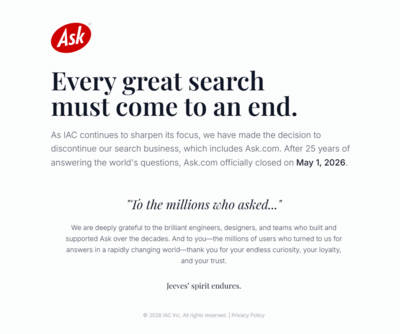
“Every great search must come to an end. As IAC continues to sharpen its focus, we have made the decision to discontinue our search business, which includes Ask.com. After 25 years of answering the world's questions, Ask.com officially closed on May 1, 2026. Jeeves’ spirit endures,” IAC wrote in a note on the ask.com home page.
Announcing the shutdown, IAC acknowledged the contributions of the engineers, designers, and teams who built and sustained the platform, while thanking millions of users worldwide for their curiosity and trust.
Ask Jeeves
Launched in 1996 as Ask Jeeves by founders Garrett Gruener and David Warthen, the platform stood out in the early days of the web for allowing users to pose questions in natural language rather than keyword-based queries. The service derived its name and identity from ‘Jeeves,’ the fictional valet created by British author P. G. Wodehouse, symbolising a digital assistant designed to fetch precise answers.
In its early years, Ask built a niche for its question-and-answer functionality, particularly in areas such as mathematics, vocabulary, and unit conversion, while also hosting a wide range of editorial content akin to an online encyclopaedia.
The holding company, IAC, bought the web search provider in 2005 for $1.85 billion in stock to capitalise on growth in internet advertising and search. The company underwent a major rebrand in 2006, dropping the ‘Jeeves’ persona to become Ask.com, alongside the development of its own web crawler and search algorithm.
Over time, it expanded its database by integrating content from other IAC-owned properties, such as Investopedia and Travel+Leisure, making thousands of topic-based articles accessible through its platform.
However, intensifying competition from larger rivals like Google gradually eroded its position. By 2010, Ask had outsourced its core search technology and repositioned itself as a question-and-answer platform, stepping back from direct competition in web search.
Search and surf
The shutdown of Ask.com points to a deeper shift in how the internet is used, moving away from the long-standing `search and surf’ culture that search engines like Google, Yahoo, and Bing helped establish.
That model was built on users querying the web and navigating the results. It is now being reshaped by the rise of artificial intelligence (AI) assistants and chatbots such as ChatGPT and Claude, which increasingly deliver direct answers rather than links.
The shift is visible in declining search traffic for publishers, including lower link click-through rates due to Google’s AI-generated overviews. Globally, Google dominates search with close to 90% market share, while engines like Bing, Yahoo, and DuckDuckGo together make up most of the remaining 10%.
Per a 2026 report by the data analytics firm Chartbeat, pageviews from Google Search dropped 34% between December 2024 and December 2025, while traffic from Google Discover declined 16% over the same period. Pageviews refer to the number of times webpages are opened by users after clicking on search results, while Google Discover is a personalised feed that shows users articles, videos, and updates based on their interests without requiring a search.
The shift is also reflected in Google’s parent Alphabet’s earnings reported on Wednesday, where businesses other than its flagship search advertising are growing faster. Google Cloud leads this shift, with its revenue increasing 63% on-year to $20 billion in the first quarter of 2026, accounting for 18% of Alphabet’s revenues.
At the same time, the nature of internet traffic itself is also changing as bots accounted for over 53% of all web activity in 2025, up from 51% the previous year. Per a report by French tech giant Thales, human activity contributed to 47% of all web activity last year.
Taken together, these trends suggest that the internet is no longer primarily a space users explore through search queries, but one increasingly mediated by AI systems and automated traffic, making the closure of Ask.com less an isolated event and more a marker of a structural transition in how the web is accessed and used.
“Every great search must come to an end. As IAC continues to sharpen its focus, we have made the decision to discontinue our search business, which includes Ask.com. After 25 years of answering the world's questions, Ask.com officially closed on May 1, 2026. Jeeves’ spirit endures,” IAC wrote in a note on the ask.com home page.
Announcing the shutdown, IAC acknowledged the contributions of the engineers, designers, and teams who built and sustained the platform, while thanking millions of users worldwide for their curiosity and trust.
Ask Jeeves
Launched in 1996 as Ask Jeeves by founders Garrett Gruener and David Warthen, the platform stood out in the early days of the web for allowing users to pose questions in natural language rather than keyword-based queries. The service derived its name and identity from ‘Jeeves,’ the fictional valet created by British author P. G. Wodehouse, symbolising a digital assistant designed to fetch precise answers.
In its early years, Ask built a niche for its question-and-answer functionality, particularly in areas such as mathematics, vocabulary, and unit conversion, while also hosting a wide range of editorial content akin to an online encyclopaedia.
The holding company, IAC, bought the web search provider in 2005 for $1.85 billion in stock to capitalise on growth in internet advertising and search. The company underwent a major rebrand in 2006, dropping the ‘Jeeves’ persona to become Ask.com, alongside the development of its own web crawler and search algorithm.
Over time, it expanded its database by integrating content from other IAC-owned properties, such as Investopedia and Travel+Leisure, making thousands of topic-based articles accessible through its platform.
However, intensifying competition from larger rivals like Google gradually eroded its position. By 2010, Ask had outsourced its core search technology and repositioned itself as a question-and-answer platform, stepping back from direct competition in web search.
Search and surf
The shutdown of Ask.com points to a deeper shift in how the internet is used, moving away from the long-standing `search and surf’ culture that search engines like Google, Yahoo, and Bing helped establish.
That model was built on users querying the web and navigating the results. It is now being reshaped by the rise of artificial intelligence (AI) assistants and chatbots such as ChatGPT and Claude, which increasingly deliver direct answers rather than links.
The shift is visible in declining search traffic for publishers, including lower link click-through rates due to Google’s AI-generated overviews. Globally, Google dominates search with close to 90% market share, while engines like Bing, Yahoo, and DuckDuckGo together make up most of the remaining 10%.
Per a 2026 report by the data analytics firm Chartbeat, pageviews from Google Search dropped 34% between December 2024 and December 2025, while traffic from Google Discover declined 16% over the same period. Pageviews refer to the number of times webpages are opened by users after clicking on search results, while Google Discover is a personalised feed that shows users articles, videos, and updates based on their interests without requiring a search.
The shift is also reflected in Google’s parent Alphabet’s earnings reported on Wednesday, where businesses other than its flagship search advertising are growing faster. Google Cloud leads this shift, with its revenue increasing 63% on-year to $20 billion in the first quarter of 2026, accounting for 18% of Alphabet’s revenues.
At the same time, the nature of internet traffic itself is also changing as bots accounted for over 53% of all web activity in 2025, up from 51% the previous year. Per a report by French tech giant Thales, human activity contributed to 47% of all web activity last year.
Taken together, these trends suggest that the internet is no longer primarily a space users explore through search queries, but one increasingly mediated by AI systems and automated traffic, making the closure of Ask.com less an isolated event and more a marker of a structural transition in how the web is accessed and used.
Next Story