
Two Pune engineering firms - KPIT and Persistent - are the stars of India's tech services business


BENGALURU: Some of our big stories on Times Techies lately may suggest an obsession with Pune. Our colleague Swati Shinde wrote how the city’s long-standing mix of automotive, defence, and manufacturing expertise and the consequent product-thinking culture has led to the establishment of a number of global capability centres (GCCs) focused particularly on product engineering, using new-age digital tools like AI, simulation and cloud. Akhil George wrote that French company Dassault Systemes’ largest development lab is in Pune, and the work the centre is doing is redefining how the world designs planes, cars and cities.
Today, again, we have a fantastic Pune story. It’s actually just a coincidence these stories have come so close together, and also a reflection of how our focus on Bengaluru and Hyderabad, and on the large IT services companies, tends to put many other trends in the shadows.
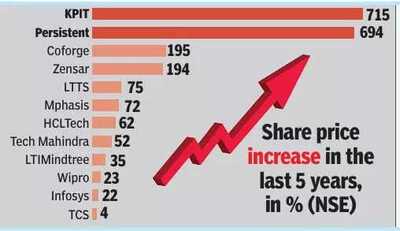
Look at Persistent and KPIT , both Pune tech services companies, and even Zensar , another Pune firm. Their share price increases over the past five years – a reflection of their revenue growth – are miles ahead of those of other IT services companies. Persistent and KPIT shares are up about 700% in this period, while those of almost all the biggest IT services companies have risen at less than 30%.
 It’s that same Pune strength in product and digital engineering that has catapulted the two companies, as also Zensar, to new orbits, and made some of their founders crazily rich. While IT services allow businesses to access technical tools and information for their operational processes and daily tasks, product engineering is the application of engineering principles to design, develop, test, deploy, and maintain a product throughout its lifecycle. It often combines various engineering disciplines like software, mechanical, and electrical.
New advanced technologies like AI, IoT, automation, digital twins, and cloud computing have made product development easier and faster. Some of these technologies also need to be incorporated into products, which has increased the complexity of product development. Enterprises often lack in-house expertise to do all of this. The Pune companies took advantage of that to strengthen their outsourced engineering services capabilities.
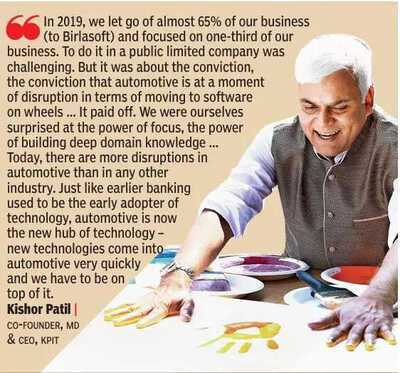 KPIT in 2019 took the brave step of divesting its IT services business to Birlasoft, to focus solely on automotive engineering, which was about a third of revenues, and an area the leadership was most passionate about. Co-founder & MD Kishor Patil says when they saw what Tesla and the Chinese were doing in automotive, they felt it could be a great opportunity to focus totally on it. “Five years back, we redefined everything, including our vision statement – we redefined as if we were a startup, with a clear goal of building global leadership,” he says.
The auto world was changing dramatically with alternative propulsion systems, particularly electrification, with digital cockpits, and autonomous driving. Patil spent a lot of time developing people skills in these areas. And these moves paid off handsomely. KPIT is doing core platform work for many of the biggest global brands. Between 2020-21 and 2024-25, revenue grew from $275 million to $691 mn, a CAGR of over 20%. “Our employees tell us how they are treated differently from others when they go to a client, because that's the respect KPIT has built,” Patil says.
Software-like economics
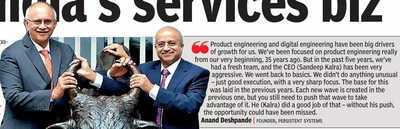
As for Persistent, it pivoted to what Pareekh Jain , CEO of Pareekh Consulting, calls “a fierce digital engineering focus”, under Sandeep Kalra , who came in as CEO in 2020 after stints in the US with Harman and HCL. Jain says they also built a partner ecosystem with the likes of Salesforce, AWS, IBM, Google, and also PE firms, instead of relying solely on direct enterprise sales.
 Phil Fersht , CEO of HfS Research, says the share price surge in Persistent and KPIT is the market recognising these firms have become engineering-led businesses with software-like economics, not services companies optimising utilisation. “The broader lesson for the Indian IT services industry is uncomfortable but clear. The old model is finished. Persistent and KPIT show what happens when firms have the courage to burn the legacy playbook and rebuild around engineering depth and IP ownership.”
Today, again, we have a fantastic Pune story. It’s actually just a coincidence these stories have come so close together, and also a reflection of how our focus on Bengaluru and Hyderabad, and on the large IT services companies, tends to put many other trends in the shadows.
Look at Persistent and KPIT , both Pune tech services companies, and even Zensar , another Pune firm. Their share price increases over the past five years – a reflection of their revenue growth – are miles ahead of those of other IT services companies. Persistent and KPIT shares are up about 700% in this period, while those of almost all the biggest IT services companies have risen at less than 30%.
New advanced technologies like AI, IoT, automation, digital twins, and cloud computing have made product development easier and faster. Some of these technologies also need to be incorporated into products, which has increased the complexity of product development. Enterprises often lack in-house expertise to do all of this. The Pune companies took advantage of that to strengthen their outsourced engineering services capabilities.
The auto world was changing dramatically with alternative propulsion systems, particularly electrification, with digital cockpits, and autonomous driving. Patil spent a lot of time developing people skills in these areas. And these moves paid off handsomely. KPIT is doing core platform work for many of the biggest global brands. Between 2020-21 and 2024-25, revenue grew from $275 million to $691 mn, a CAGR of over 20%. “Our employees tell us how they are treated differently from others when they go to a client, because that's the respect KPIT has built,” Patil says.
Software-like economics
As for Persistent, it pivoted to what Pareekh Jain , CEO of Pareekh Consulting, calls “a fierce digital engineering focus”, under Sandeep Kalra , who came in as CEO in 2020 after stints in the US with Harman and HCL. Jain says they also built a partner ecosystem with the likes of Salesforce, AWS, IBM, Google, and also PE firms, instead of relying solely on direct enterprise sales.
Next Story