
Went hands on with Samsung's Galaxy Z TriFold, and it's impossible not to want one


The first time you unfold Samsung 's Galaxy Z TriFold, your brain does a little skip. It's like watching a magician pull a tablecloth from under a full dinner set—intellectually, you understand what's happening, but emotionally? You're not quite ready for it.
I spent some time with the TriFold—barely 10 minutes, but enough to leave an impression. Honestly, I'm still trying to wrap my head around it. Not because it's complicated. It's just that holding a phone that transforms into a legitimate 10-inch tablet feels like carrying a tiny piece of the future in your pocket. And unlike most "futuristic" gadgets that demo well but fail in practice, this one actually works.
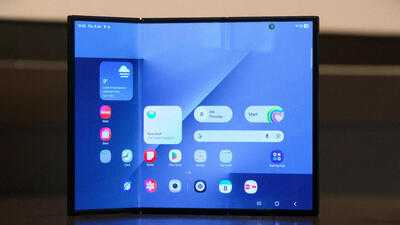
The fold that keeps on folding
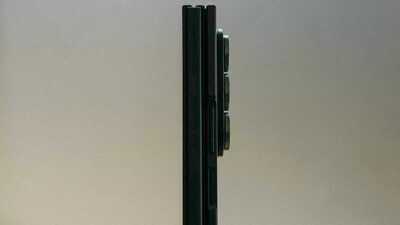
Let's address the elephant first (cliche, I know): closed up, the TriFold is thick. At 12.9mm and 309 grams, it's noticeably chunkier than the Z Fold 7, and we're talking Z Fold 5 levels of bulk here—a phone from a few generations back. Samsung spent years shaving off millimetres, so you'd think why would they throw that progress out the window. Well, they didn't.
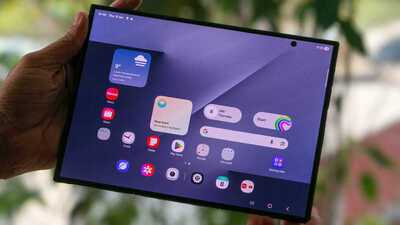
The moment you start unfolding it—first flipping open the right panel, then the left—all that bulk suddenly makes sense. You're not holding a slightly-bigger-than-usual phone anymore. You're holding what I can only explain as a tablet. Except this tablet was in your jeans pocket five seconds ago. And get this: fully unfolded, the TriFold measures just 3.9mm at its thinnest point. That's thinner than the Z Fold 7 (4.2mm) and even thinner than the S25 Edge (5.8mm), Samsung's thinnest slab phone. So yeah, it's chunky when closed, but when open? It's actually Samsung's thinnest device. The engineering trade-off suddenly clicks.
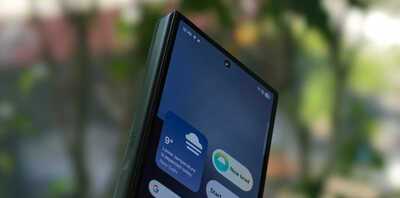
The unfolding process itself is surprisingly smooth. Samsung's dual-hinge system uses different types of magnets that either push or pull depending on their position, and you can feel the engineering at work. It doesn't require gorilla strength, but there's enough resistance to feel deliberate and satisfying. Kind of like closing a luxury car door—you know it's expensive because of how it moves.
The screen that swallows everything else
Once fully open, the TriFold hits you with 10 inches of AMOLED display in a 4:3 aspect ratio. This isn't like the Z Fold 7's almost-square 8-inch screen. This is proper tablet territory. For how much ever time I had with it I could only glance upon the trailer for Christopher Nolan's The Odyssey on it, and even with IMAX's ultra-wide format, the viewing experience was genuinely impressive. No squinting at letterboxing. No feeling like you're watching through a mail slot.
Again, I didn’t get to read much on it, but reading would feel natural too. The 4:3 ratio gives you actual vertical space, which is something the previous Z Folds never quite nailed. You’ll not be constantly scrolling or trying to make sense of awkwardly proportioned paragraphs. It just works the way a tablet should work.
What really sold me, though, was DeX mode. Samsung's desktop environment has always been a neat party trick on regular foldables, but on the TriFold, it becomes genuinely useful. I could see myself actually ditching a laptop for this thing. Pair it with a compact Bluetooth keyboard and mouse, and you've got a surprisingly capable workstation that fits in a jacket pocket. During the demo, I opened three apps simultaneously without any claustrophobia. There was actual breathing room.
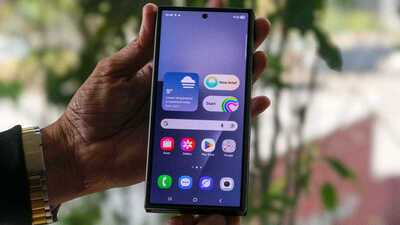
The cover screen is standard Samsung fare—it works exactly like on the single folding Z Folds. But actually holding the TriFold while using just that outer display? That's where the bulk becomes noticeable. The thickness and weight aren't deal-breakers, but your hand will definitely feel them.
The little details that matter
Samsung didn't just slap another hinge on a phone and call it a day. There's thoughtful engineering scattered throughout. The crease visibility, for instance, is noticeably reduced compared to earlier foldables. Maybe these were pristine demo units that haven't been folded ten thousand times yet, but still—it's promising.
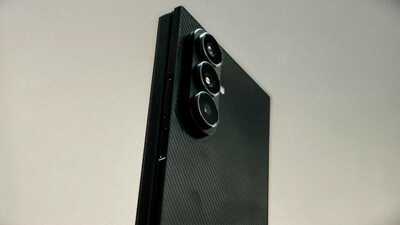
The carbon fiber-like finish on the back provides decent grip, which you'll appreciate given the device's weight. And when fully unfolded, the TriFold is shockingly thin. The current thickness is actually limited by the USB-C port, which is both impressive and slightly concerning for future iterations. Where do you go from here? Portless designs?
There's also a built-in idiot-proofing system. Try to fold the TriFold the wrong way—right panel first instead of left—and the phone violently vibrates while throwing up a warning on the screen. It's the smartphone equivalent of your car beeping when you forget to put on your seatbelt. Annoying? Maybe. Necessary? Probably.
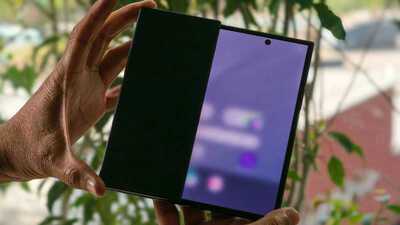
One thing that nags at me, though. The inward-folding design means you're stuck in an all-or-nothing situation. It's either the narrow 6.5-inch cover screen or the full 10-inch tablet — no in-between. Huawei's Mate XT with its Z-fold lets you stop halfway and use two panels when you want something more than a phone but less than a full tablet. That flexibility would've been nice here. Plus, when the TriFold is closed, those gorgeous AMOLED panels are hidden away, leaving you staring at thick bezels and a carbon fiber back. It's functional, sure, but not exactly exciting to look at. Then again, Samsung insists inward folds are more durable, so maybe practicality wins over flexibility here.
The battery situation also gives me pause. The 5600mAh cell sounds substantial on paper, but when you're powering a 10-inch AMOLED screen, those numbers start feeling inadequate. Phones with single displays are shipping with 7000mAh+ batteries nowadays. This thing has multiple screens and presumably burns through power running DeX mode and multitasking. Will it last a full day of actual use? That's something we’ll get to know only when we use it long enough, but it's a fair question to ask.
So, should you want one?
Here's my problem with the Galaxy Z TriFold: I kind of hate how much I like it. Yes, it's chunky when folded — thicker and heavier than any phone should reasonably be. But unfold it and suddenly it's thinner than Samsung's own flagship slabs, thinner even than the Z Fold 7. The industry spent years obsessing over millimetres, and Samsung just proved that thickness is contextual. When you're holding a 10-inch tablet that was in your pocket seconds ago, a few extra millimeters folded up don't seem to matter as much. The appeal is undeniable.
Using the TriFold feels less like holding a phone and more like holding three phones that decided to team up. It's the kind of device that makes you rethink what a smartphone even is. Maybe we don't need phones to keep getting smaller. Maybe the endgame is a device that can be multiple things depending on what you need at any given moment.
Of course, there's the price. Based on its South Korea pricing of around 3.6 million won, we're looking at roughly $2,500 or ₹2.2 lakh. For that money, you could buy a flagship phone and a decent tablet with cash to spare. The math doesn't make sense for most people. But here's the thing: the TriFold isn't trying to make sense for most people. It's a halo product, a showcase of what's possible. It's for the early adopters who want the absolute bleeding edge, consequences be damned.
The TriFold isn't making its way to India, at least not officially. It's currently available in South Korea, with plans for a US release later this year and a few other select markets, but India isn't on that list. Which is a shame, because it'd be fascinating to see how a device this ambitious would fare in a market that's typically price-conscious but increasingly willing to splurge on flagship tech. Then again, at 2+ lakh, maybe Samsung's being realistic about demand.
Still, after my brief time with it, I can't help but want more. There's something deeply satisfying about folding and unfolding this thing, watching it transform from one form factor to another. It's the kind of tactile pleasure that's hard to quantify but impossible to ignore. The TriFold might not be the phone most people need, but it might just be the phone some people didn't know they wanted.
And honestly? That's kind of the point of a device like this. Not to make sense, but to make you wonder what's possible. Mission accomplished, Samsung.
I spent some time with the TriFold—barely 10 minutes, but enough to leave an impression. Honestly, I'm still trying to wrap my head around it. Not because it's complicated. It's just that holding a phone that transforms into a legitimate 10-inch tablet feels like carrying a tiny piece of the future in your pocket. And unlike most "futuristic" gadgets that demo well but fail in practice, this one actually works.
The fold that keeps on folding
Let's address the elephant first (cliche, I know): closed up, the TriFold is thick. At 12.9mm and 309 grams, it's noticeably chunkier than the Z Fold 7, and we're talking Z Fold 5 levels of bulk here—a phone from a few generations back. Samsung spent years shaving off millimetres, so you'd think why would they throw that progress out the window. Well, they didn't.
The moment you start unfolding it—first flipping open the right panel, then the left—all that bulk suddenly makes sense. You're not holding a slightly-bigger-than-usual phone anymore. You're holding what I can only explain as a tablet. Except this tablet was in your jeans pocket five seconds ago. And get this: fully unfolded, the TriFold measures just 3.9mm at its thinnest point. That's thinner than the Z Fold 7 (4.2mm) and even thinner than the S25 Edge (5.8mm), Samsung's thinnest slab phone. So yeah, it's chunky when closed, but when open? It's actually Samsung's thinnest device. The engineering trade-off suddenly clicks.
The unfolding process itself is surprisingly smooth. Samsung's dual-hinge system uses different types of magnets that either push or pull depending on their position, and you can feel the engineering at work. It doesn't require gorilla strength, but there's enough resistance to feel deliberate and satisfying. Kind of like closing a luxury car door—you know it's expensive because of how it moves.
The screen that swallows everything else
Once fully open, the TriFold hits you with 10 inches of AMOLED display in a 4:3 aspect ratio. This isn't like the Z Fold 7's almost-square 8-inch screen. This is proper tablet territory. For how much ever time I had with it I could only glance upon the trailer for Christopher Nolan's The Odyssey on it, and even with IMAX's ultra-wide format, the viewing experience was genuinely impressive. No squinting at letterboxing. No feeling like you're watching through a mail slot.
Again, I didn’t get to read much on it, but reading would feel natural too. The 4:3 ratio gives you actual vertical space, which is something the previous Z Folds never quite nailed. You’ll not be constantly scrolling or trying to make sense of awkwardly proportioned paragraphs. It just works the way a tablet should work.
What really sold me, though, was DeX mode. Samsung's desktop environment has always been a neat party trick on regular foldables, but on the TriFold, it becomes genuinely useful. I could see myself actually ditching a laptop for this thing. Pair it with a compact Bluetooth keyboard and mouse, and you've got a surprisingly capable workstation that fits in a jacket pocket. During the demo, I opened three apps simultaneously without any claustrophobia. There was actual breathing room.
The cover screen is standard Samsung fare—it works exactly like on the single folding Z Folds. But actually holding the TriFold while using just that outer display? That's where the bulk becomes noticeable. The thickness and weight aren't deal-breakers, but your hand will definitely feel them.
The little details that matter
Samsung didn't just slap another hinge on a phone and call it a day. There's thoughtful engineering scattered throughout. The crease visibility, for instance, is noticeably reduced compared to earlier foldables. Maybe these were pristine demo units that haven't been folded ten thousand times yet, but still—it's promising.
The carbon fiber-like finish on the back provides decent grip, which you'll appreciate given the device's weight. And when fully unfolded, the TriFold is shockingly thin. The current thickness is actually limited by the USB-C port, which is both impressive and slightly concerning for future iterations. Where do you go from here? Portless designs?
There's also a built-in idiot-proofing system. Try to fold the TriFold the wrong way—right panel first instead of left—and the phone violently vibrates while throwing up a warning on the screen. It's the smartphone equivalent of your car beeping when you forget to put on your seatbelt. Annoying? Maybe. Necessary? Probably.
One thing that nags at me, though. The inward-folding design means you're stuck in an all-or-nothing situation. It's either the narrow 6.5-inch cover screen or the full 10-inch tablet — no in-between. Huawei's Mate XT with its Z-fold lets you stop halfway and use two panels when you want something more than a phone but less than a full tablet. That flexibility would've been nice here. Plus, when the TriFold is closed, those gorgeous AMOLED panels are hidden away, leaving you staring at thick bezels and a carbon fiber back. It's functional, sure, but not exactly exciting to look at. Then again, Samsung insists inward folds are more durable, so maybe practicality wins over flexibility here.
The battery situation also gives me pause. The 5600mAh cell sounds substantial on paper, but when you're powering a 10-inch AMOLED screen, those numbers start feeling inadequate. Phones with single displays are shipping with 7000mAh+ batteries nowadays. This thing has multiple screens and presumably burns through power running DeX mode and multitasking. Will it last a full day of actual use? That's something we’ll get to know only when we use it long enough, but it's a fair question to ask.
So, should you want one?
Here's my problem with the Galaxy Z TriFold: I kind of hate how much I like it. Yes, it's chunky when folded — thicker and heavier than any phone should reasonably be. But unfold it and suddenly it's thinner than Samsung's own flagship slabs, thinner even than the Z Fold 7. The industry spent years obsessing over millimetres, and Samsung just proved that thickness is contextual. When you're holding a 10-inch tablet that was in your pocket seconds ago, a few extra millimeters folded up don't seem to matter as much. The appeal is undeniable.
Using the TriFold feels less like holding a phone and more like holding three phones that decided to team up. It's the kind of device that makes you rethink what a smartphone even is. Maybe we don't need phones to keep getting smaller. Maybe the endgame is a device that can be multiple things depending on what you need at any given moment.
Of course, there's the price. Based on its South Korea pricing of around 3.6 million won, we're looking at roughly $2,500 or ₹2.2 lakh. For that money, you could buy a flagship phone and a decent tablet with cash to spare. The math doesn't make sense for most people. But here's the thing: the TriFold isn't trying to make sense for most people. It's a halo product, a showcase of what's possible. It's for the early adopters who want the absolute bleeding edge, consequences be damned.
The TriFold isn't making its way to India, at least not officially. It's currently available in South Korea, with plans for a US release later this year and a few other select markets, but India isn't on that list. Which is a shame, because it'd be fascinating to see how a device this ambitious would fare in a market that's typically price-conscious but increasingly willing to splurge on flagship tech. Then again, at 2+ lakh, maybe Samsung's being realistic about demand.
Still, after my brief time with it, I can't help but want more. There's something deeply satisfying about folding and unfolding this thing, watching it transform from one form factor to another. It's the kind of tactile pleasure that's hard to quantify but impossible to ignore. The TriFold might not be the phone most people need, but it might just be the phone some people didn't know they wanted.
And honestly? That's kind of the point of a device like this. Not to make sense, but to make you wonder what's possible. Mission accomplished, Samsung.
Next Story